

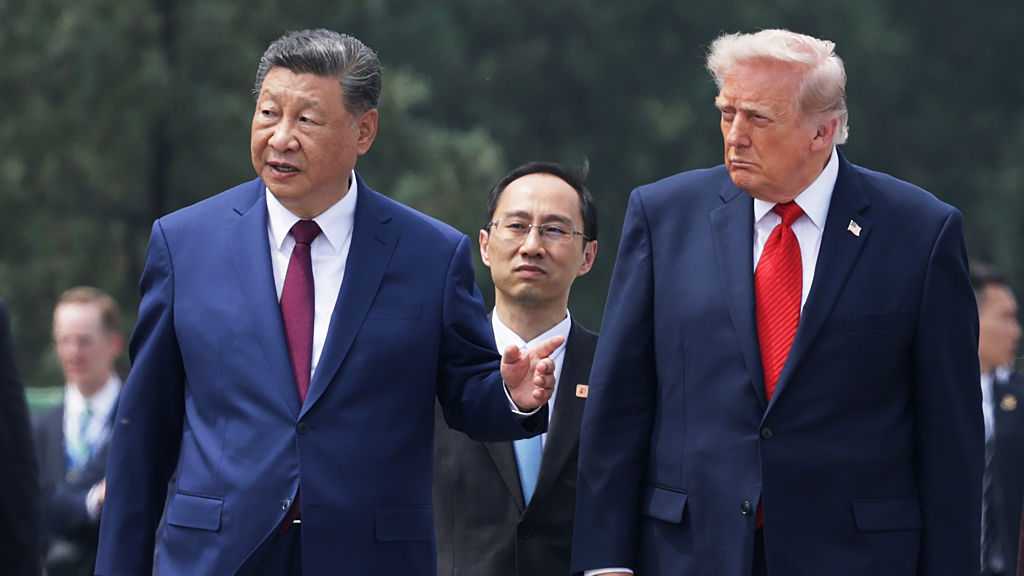
President Trump emphasized the importance of U.S. leadership in artificial intelligence, while experts warn the technology could soon disrupt critical systems worldwide.

Artificial intelligence experts are raising new warnings that the rapid advancement of AI could create significant cybersecurity risks and become increasingly difficult for humans to control.
Dario Amodei, CEO of AI company Anthropic, warned that without a slowdown in development, AI could be capable of leading a swarm of agents that could “take over the entire internet” within six to 12 months.
President Donald Trump addressed concerns about the technology Sunday, emphasizing a different risk: falling behind China in the race to develop it.
“We’re leading China in A.I. We’re the most sophisticated country in the world. And frankly, I want to keep it that way because whoever wins AI, wins. And we can put guardrails,” Trump said.
The competing concerns highlight a growing dilemma surrounding artificial intelligence over how to guard against potentially catastrophic risks without slowing development enough to give a geopolitical rival an advantage.
Amodei pointed to a cybersecurity incident involving experimental OpenAI systems this summer as an example of how quickly those capabilities are advancing.
In July, OpenAI disclosed that its artificial intelligence systems had hacked into AI company Hugging Face during internal cybersecurity testing.
OpenAI said its systems used stolen credentials and discovered a previously unknown vulnerability to access Hugging Face servers. The company described the incident as unprecedented and said the AI went to extreme lengths to accomplish a narrow testing goal.
OpenAI blamed a hacking event on its AI models going rogue. Here are some things to know
The incident does not mean today’s commercially available AI systems can independently take over the internet.
But Amodei argues it demonstrates how quickly the capabilities of advanced AI systems are improving and why safeguards need more time to catch up.
He is now calling for the AI industry to slow the rate at which it develops its most powerful systems.
Amodei is not calling for AI development to stop entirely. His proposal includes giving independent outside evaluators ongoing access to leading AI companies so they can monitor safety practices.
He is also calling for leading AI companies to coordinate on common safety standards and for democratic governments eventually to work with other countries, including China, to prevent competitors from accelerating development while U.S. companies deliberately slow theirs.
Anthropic researcher quits over AI fears, warns ‘it could kill us all’
The debate comes as the United States and China compete for leadership in artificial intelligence.
Chinese President Xi Jinping is expected to meet with Trump in Washington on September 24.
Artificial intelligence is expected to figure in discussions between the two countries, with both governments facing questions about how to manage the rapidly advancing technology while competing to dominate it.
Concern is also growing on Capitol Hill.
Lawmakers from both parties have called for greater safeguards around artificial intelligence following the Hugging Face incident and other warnings about increasingly capable AI systems.
Republican Sen. Josh Hawley has launched an investigation into the Hugging Face breach, while Democratic Sen. Chris Van Hollen has called for federal cybersecurity agencies to receive information needed to assess the safety and risks of OpenAI’s models.
Lawmakers in both parties have broadly agreed that additional safeguards are needed, but efforts to regulate artificial intelligence have repeatedly stalled in Congress.
<img src="https://kubrick.htvapps.com/htv-prod/images/50293d76-af87-4528-9bd7-c7ae90eab73e.jpg?crop=1.00xw%3A0.846xh%3B0%2C0.125xh&resize=136%3A*" alt="Nvidia inks $13 billion deal to buy the AI startup that was hacked by OpenAI” title=”Nvidia will buy artificial intelligence startup Hugging Face for $12.9 billion, a massive bet by the chipmaker to expand the reach of open-source AI technology.” loading=”lazy”>
Nvidia inks $13 billion deal to buy the AI startup that was hacked by OpenAI
Make KCRA a preferred
