

I was pretty excited to watch OpenAI’s DevDay yesterday. Inadvertent rogue model hacking issues aside, the company has always been good on the product side of the house. So I really wanted to see their take on AI personal assistants, a space which is having a moment after years of broken promises. Sam Altman wasted no time on stage, about 90 seconds in promising “the thing you’ve asked for the most” and “a whole new way to work with AI” and “the real deal version of AI”. And so?
Honestly, I’m sort of confused.
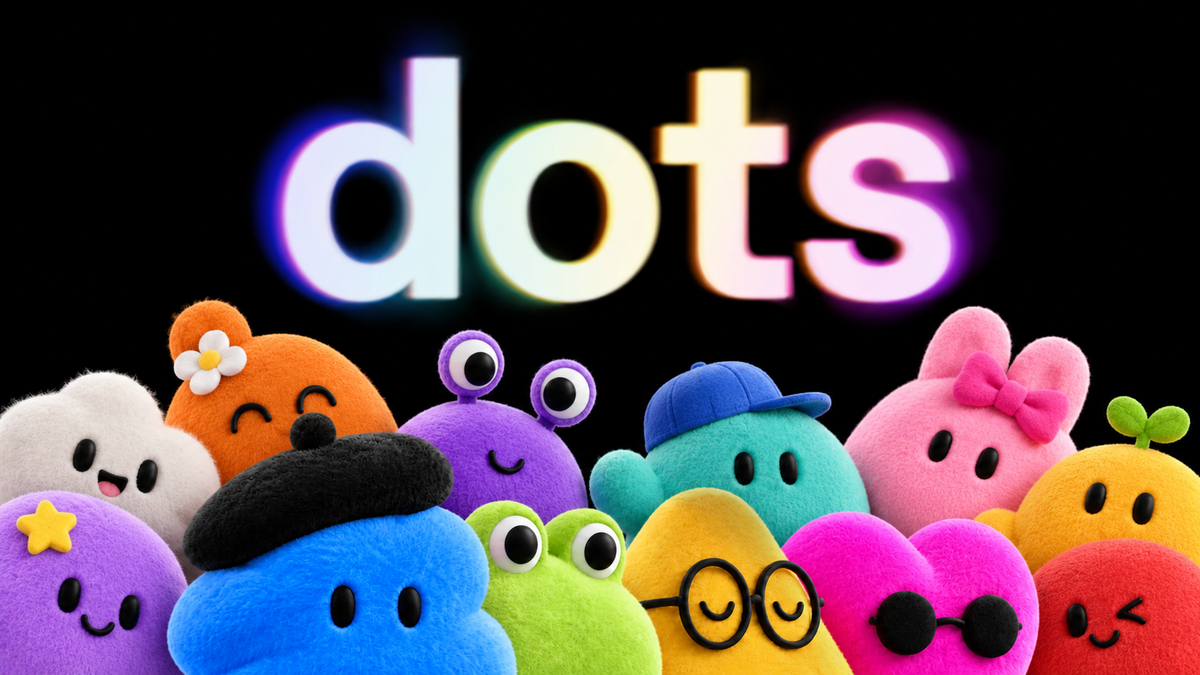
Dots are your cute, little AI assistant. Emphasis on cute. While technically you can stylized them as an ‘O’ – albeit a somehow still cute colorful one – or a ‘Pet’ (a holdover from Codex), the clear emphasis is on the cute, cuddly, colorful faces. They’re far more like Microsoft’s failed blob thing for Copilot than what Meta is doing with Muse. Actually, they’re even more like Grok Bot, which may be the point.
That’s fine, cute AI isbetter thansay, “we’re going to end the world” AI – though I can’t help be yet again be reminded of the smiling-while-being-mischievous Miss Minutes AI from Loki– but it’s also a weird contrast to the actual framing OpenAI is conveying here. That is, Dots aren’t meant to be the “booking plane ticket” bots, tasks which Altman called “trivial” for such AI, but rather “we wanted to be way more ambitious”.
So are Dots instead meant to cure cancer? I mean, maybe! But that’s also not the framing OpenAI was using on stage. Instead, it was seemingly more about helping you get work done. And with an emphasis on being proactive based on what your Dot knows about you. That’s also fine! But that’s also seemingly what all the other AI assistants are doing, including Muse and Grok Bot and Instinct and even now Copilot.
Of course, Dots have an advantage in that they’re baked into ChatGPT, a product which has 1.2 billion weekly active users, as Altman touted on stage. While that’s not more users than Meta has overall, they also opted to launch Muse as a stand-alone new service – albeit one that can be and will be heavily promoted across those multi-billion user products. Those are two very different approaches, with upsides and downsides to each, but oddly I find myself drawn more to Meta’s positioning here.
I say “oddly” because I’ve historically loathed some of Meta’s products and product decisions, certainly in recent years. And while many people simply refuse to trust the company due to their myriad issues in the past, I’m willing to keep an open mind – provided the product is good. And Muse is good! It’s early, but promising on a number of fronts. Dots has elements I like as well – I’ll get to those – but the higher level positioning is just confusing to me.
Muse is for consumers – at least until Meta pushes more into enterprise, which they’re working on. Dots is for… well, OpenAI would say it’s for everyone, but it’s clearly being angled for workers – or “builders” to use OpenAI’s clearly preferred parlance (their “Here’s to the builders” video at the end of the keynote was a Apple-like salute). Yes, cute faces and all.
I suspect what happened here is that OpenAI had been working on this project for a while, but also knew that Meta and SpaceXAI – two hated rivals, no less – were getting close to launching their products into market. But the company wasn’t sure which product to target – Muse or Grok Bot – so they just said “both”. And so we have their weird dichotomy of cute faces for serious business.
Again, OpenAI would undoubtedly frame it that Dots are for everything. But they also clearly have been pivoting hard away from the consumer market that they’ve dominated in AI in order to match their true rival: Anthropic. And it seems to be working, at least from an underlying business perspective. But also without question the consumer business has been hurt as a result. Sora is dead,Atlas has fallen, ChatGPT is bloated, and now Dots are here to help you take care of office tasks.

Yes, I’m being a little unfair, but the framing does matter here because the lack of clarity and purpose about what these things could and should do could just lead to more bodies in the AI assistant graveyard. If your product can do everything, you run a real risk that no one uses it for anything. Because no one has any idea what to do or where to start. Being proactive helps – and Muse seems particularly good at this – but the high-level positioning matters too. Is this for home or work? Yes, it may be both eventually, but it needs to start somewhere!
ChatGPT owns the consumer market for AI. OpenAI may not have set out with this goal, but here we are. But they’re increasingly ceding that market as they go after Anthropic’s market. And Meta is right there, more than happy to take it!
In this regard, my viewpoint is almost the exact opposite of my friend Casey Newton’s as he writes about today in Platformer. He totally groks Dots while he doesn’t grok Muse. I suspect part of it is that he’s trying to build a business while I’m just here to mess around on the internet (and apparently book plane tickets – which I have actually done once with Muse so far). Muse feels more consumer-y while Dots feels more business-y. He concedes the “confused” product messaging for Dots, as also noted by Benedict Evans, but obviously also just gets a lot more out of that product, clearly.
I still get more out of ChatGPT overall too, but I think Muse’s angle may be a better one for that broader AI assistant consumer audience. Granted, I’ve been using Dots for only a few hours, but that’s my sense, right now.
To that end, some other quick product thoughts: I like that Dots – I’ve named my ‘Mortimer’ to complement ‘Moneypenny’ on Muse – resides in its own area of ChatGPT. I was worried it would be crammed in as yet another sub-menu of Chat or Work or Codex – or all three.
And I like keeping my more “traditional” AI chats separate. But that’s mainly because it allows me to keep using ChatGPT as I have been. Again, for most consumers, I assume they want one chat boxto rule them all, not 4 or 5 different options? So perhaps Muse also has an advantage here, though their one stream for chat means things get buried, fast. (Which is clearly why “side chats” exist.) Then again, that’s how you would message an actual assistant so that might be easier for people to wrap their heads around. But AI is also the ultimate product that shows how technology can operate at scale far greater than human beings can, so one stream won’t last long for many.
I do like Dots traditional “read” receipts. And I appreciate emoji reactions on both. Both do a nice job with little touches to make the bots feel more “alive” such as typing indicators, but also just little movements with the avatars when they’re working or waiting. Those avatars being infinitely – literally! – more customizable on Muse is obviously a plus, though such constraints may help Dots branding? As long as they don’t mind that branding for a serious AI assistant being a cute, colorful creature – my ‘Mortimer’ wears a monocle and a bowtie!
The idea of calling your Dot on the phone is sort of wild and kind of fun but perhaps a bit too anachronistic? Why not just use the current vocal AI paradigm for this? Will young people even know what the dial tone is?
Putting Slack integration front-and-center makes sense for that work context, but again, just highlights Dots as angled towards more of a business service.
Being able to see your Dots full computer is awesome. Muse obviously got in some (mostly misguided) hot water over being able to download the contents of your assistant’s machine in the cloud, so they made it even more transparent, but this is the correct approach. It’s not just the browser you can take over with Dots, but the entire computer.1 Because, again, it’s yours!
That said, Meta was more clear in their messaging here about each individual user getting their own virtual machine. And they certainly have been more clear about the <a href="https://bitcomme.com/is-salesforce-crm-reasonable-after-security-flaws-and-service-outages/” title=”Is Salesforce (CRM) Reasonable After Security Flaws And Service Outages?”>security efforts around that machine and your overall usage. These elements were more or less mentioned in passing during Altman’s DevDay keynote. Then again, Meta also has to focus on these far more given their aforementioned history.
Muse’s focus on ‘Feed’, ‘Ideas’, and ‘Goals’ just once again make it seem so much more consumer-oriented, whereas Dots has ‘Space’ (technically, all of ChatGPT has ‘Space’ it just launched alongside Dots and is integrated), which is OpenAI’s Office/Google Docs/Notion competitor. Again, this seems to say a lot about the positioning here. Pay no attention to those extremely cute faces!
Both products are clearly going to evolve quickly. But I can’t help but wonder if Dots isn’t indicative of the push and pull OpenAI feels overall between consumer and business use cases and users. Again, they want to be both, but it’s hard enough to be one. Anthropic is much more clear in this regard. At least until their cutesy AI assistant thing launches.
1 Weird that the browser icon is just the Chromium one and not Atlas? Again, that product is gone, but it could have lived on here? Then again, maybe the Chromium logo will just make more sense to people – though it’s not exactly Chrome! ↩
#from afar#openai#chatgpt#dots#meta#meta ai#muse#grok#instinct#sam altman#copilot#anthropic#ai#tech#product
