

Nidec founder, 8 others, blamed for accounting fraud losses
- Share
- list
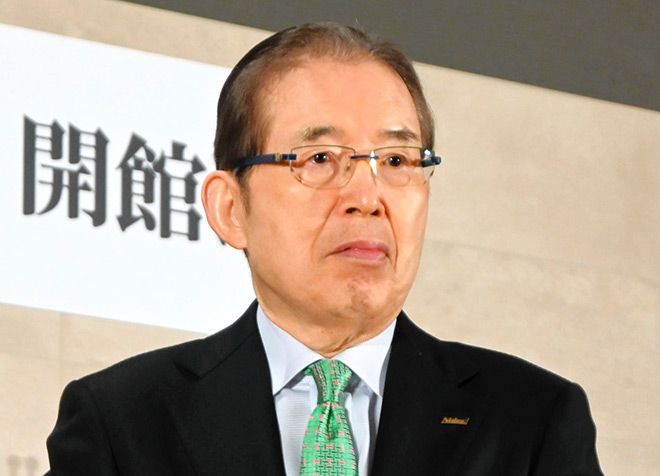
Nidec Corp. founder Shigenobu Nagamori in March 2023 (Asahi Shimbun file photo)
Nine former and current executives at major motor manufacturer Nidec Corp. bear responsibility for an estimated financial loss of 27.6 billion yen ($175 million) caused by accounting fraud schemes, an investigation found.
A report released Oct. 20 by a committee approved by Nidec’s board of directors said company founder Shigenobu Nagamori and former President Mitsuya Kishida are among those who should be held liable.
Nidec had long delayed recognizing losses in its dogged pursuit to reach financial goals and targets. These losses accumulated across the corporate group in what the report described as a “negative legacy” of assets whose book values were open to question.
According to the report, the company made several organization-wide efforts to resolve the issue. But in every case, it adopted a policy of recognizing losses only if doing so would not interfere with achieving performance targets.
The report said this policy represented a reversal of the fundamental principles of accounting, under which profit is normally determined only after losses have been properly recognized.
Under Nidec’s “asset soundness project” launched in 2016, Nagamori and former Chairman Hiroshi Kobe, a close aide of the founder, decided on and approved accounting methods that deviated from standard practices. Akira Sato, then the chief financial officer, took the lead in implementing the unorthodox methods to conceal losses.
Hiroyuki Yoshimoto, who became president in 2018, and Jun Seki, who later assumed the post, also failed to correct these accounting practices, the report said.
The report listed three “realities” of the accounting fraud: top management, including Nagamori, held mistaken views about accounting; the CFO formulated improper policies in line with the bosses’ intentions; and successive presidents failed to correct the policies and repeatedly postponed proper accounting methods.
In the fiscal year that ended in March 2025, Nidec’s automotive components business unit concealed the fact that it had agreed with a client to discontinue production of an inverter product. The unit submitted an outdated business plan to an auditing firm that still included projected sales of the product.
This misconduct was aimed at avoiding an impairment loss on fixed assets, the report said.
Regarding former President Kishida, who also headed the automotive components business unit at the time, the report said he understood the purpose of submitting the false business plan and failed to take any corrective measures.
Along with the then-CFO, who was similarly aware of the false explanations, Kishida failed to fulfill his responsibilities as a director, the report said.
The report noted that the misconduct, which mainly consists of postponing the recognition of losses, “did not result in profits flowing out of Nidec.”
However, it estimated the company’s damages at about 22.2 billion yen for investigative committee expenses, about 5.3 billion yen in audit-related costs, and a listing agreement violation penalty of 91.2 million yen paid to the Tokyo Stock Exchange.
The report said the scope of responsibility for the losses differs among the nine current and former executives.
It noted that some, such as Nagamori and Kobe, neglected their duties in most of the cases investigated, whereas others, such as Yoshimoto and Seki, only failed to take corrective action afterward.
Nidec said it is considering taking legal action, including lawsuits, against the executives for the loss. It will make a decision after revising its past financial statements and completing other related work.
- Share
- list
