

SEO has been declared dead more times than I care to remember.
Panda killed it. Mobile killed it. Voice search killed it. Featured snippets killed it. AI Overviews are currently in the process of killing it, apparently, and no doubt something else will kill it again before Christmas.
I traditionally roll my eyes at the whole concept as I remain a huge advocate of the power of search and the simple truth is that SEO remains the most potent traffic consideration for any marketer, but I am definitely in the camp that believes that good GEO is a natural bed partner to good SEO, so I don’t think that they should be seen as entirely different disciplines
I have, however, this week found myself reluctantly agreeing with a version of the ‘SEO is dead’ argument, and it has nothing to do with AI.
What happened?
We have been recruiting recently, so I have met a number of individuals who give me a fascinating window into what other agencies are doing.
What struck me this time was how many candidates from SEO agencies – people with genuinely decent experience, working on real client accounts – had never touched off-site optimisation.
Not “we do a bit of outreach when budget allows”. Not “we work with a specialist partner”. Nothing at all.
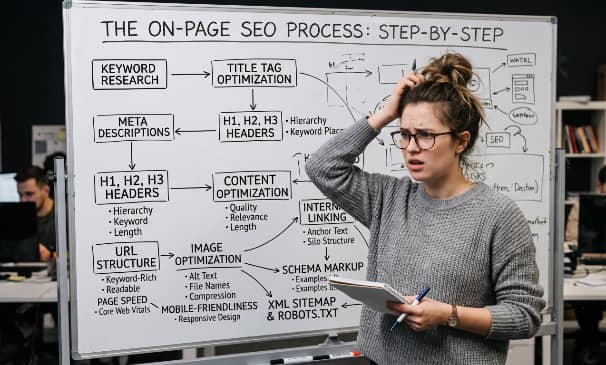
Their flavour of SEO is technical audits, keyword research, on-page optimisation and content. That is the entire remit. Off-site was somebody else’s problem
Or nobody’s problem?
I want to be clear that this is not a criticism of the candidates. They were doing the job they had been given, and doing it well. My head scratching is with the agencies that limit SEO to “things we can do inside a CMS”.
A website is a claim, not proof
Here is where I struggle.
We are living in the era of E-E-A-T. Experience, expertise, authoritativeness and trustworthiness. Google has been banging that drum for years and AI-powered search has, if anything, made it louder.
Every guidance document, every quality rater update, every bit of advice from Google comes back to the same question: why should anyone believe you?
Surely, it is impossible to answer this question using only your own website?
You can write “leading provider of X” on your homepage. You can add author bios. You can build out a beautiful about us page with photographs of the team and a paragraph on your values. You can add Organisation schema, Person schema and every other bit of structured data you fancy. All of it is you saying things about you.
A website is a claim. It is a very useful, very necessary claim, and one you should absolutely make as clearly as possible. But it is not evidence. Nothing on your own domain independently corroborates a single word of it.
Marking your own homework has never been a winning strategy and it is a particularly poor one when the entire ranking philosophy is built around trust.
Where the proof actually lives
In my humble opinion, I would suggest that proof lives everywhere except your website.
It lives in the trade publication that quoted your MD. The industry body that lists you as a member. The podcast that had your head of product on as a guest. The local news piece about your new premises. The genuinely useful research you published that other people found worth referencing. The reviews. The forum thread where a customer said you were good.
That is what corroboration looks like, and it (very) rarely happens by accident. Somebody has to go out and earn it.
This is not a new concept – it is what links have always been a proxy for. I have never really liked talking about link building, as it implies low quality spam, but there can surely be no doubt that links remain extremely important to SEO?
What has changed is that the proxy has broadened. It is no longer just about a hyperlink with the right anchor text – it is about whether your organisation exists meaningfully in the wider conversation. Brand mentions, unlinked citations, third party coverage, consistent entity signals.
If you are only ever optimising your own pages, you are polishing the claim and ignoring the proof entirely.
AI has raised the stakes
I have written before that I think AI search is an evolution rather than a revolution, and I stand by that.
But large language models are, at their heart, machines built on what the web collectively says. When an AI system decides which organisations to mention in a summary, it is drawing on a picture assembled from thousands of sources. Your own website is one of them. It is not the loudest one, and it is by definition the least impartial one.
If the wider web has nothing to say about you, there is very little for an AI system to work with. You are not part of the conversation because, as far as the training data is concerned, there is no conversation.
Good content is the entry fee, not the win
I am absolutely not arguing that content does not matter. It matters enormously and it always has.
Original, useful, genuinely expert content is the foundation of everything else – you cannot earn coverage, citations or credibility without something worth talking about.
What I am saying is that it is no longer a differentiator on its own. Everyone has content. Thanks to AI, everyone can now produce an enormous amount of it very cheaply, which is precisely why it is worth less as a signal than it used to be.
Content gets you into the room. It does not win you the argument.
So, is SEO dead?
No. Obviously not. Whilst search engines still drive huge amounts of highly targeted web traffic, SEO will still be a thing.
But site-only SEO? I think that genuinely is, or at least it is well on the way. If your definition of search engine optimisation stops at the edge of your own domain, you are doing half a job and calling it a discipline.
Digital PR is not an optional extra to be bolted on when there is spare budget in Q4. It is not a separate department that SEO occasionally emails. It is the part of SEO that supplies the evidence for everything the website claims, and without it you are asking Google, and increasingly asking AI systems, to take your word for it.
If you work with an SEO agency, it is worth asking a fairly simple question: who is doing your off-site work, and what have they earned you this year? If the honest answer is nobody and nothing, that is not an SEO programme. It is website maintenance with a keyword tool attached.
And if you are an SEO who has never been allowed anywhere near the off-site side of things, my honest advice is to go and learn it.
It is the half of the job that is getting more important, not less.
