

Infofla Solves Record & Replay Automation
Editions
Infofla “Solved Record & Replay Business Automation with On-Premise”
- listen
- Font size down
- Font size up
Posted August. 19, 2026 11:20,
Updated August. 19, 2026 11:21
- listen
- Font size down
- Font size up
– Infofla highlights that “Record & Replay” automation lets users simply demonstrate tasks for AI to learn instead of writing complex code.
– While big tech offers similar features, their cloud-based models pose security and privacy risks for sensitive data.
– Infofla solves this with Selto, a secure, on-premise automation solution tailored for public and financial sectors.
The biggest topic recently emerging among companies is AI, and business automation based on it. However, if you expect that merely adopting AI technology will immediately improve work efficiency, you might be disappointed. This is especially true if a methodology—such as which AI to adopt and how, and which tasks to automate using it and how—is not properly established.
In particular, in order to assign tasks to AI, you might have to write down the procedures one by one as prompts or scripts, and when the on-screen UI changes, you have to modify them again; you may have to go through various trial and error while applying this on a test basis. If it is a task that requires different processing depending on conditions or handling repeated values, a situation eventually arises where you must borrow the hands of personnel equipped with development knowledge. The AI introduced to increase work efficiency ends up increasing the workload instead.
The place where such trial and error is particularly prominent is internal business systems like ERP and groupware built in-house by each institution. Because the screen structures and business rules are different for each institution, no matter how detailed the explanation is with a prompt, there are many cases where general-purpose AI models fail to perform properly.
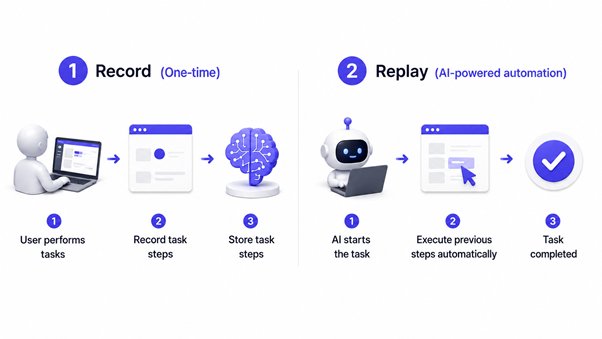
The workflow of demonstration-based automation (Record & Replay) /
As an alternative to overcome these limitations, the method recently gaining attention is ‘demonstration-based automation,’ so-called ‘Record & Replay’. It is a method where if a user demonstrates a task once on the screen, the AI learns this, creates a reusable ‘skill,’ and subsequently performs it repeatedly. Its defining characteristic is that it completes automation literally just by ‘showing,’ without writing complex prompts or scripts.
Global big tech companies have also successively joined this trend. In particular, it began to be widely known in the market when OpenAI introduced the ‘Record & Replay’ function to its coding agent ‘Codex’ last June. It is a method where if a user demonstrates a repetitive task once, Codex analyzes it to make a reusable skill, and then processes it autonomously afterwards. While existing macros or RPA recorded and played back click coordinates and key inputs exactly as they were, the difference is that Codex understands the ‘intent’ of the workflow, not the action itself.
The ‘Record & Replay’ function introduced to the coding agent Codex by OpenAI last June /
Anthropic also responded with a similar feature in about a month. On July 21st, they added the ‘Record a skill’ feature to ‘Cowork’, a collaboration feature of the Claude desktop app. When a user records the screen and explains the work process with their voice, Claude converts this into a reusable skill. As the two competing companies successively released features in a similar direction with an interval of just over a month, evaluations are emerging in the industry that ‘demonstration-based automation’ is establishing itself as the new standard in the business automation market.
However, all of these functions currently operate on a cloud basis. Because it is a structure where the content displayed on the screen and business data are transmitted externally, such as to their own servers for processing, it is difficult to apply immediately to fields handling confidential and sensitive information. Furthermore, there are cases where there are restrictions in the adoption environment, such as being exclusive to a specific operating system, excluding specific regions, or being limited to specific pricing plans.
Infofla Implements On-Premise Based Record & Replay Ahead of Big Tech
There is a domestic startup that accurately targeted this exact point. It is ‘Infofla’ (CEO In-Mook Choi), a company specializing in AI-based IT automation solutions. The demonstration-based automation feature of Infofla’s B2B business automation agent ‘Selto’ is provided in an on-premise environment, not the cloud.
A particularly noticeable point is the timing. Infofla had already been applying this method to the B2B field even before global big tech companies successively launched related features. Founded in 2019, Infofla has built its presence in the business automation market by introducing the real-time object recognition RPA ‘RPACA’ and the AI-based integrated management system ‘ITOMS’, and subsequently introduced the in-house developed VLM (Vision Language Model) based agent ‘VLAgent’ by adding image processing capabilities to LLM (Large Language Model). Selto is driven based on this.
Infofla’s B2B business automation agent ‘Selto’ implemented Record & Replay in an on-premise environment /
Selto has previously enhanced its completeness through the V2 update in July of last year by adding a function that allows users to directly visually confirm the screen learned by AI, an ‘if (conditional branching)’ function that operates differently depending on conditions, and a ‘variable function’ that saves repeated information as variables. It essentially managed to implement even demonstration-based automation on-premise on top of this foundation. In demonstration-based automation, the user does not have to manually configure these features. Because if a user demonstrates a task once on the screen, Selto figures out the conditions and repetition rules on its own and organizes them into a skill, so even field personnel without development knowledge can directly automate their own work.
Along with this, Selto also emphasizes that in the process of automating internal tasks, it learns the relevant institution’s business data and system environment together, developing into a dedicated model optimized for that institution as time passes. The explanation is that because it is a structure where it directly learns the internal systems unknown to general-purpose cloud models in the field, the accuracy increases the more you use it. Of course, since it is an on-premise method, the data generated during this learning process also does not go outside the institution.
Infofla CEO In-Mook Choi said in an interview with reporters, “Infofla’s business automation solution has already gone through verification at a certain central government ministry’s top-tier site and famous shopping malls, and there are adoption cases in the public sector as well, such as failure monitoring for a certain university and government site,” and added, “Even before global big tech companies announced Record & Replay, we were already providing demonstration-based automation functions on-premise, and this will have great significance, especially in public and financial fields where security is crucial.”

Most Viewed
- 역주행 승용차, 25t 트럭과 충돌…30대 운전자 숨져
- [오늘의 운세/8월 19일]
- 故이태석 신부 제자, 남수단 첫 신경과 전문의에
- “용변 실수한 장애승객 손수 씻겨준 고속버스 기사 뭉클”
Headline News
San Diego Padres sold for record $3.9 billion
Opinion
- EditorialInvestment delays test Korea-U.S. trade deal
- Op-edNot every death needs breaking news
