

From AI Users to AI Leaders: How Businesses Can Navigate Generative AI
Artificial intelligence is rapidly becoming part of how organizations operate, compete and make decisions. Businesses not only need more AI programmers and data scientists; they also need managers, analysts and business leaders who understand what AI can do, where it can create value and how to use AI responsibly in a changing business environment.
Generative AI now sits at the center of business transformation, making AI literacy and AI fundamentals essential across an organization. According to Stanford University’s 2026 AI Index, 88% of surveyed organizations reported using AI in at least one business function in 2025. Generative AI alone was being used in at least one business function by 70% of organizations. The question for many businesses is therefore changing from “Should we use AI?” to “How do we use AI responsibly and effectively?”
Using AI Is Not the Same as Understanding AI
Tools such as ChatGPT and Microsoft Copilot have made AI remarkably easy to use. But knowing how to use an AI tool is very different from knowing how to implement AI successfully within an organization. Business leaders must determine which problems are appropriate for AI, what data AI systems should access, how results should be evaluated, how privacy and security will be protected, and when human oversight is necessary. These aren’t simply technology decisions. They are business decisions grounded in AI knowledge, AI literacy and data governance.
Assessing an Organization’s Generative AI Readiness
Executives should complete a readiness check to connect their organization’s AI knowledge with governance, security and measurable value. Questions to ask when assessing AI readiness include:
- Do we have clear business outcomes tied to AI-driven business transformation?
- Are our data pipelines and data governance for AI mature?
- Do teams possess AI fundamentals and AI literacy to evaluate outputs and risks?
- Are there policies for model selection, monitoring and responsible use?
- Do we have roles and processes to manage the changing business environment?
Top Enterprise Applications for AI
Leading uses for generative AI in business include customer support copilots, marketing content generation, sales support, knowledge management, code assistance, product design and research, and development acceleration. In operations, generative AI for managers can streamline reporting, help draft operating procedures and generate analytics summaries. In each use case, pairing generative AI with data governance ensures accuracy, compliance and reliable outcomes.
How Can AI Improve Customer Experience and Engagement?
Generative AI can personalize recommendations, craft dynamic offers, summarize interactions and power 24/7 intelligent assistants, which can help connect customers to the products and services they need. With robust data governance for AI, organizations can unify customer data, respect privacy and maintain brand voice, resulting in faster response times, consistent service quality and deeper engagement. This is where AI-driven business transformation meets measurable customer value.
Roles to Govern Generative AI Projects
To lead responsibly, organizations should define roles that relate to AI projects, such as an executive AI sponsor to align strategy; a head of data governance to own data governance and data governance for AI; an AI product owner to translate business needs; an AI risk and compliance lead to oversee policy; and an AI operations engineer to monitor models. Business leaders should collaborate with these roles to embed AI fundamentals, AI literacy and AI knowledge in daily practice throughout their teams.
AI Literacy Is Becoming a Business Skill
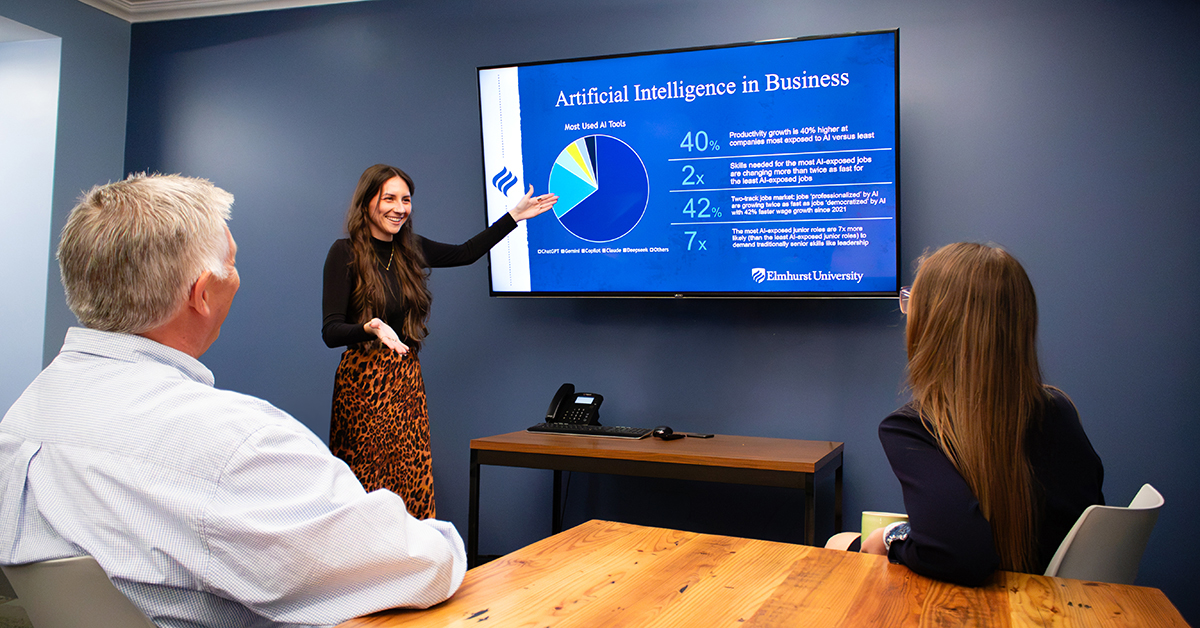
PwC’s 2025 Global AI Jobs Barometer found that the skills employers seek are changing 66% faster in jobs most exposed to AI, and workers with AI skills commanded a 56% wage premium. The World Economic Forum identifies AI and big data among the fastest-growing skills through 2030, while emphasizing analytical thinking, leadership and collaboration. That combination matters: organizations increasingly need professionals who can combine AI knowledge with business judgment, critical thinking and leadership to thrive in a changing business environment.
From AI Users to AI Leaders
Millions of professionals are learning to use generative AI. The next step is learning how to lead with it—asking, “How can AI improve this business process, and how do we implement it responsibly?” That is the difference between using AI and leading AI-driven business transformation with strong data governance.
Preparing Professionals for an AI-Driven Workplace
Elmhurst University’s graduate certificate in Generative AI in Business Transformation was designed around this changing business environment. The program combines generative and applied AI with AI fundamentals, data governance, project management and leadership. The goal is not to turn every student into a programmer; it is to prepare professionals to understand AI well enough to identify opportunities, evaluate risks, make informed decisions and help organizations successfully implement generative AI.
The five-course certificate can be completed online or on campus in as little as one year, and students who later pursue Elmhurst University’s MBA can apply the first four certificate courses toward the degree.
AI technology will continue to change. The lasting competitive advantage will not simply be having access to AI. It will be having people who know what to do with it—grounded in AI literacy, AI fundamentals and data governance for AI—to guide sustainable business transformation.
To learn more about Elmhurst University’s graduate programs, fill out the form below.
Fill out my online form.
About the Author
 Kip Carlson is a lecturer and director of the M.S. in Data Science and Analytics program at Elmhurst University.
AI Skills
March 24, 2026 | 5 Minute Read
How AI Is Revolutionizing Graduate Education: Meet Professor Network
April 29, 2025 | 6 Minute Read
How AI is Revolutionizing Veteran Support
March 18, 2025 | 7 Minute Read
