

Anyone who orders online knows the pain points of the process: delayed shipping, a package damaged in transit, or the wrong item packed due to human error. For the e-commerce site, each such malfunction does not only result in a disappointed customer. It generates returns, customer service inquiries, additional costs and, sometimes, even the loss of a future purchase.
Agan Industries, a company that has over four decades of experience in distribution systems for large organizations, identified a decade ago that its accumulated experience can also address one of the central challenges of the e-commerce world.
This is how the TPE – Third Party E-Commerce – model was born, designed to manage the order fulfillment chain for the online merchant through a combination of automation, robotics, software, and human oversight.
“When we built the model, three main components were before our eyes,” says Nimrod Angel, Agan Industries’ Chief Sales & Operating Officer. The first is accuracy: so that the customer receives the exact product ordered. The second is delivery time: which has become a critical parameter in the world of online commerce. The third is cost: for the model to work, it must be cost-effective and save the online merchant money.
How is this done?
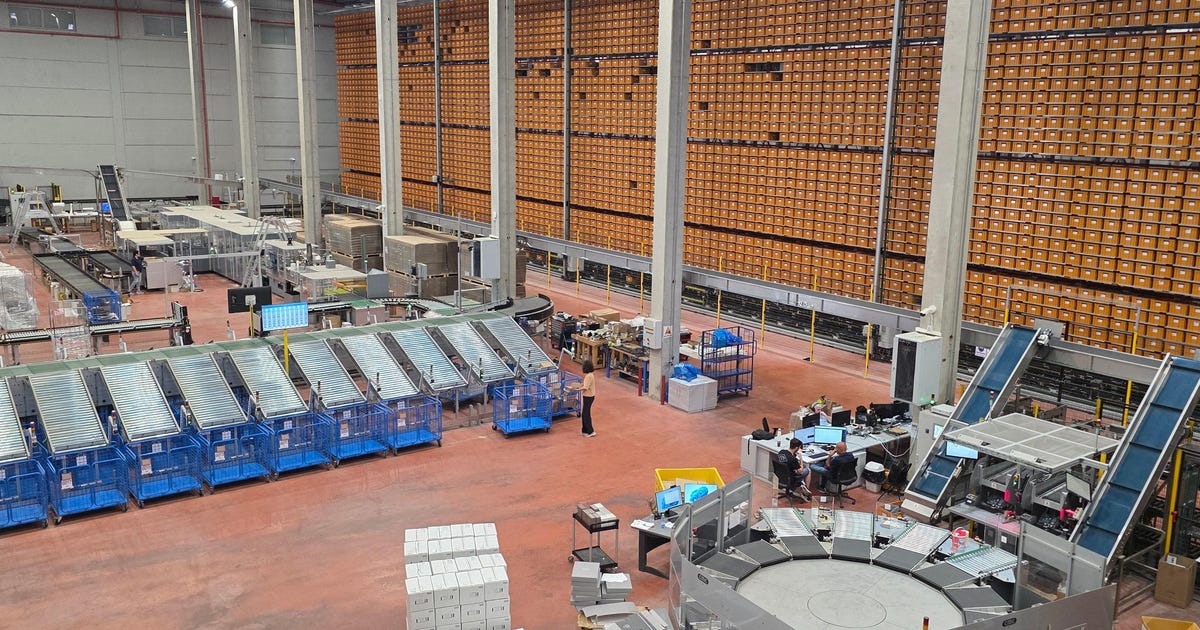
“The solution requires a combination of software and hardware. Therefore, we approached an Italian company with whom we had previously cooperated. They showed great interest in the proposed model. Together, we designed the project with their hardware and our software. The result is the construction of a unique, first-of-its-kind logistics center, where robotic picking of products, automatic packaging, tailored to the order size, printing of recipient details, adding personal elements if necessary, sorting and selection of the appropriate shipping company – are all done at once, with full control over every single detail in the process.”
What is the significance of selecting the shipping company?
“Dozens of shipping companies operate in Israel, each with different advantages, disadvantages and specializations. Not every company is suitable for every product, region, or type of shipment. We built a knowledge base that allows the system to automatically select the most suitable shipping company for each order, according to its characteristics.”
And what is the personalization element?
“We operate in the field of small products, and due to the fact that the packaging we produce is personally printed in color, it is also very suitable for the gift industry. A customer purchasing a gift can request to attach a personal greeting, print a personal text, or an image on the packaging, and the system allows this to be done accurately and be synchronized with the order data. In the same way, it is possible to add an invoice, a delivery note, an exchange slip, coupons or marketing messages from the supplier.”

From Website Order to Customer’s Door
The TPE model in its fully automatic configuration began operating about a year ago. E-commerce sites using the service, transfer their inventory to Agan Industries’ logistics center, and from that moment the merchants’ role focuses solely on marketing and sales. Order details are automatically transferred to the system, which manages the process from picking and packaging to handing over the shipment to the shipping company.
One of the main challenges lies precisely at the end of the process, in the Last Mile – the journey from the logistics center to the customer.
“The Last Mile is one of the most complex parts of e-commerce,” says Nimrod. “In Israel, the challenge is particularly great due to blockages, construction work and areas where navigation and location are more complicated. The ability to use software to match each order to the shipping company allows us to reduce failure points significantly.”
According to Nimrod, the company manages to achieve a zero-error rate in the automatic process. “This is precisely the difference between a manual process and a robotic-automatic process. In the manual method, people pick, pack, label and send – and an error can occur at any stage. With us, most of the process runs almost without human intervention.”
The facility, he says, was designed to handle about 10,000 orders per day. The algorithm also takes into account the order’s weight and product sensitivity, guiding the packaging system accordingly.
“It is not enough for the correct product to arrive on time,” he emphasizes. “If it is a glass product and it breaks in transit, from the customer’s perspective, the delivery failed – and from the merchant’s perspective, another logistical cycle begins.”
One System, a Full Picture
At the heart of the model is ATMS – a software system developed by Agan Industries for inter-organizational distribution that interfaces with e-commerce sites and manages the entire order chain, from the moment an order is placed on the website until the shipment is handed over to the shipping company.
“The system manages the WMS module responsible for inventory. It brings together under one roof order reception, integrity checks, order prioritization, robotic picking, packaging and sorting for shipping companies, as well as shipment management and tracking,” Nimrod explains.
For the online merchant, all information is presented in one portal in real time: order status, inventory levels, consumption data and unusual events. Significantly, the system also allows for certain changes after order reception, such as adding a product to an existing order, alerting other issues requiring attention
When Logistics Doesn’t Limit Growth
Since transitioning to the fully automatic model, Agan Industries has expanded its activity in the Israeli e-commerce world to include the fields of nutritional supplements, pharmaceuticals, cosmetics, jewelry and accessories. According to the company, for some customers, the transition is not just outsourcing logistical operations, but also a way to remove any barrier that prevented them from growing.
As an example, Nimrod mentions a hair product business owner who struggled to manually handle more than 300–400 orders per month. After transferring logistical operations to Agan Industries, her order volume, he says, grew to about 2,000–3,000 per month. The system also allows for maintaining brand identity: every shipment can be sent in branded packaging with the supplier’s name and logo, instead of generic packaging.
“We can clearly see that customers who switch to us can increase their volumes,” Nimrod explains. “In e-commerce, meeting deadlines is crucial. A customer who does not receive an order on time may cancel it – or simply not return. When picking, packaging, printing and data transfer to the shipping company are performed automatically, the possibility of errors is greatly reduced, allowing the m
erchant to focus on sales and growth instead of operations.”
From Israel to The Global Market
Agan Industries is already looking far and beyond the local market. At the outset, the ATMS system was developed as a standalone product that can serve any e-commerce logistics warehouse, at any level of complexity. Today, it operates with great success in a complex and challenging market – the Israeli market.
In addition, the system works in a Grid configuration: it enables several small, efficient logistics centers to operate in sync with a single ATMS, thereby shortening the distance to customers by establishing logistics centers close to population centers.
ATMS integrates, in the most efficient way, a range of subsystems that together provide a complete solution for the logistics site, eliminating the need to purchase and maintain separate essential systems. These include: WMS, WCS, an order management system, a management dashboard for the client, electronic communication with the end customer, full billing management including reporting, an alert system for managing malfunctions and shortages, optimal shipping-company selection, optimal sorting and preparation of packages for distribution, storage optimization, packaging optimization, and a print management and personalization system for the packaging.
“The system is already in its third version. It is an advanced Web system, and, therefore, the next step, for us, is to explore the possibility of marketing it outside Israel and enabling e-commerce sites and logistics companies worldwide to manage their order systems using it.”
If in the world of online commerce the encounter between the customer and the brand occurs on screen, the real experience is often tested precisely at the moment the package arrives at the door. Agan Industries seeks to realize expectation alignment fully – transforming a process fraught with failure points into a single, automatic and controlled system.
For more info:https://ecommerce.agan-ind.co.il
Partnered with Agan Industries
