

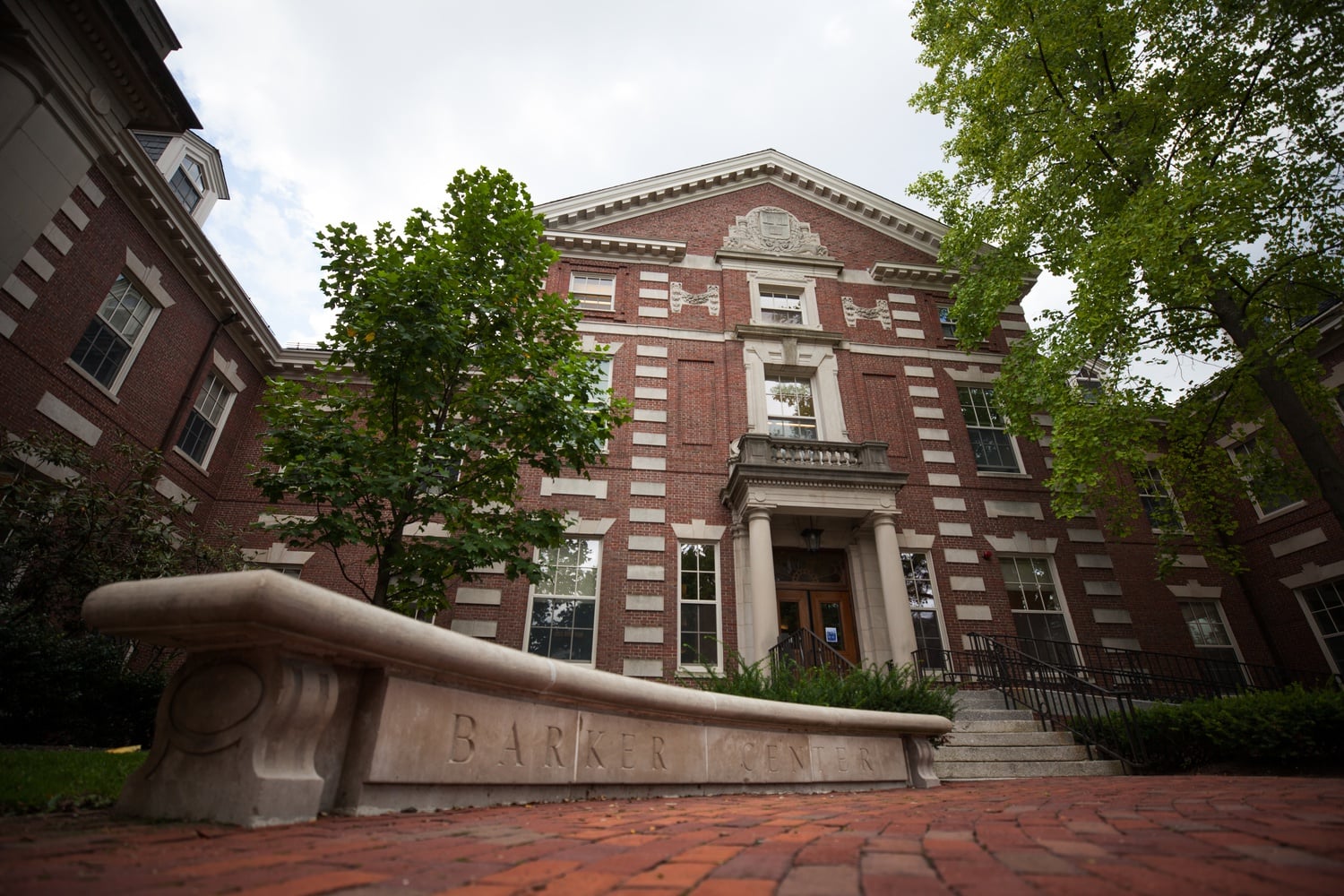
The Barker Center houses several of Harvard’s humanities departments. Faculty in the humanities and social sciences expressed concern over a suggestion by College Dean David J. Deming that writing-intensive courses integrate artificial intelligence.|By Kai R. McNamee
By Abigail S. Gerstein and Amann S. Mahajan, Crimson Staff Writers
Harvard faculty in the humanities and social sciences expressed broad concern over an email Harvard College Dean David J. Deming sent students Wednesday suggesting that artificial intelligence be integrated into “writing-intensive” courses.
Deming identified “AI use policies” as a priority for the academic year in the Wednesday message, saying he hoped to roll out College-wide advisory guidelines on AI by the end of the year and proposing “AI acceptance or even encouragement” in writing- and project- heavy classes.
He added that the approach would help affiliates avoid “the AI-detection business because it damages trust between faculty and students.” The message also linked to a Substack article by Colorado State University professor Kyle Saunders arguing that students need AI skills to meet the demands of a modern workforce — an issue Deming has emphasized in previous remarks.
In interviews and written statements, most faculty in writing-intensive fields agreed that they wanted to avoid policing student AI use but remained divided on Deming’s broader proposal for “AI acceptance, or even encouragement.”
Faculty in the humanities and social sciences have generally shied from incorporating AI into their courses. A Crimson analysis of a random sample of roughly 600 fall <a href="https://bitcomme.com/top-influencer-marketing-agencies-2026/” title=”Top Influencer Marketing Agencies (2026)”>2026 courses found that more than half of science and engineering courses allowed some use of AI — but that figure dropped to 35 percent in the Social Sciences Division and 27 percent in the Arts and Humanities Division.
English professor Deirdre Lynch said she did not want to be “the cop” combing student assignments for traces of AI, but confirmed she will maintain a blanket ban on AI tools in her two fall courses, despite Deming’s suggestion.
“Writing is sort of a personality and individual thoughts clashing with something shared called language,” she said. “You figure out what your style is through that clash.”
Lynch added that Deming’s enthusiasm for the tools overlooked larger concerns about AI, including its environmental impact and effects on student skill-building.
Get The Crimson in your inbox.
College spokesperson Jonathan Palumbo emphasized that Deming’s email is a “prompt to continue a conversation.” Deming referred to his suggestions as “initial thoughts” in the Wednesday email.
Although faculty did not receive Deming’s message, Dean of Undergraduate Education Amanda Claybaugh sent a separate email to faculty Wednesday asking them to share their views on AI use in class but making no explicit suggestions for changes to AI policies.
History professor Peter E. Gordon wrote in a statement that AI use in writing classes would only exacerbate what he called a “marked decline in student attention” since the rise of digital media — and push students to outsource their thinking.
“It may also discourage students from developing their own responses to works of art, music, literature, and philosophy, encouraging them to rely upon conventionalized experiential reports as generated by the new technologies,” he wrote.
AI has already begun reshaping student teaching and learning for freshmen. The College introduced a mandatory AI learning module for first-year Expository Writing courses.
Amy Hanes, an Expos preceptor, said Deming’s emphasis on AI in writing would not change how she will teach her courses but that she remained worried about how his comments might sway student opinions.
“I am concerned that students may start to question how valuable or necessary writing is if the conversation shifts to we should use AI with things that have to do with writing,” she said.
Other faculty were more receptive to Deming’s proposals, saying that responsible AI use could help faculty avoid policing. Comparative Literature and English professor Homi K. Bhabha, who is teaching one undergraduate course this fall, said he would continue having students keep AI logs documenting how they used AI to prepare for class.
But Bhabha drew a line at students using AI to do all the thinking for them — it could not, for example, be used to write students’ essays.
“AI can help you prepare the ground for your thinking, for your preparation. But once the ground is prepared, you have to stand on it with your own voice and your own vision,” he said.
—Staff writer Abigail S. Gerstein can be reached at [email protected] and on Signal at abbysg.97. Follow her on X@abbysgerstein.
—Staff writer Amann S. Mahajan can be reached at [email protected] and on Signal at amannsm.38. Follow her on X@amannmahajan.
Want to keep up with breaking news?Subscribe to our email newsletter
Have a tip for The Crimson?Share it confidentially
See more on:College Administration, FAS
