

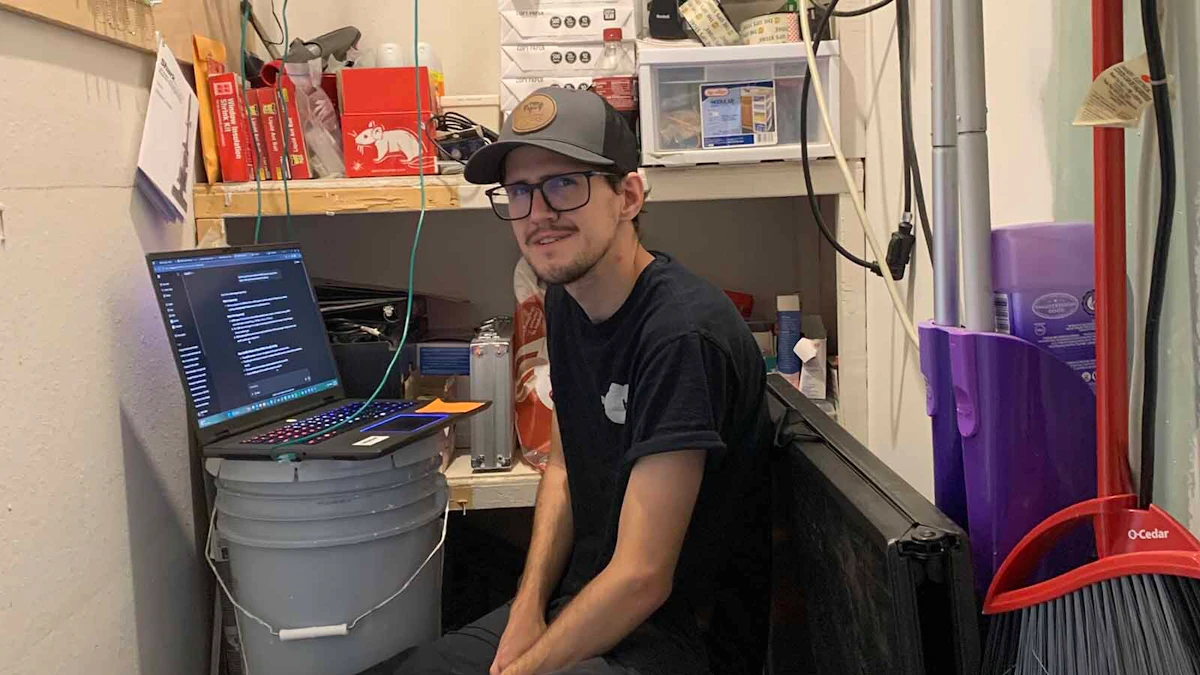
Nick Boltin hates sunlight. Actually, it’s probably more accurate to say he loves his basement
Boltin makes it clear that he doesn’t like leaving his house to go to the office.
Dan Knievel handles that. He’s Boltin’s longtime friend, and now business partner, at White Hat Rescue.
That’s their startup cybersecurity firm in Gillette, where the pair of tech nerds are on a mission to out-hack the malicious hackers to target people online.
It’s safe to say that Boltin leans into the cyber-geek stereotype with pride. He’s a small guy with thick-rimmed glasses in a ballcap with the type of pale skin that appears nourished by the glow of monitors, not sunlight.
He considers this an asset for a guy in his line of work, who is capable of hacking into federal infrastructure to turn off utilities or divert water flow but who instead uses his powers for good.
“I tell all my clients I lack Vitamin D, and that’s how they know they’ve chosen the right guy to protect them,” Boltin said with a laugh.
While Knievel manages clients and day-to-day operations in-house, Boltin immerses himself in the nuts and bolts: designing systems, writing code, and building digital fortifications against breaches and cybercriminals.
Knievel said that it takes some effort to coax Boltin out of his dark lair.
Like his partner, Knievel is a thin guy in a ballcap who has the steady reserve of a guy twice his age, and translates Boltin’s computer-ese into regular speak while keeping his friend on task.
The two sat down at the shared conference room at the Fuel Business Incubator office in Gillette, where they rent an office, to talk about themselves and the work they do building and maintaining secure computer systems designed to thwart cyberattacks and protect sensitive data from theft.
Mostly they work for their clients, but they also help out people who have just been hacked.
Using Powers For Good
This just happened, in fact.
Last week, Boltin helped his wife’s friend hang on to her house deed and the bulk of her money after scammers tricked her into installing remote-access software disguised as customer support.
This is a popular scam in which cyber-criminals call or email a person warning that an account or computer has been compromised.
The scammers operate by ginning up fear or distraction; this one struck while the woman was multitasking and not clearly thinking the situation through.
As a result, by letting the scammer download a remote access tool onto her computer, she’d inadvertently handed over control of everything — bank accounts, credit cards, email — to the scammer, thinking she was fixing a problem.
The thief siphoned $400 in Bitcoin from her cash app before her bank’s fraud alert woke her to a second attempt for $1,400.
She went first to the police but was told they couldn’t examine her laptop. So, she contacted Boltin’s wife, who connected her to Boltin.
He, in turn, scanned her laptop with his custom-built “Ninja” White Hat Rescue software tool, which he designed to undo the damage and lock out the intruder to prevent him from doing further harm.
He was also able to help her change passwords in time to prevent more damage — including cutting off the scammer’s ability to access her house deed — work that took both of them an entire day with Boltin donating his time.
He wasn’t able, however, to get back her stolen cash, but he did file reports with both the Gillette Police and the FBI on her behalf.
Happening All The Time
Gillette Chief of Police Brent Wasson wasn’t sure who the woman had talked to that day at the police station because no report was filed but confirmed the detective received Boltin’s report.
Wasson noted that the GPD computer forensics team had been attending a training session in Riverton that day, which could have led to a miscommunication.
But the department’s cybercrime unit receives theft reports like this all the time and actively works on them, handling on average about a dozen a week.
He encourages anyone who has been compromised to contact them. In many instances, he explained, seizing a suspect’s physical device isn’t necessary. Investigators use various third-party services to access digital platforms directly.
The problem on their end, Wasson added, is that many mobile payment and electronic transfer services impose minimum thresholds — often starting around $6,000 — below which law enforcement is unable to freeze or seize transactions.
“These scammers are well aware of these thresholds,” Wasson said, noting that this impacts their ability to recoup stolen money.
He noted one instance outside of Gillette where a scammer transferred $1.3 million from a victim and worked feverishly to break up that money into smaller chunks to get under those thresholds.
They know what they’re doing, he said.
“It’s one of the complexities of these types of crimes that make them difficult,” he said. “It’s also when you think well, surely Congress could help us with this, but a lot of these platforms are outside of the United States, and then jurisdiction obviously is the biggest issue.”
Regardless of the amount of money lost, Wasson encouraged anyone who has been scammed to report the crimes to police as quickly as possible.
Taking Cybercrime Personally
“Unfortunately, it’s the new normal,” Boltin said, which is where he and Knievel step in.
They do this partly to help victims, whether paying clients or innocent people who have no idea what to do. Partly because they have seen the havoc it causes in people’s lives, and also because Boltin takes it personally.
He’s seen firsthand the particular breed of greed that drives these crimes and the perpetrators who have zero regard for the people they hurt and damage they leave behind.
It’s also about providing a much-needed service and giving back to the community — t he same one that welcomed them home and helped launch their business after years of living away.
In a state where nearly two-thirds of its Wyoming-born residents leave for more lucrative careers in bigger cities by the age of 30 – one of the largest outmigration rates in the nation – Boltin and Knievel are the rare current flowing in the other direction.
They had their taste of it — the high-rise salaries, the flashier amenities of cities far larger and more exotic than Gillette.
But something was missing, which they boiled down to a lack of community and sense of home.
Originally from Rozet, a speck on the map 15 miles east of Gillette with just a post office, school, bar and a long line of Burlington Northern Santa Fe locomotives parked on unused sidings along the highway, the two initially couldn’t wait to get away.
After high school, both enrolled at the University of Wyoming — Knievel first, Boltin following a year later. Knievel earned a finance degree, served a four-year term in the Army handling management and logistics, then accepted a supervisory role at one of Amazon’s fulfillment centers, working among people three times his age.
He quickly rose through the ranks, moving around the country from North Carolina to Georgia and then Baltimore, Maryland, as one of a dozen managers overseeing thousands of employees on any given shift.
“I was fortunate,” Knievel said modestly. “It wasn’t anything I deserved to do. I was just at the right time for the right opportunity each time.”
He credits God for his gifts and opportunities, and himself for his mistakes.
Jailbreaking
Boltin’s trajectory was born of frustration, and in his early teens he started hacking into video games, mostly because he sucked and wanted to be better, if that meant cheating.
This led him to learn how to reverse-engineer certain video games like “Call Of Duty” by “jailbreaking” his gaming console, allowing him to modify not only the system but also the content within the system to give him the edge.
“At one point I was ranked in the top 10 world leaderboards,” he said.
Not satisfied with his own success, he started giving his school pals a USB drive to jailbreak their own gaming consoles.
“It wasn’t long before I was caught and forever banned from that gaming console and games,” he said. “Thanks to no guidelines on YouTube at the time, it made it super easy to track me down and inform my parents what I was up to.”
This instilled his ethical boundaries, he said, noting he hasn’t touched a game since.
And it also turned around his thinking and made him want to use his skills for good.
Taunting Criminals
Initially, law school had been Boltin’s plan, until midway through his third year, when it all started to feel hollow and he dropped out of college.
Fate stepped in that summer when he attended Defcon, an annual gathering for hackers, security experts, and digital tinkerers of every stripe who prove their mettle in a variety of competitions. It’s one of the biggest in the world, and Boltin’s skills stood out.
“I didn’t win,” he said, “but I put up a really good fight.”
It was enough to capture the eye of a recruiter from CYPFER, an international ransomware and cybersecurity company operating out of Canada, who approached Boltin with a job offer.
Though based in Montana, Boltin traveled all over the country and world, responding to major ransomware attacks targeting Fortune 500 companies, the kind that made national and international headlines.
A non-disclosure agreement precludes him from discussing specifics, but some of the bad actors he took head on were among the top 10 most notorious cybercriminal syndicates, such as LockBit, Medusa, Akira and RansomHub.
He got a lot of satisfaction over foiling their efforts, he said, and still enjoys taunting them to this day, leaving a honeypot – or an intentionally deployed decoy system, in computer speak – on the edge of his network to intrigue hackers “to mess with his stuff.”
It was hit over 100,000 times in 24 hours, he said, a statistic that laid bare the industrial scale of the threat and the relentless, systematic effort to infiltrate and plunder.
“Little do they know they will spend hours if not weeks digging into something that is a big pile of nonsense,” he said.
Numbers Not Adding Up
It took the long-time friends years to finally achieve their dream of starting a business together, Knievel said, after randomly tossing around various business ideas, including a 3-D mask during the pandemic long before that technology became commonplace.
Nothing stuck, however. They would get as far as designing a prototype, which is where the idea tanked. The maze of regulations, the paperwork, the sheer grind of starting something from nothing: It might as well have been a foreign language.
“I think where we got bottlenecked was, OK you have a good idea now, but now you need to actually run the business, which is what we didn’t have,” Knievel said.
That changed, however, when the two reached their breaking point in their late 20s for entirely different reasons.
At the top of his game at Amazon, Knievel’s faith in operational efficiency began to sour. He still ran the numbers, but now he saw the faces behind them and real-life cost of these decisions.
In one case, he saw a 33-year employee who had never missed a day get fired because he missed work after his mother died, which on paper impacted his performance.
Knievel found it increasingly harder to follow his bosses’ orders because he started to see the human toll behind the efficiency. The data couldn’t explain why morale was low or effort was lagging — problems he viewed as failures of leadership, not productivity.
“The math was sound,” he said. “But math can’t survive a toxic culture, and people get lost in the formulas.”
Missing Wyoming
Boltin, meanwhile, had hit his own wall. He watched the numbers and the many hours he was putting into the work. When he and his team had just clawed back $1.2 million for a client after a ransomware attack, his own salary didn’t budge.
The long-time friends knew they both had talent, but their jobs weren’t rewarding it. They continued talking and asking, “What if they built something of their own?” At the same time, the familiar roadblocks were still standing in their way.
Boltin never thought he’d return to Gillette — or Wyoming, for that matter. But after assignments that took him across the country and nearly to Malaysia, he found himself missing the familiar.
“I love the culture here,” he admitted. “I missed the community.”
Knievel felt it too. He liked where he’d been, but he wanted more from the work itself.
Boltin was ready. When he told Knievel he wanted to strike out on their own, the name came to him in a flash of clarity: White Hat Rescue. It was perfect — a nod to the ‘white hats’ in their field, the ones who used their skills for good.
Boltin moved back first and Knievel followed a few months later.
For a while, Boltin kept working at CYPHER, on call around the clock as one of their global emergency engineers. The breaking point came during a high-stakes deployment in Taiwan.
Working from Wyoming but living on Taipei time, he pulled two straight days without sleep while executives shouted from the sidelines.
He finally decided he’d had enough, and the two decided to find a way to go into business.
As Boltin tunneled through code and security protocols, Knievel began structuring the business — building the website, drafting proposals, selling Boltin’s expertise.
Boltin was clear: He’d handle the tech. The rest was Knievel’s domain.
IT Roustabouts
It was Knievel’s grandmother, Carol, who threw them a lifeline. During a salon appointment, her stylist mentioned the Energy Capital Start Up Challenge — a competition sponsored byEnergy Capital Economic Development since 2023, designed to help launch local startups.
That year, in 2024, their venture was selected as one of three finalists for the $50,000 competition. The prize money they received funded Boltin’s $3,500 laptop, secured them affordable space at the Fuel Business Incubator, and connected them with mentors who guided them and introduced them to would-be clients.
Boltin landed their first client, the Western Welding Academy, who he’d been contracting with on the IT side since landing in Gillette.
Both Boltin and Knievel acknowledge that without the program’s support, launching their business would have been unlikely.
Knievel describes their services as “IT Roustabouts,” meaning they provide the gamut of cybersecurity services, including setup, maintenance, infrastructure design, cybersecurity threat protection, incident response and recovery. In a nutshell, they build a security system for clients that they then manage and keep an eye on.
At this point, they have about 13 active clients and just hired their first full-time employee, who is also a local guy fresh out of college who fits in well with the culture they are trying to build. He’s in the office with Knievel while Boltin still works from home.
Word of mouth has gone a long way for the budding entrepreneurs who again credit the community for hiring a small firm as opposed to a big out-of-town tech company that may be bigger but doesn’t offer the same hands-on service.
Mostly, they see their business as a product of their hometown and state and the community that shaped them. That includes the dirt roads, the familiar faces at gas stations and football games and neighbors who still wave and show up for one another when they’re in need, Boltin said.
“We love it because it loves us first,” Boltin said, “in a thousand ways that still matter.”
Jen Kocher can be reached atjen@cowboystatedaily.com.
