

Integration of core accounting disciplines within the postgraduate accounting curriculum: evidence from South Africa
-
School of Commerce, College of Law and Management Studies, University of KwaZulu-Natal, Durban, South Africa
Article metrics
View details
Abstract
Aim:
Guided by the International Education Standards, this study explores professional competence as the integration of technical competence, professional skills, and ethical values required of aspiring South African chartered accountants. It examines the lived experiences of students exposed to integrated learning in a 1-year Postgraduate Diploma in Accounting and their perception about how integration as curriculum enhancement enhances integrated thinking and preparedness to pass professional examination. The programme is delivered by qualified professionals, adheres to rigorous academic standards, and is designed to enhance students’ preparedness for, and performance in, the South African Institute of Chartered Accountants (SAICA), first professional examination, the Initial Assessment of Competence (IAC).
Method:
A qualitative thematic analysis was employed using in-depth interviews with 11 registered Postgraduate Diploma in Accounting students who experienced the integrated teaching and assessment of financial accounting, financial management, taxation, and auditing (the “Big Four”). Interviews specifically focused on their perceptions on how integration as curriculum enhancement could enhance their integrated thinking and preparedness to pass IAC.
Results:
The findings indicate that integration is an effective educational strategy that promotes critical thinking, professional readiness, and real-world relevance. Grounded in constructivist learning theory, integrated learning supports active and interconnected knowledge construction, enabling students to link concepts across modules, develop deeper and holistic understanding, and enhance preparedness for the IAC. However, the effectiveness of integration is influenced by implementation challenges, including delayed introduction, siloed teaching practices, and misaligned assessments.
Implications:
Addressing these challenges and aligning integration with accounting education research and accreditation standards can transform it into a practice that prepares students for the profession’s interdisciplinary demands. The study underscores the importance of integrated thinking in developing the strategic and problem-solving capabilities required of future chartered accountants in a volatile, uncertain, complex, and ambiguous (VUCA) environment.
Introduction
In light of persistent gaps between graduates’ competencies and workplace expectations, there is a pressing need to enhance both performance and curriculum design. In accounting education, siloed learning exposes students to fragmented knowledge, limiting critical thinking, professional judgment, and the practical application of learning. Accounting students require specific, pervasive skills that can only be effectively developed through intentional integration of modules within the curriculum. One of the of the South African–South African Institute of Chartered Accountants (SAICA)-accredited university, offering the Postgraduate Diploma in Accounting (PGDA), introduced the integration of accounting, auditing, financial management and taxation modules, normally referred to as “Big Four” modules, to enhance holistic understanding and improve students’ preparation and success at the first professional board examination refer to as Initial Assessment of Competence (IAC). This decision was motivated by the identified lack of holistic thinking and the fragmented mindset among students, which compromised their success at the IAC level. The persistently unsatisfactory pass rates were attributed to insufficient integrated thinking, a critical competency required in the IAC examination, as students are required to write a highly integrated paper in this initial professional qualifying examination. In South Africa, SAICA accredits accounting programmes, including undergraduate degrees and the PGDAs, and is regarded as the preeminent professional accounting body, exerting substantial influence over academe licensing the profession (Phesa et al., 2025; Retief Venter and de Villiers, 2013). SAICA administers the qualifying examinations and South African Chartered Accountants are recognized globally for professional trust (South African Institute of Chartered Accountants (SAICA), 2023a). The PGDA prepares candidates for the technically intensive IAC professional examination and are delivered by qualified CAs to uphold SAICA’s standards (Phesa et al., 2025). Notable, this study did not explore performance data and based longitudinal outcomes, however is based in general premise other factors such as enhancement of curriculum enhances performance.
Integration was introduced as an innovative approach to improve PGDA pass rates by combining accounting, financial management, taxation, and auditing. Although still in its early stages, this integration occurs in both teaching and learning activities. Lecturers now co-teach selected classes to demonstrate how different accounting modules interconnect, rather than treating them as isolated subjects. Additionally, integration is reflected in the assessment process, where, on a rotational basis, each course incorporates at least 20% of content from other modules. As with any educational reform, this initiative presents both challenges and opportunities. Integration promotes active, interconnected learning, enabling students to link concepts across modules, bridge theory and practice, and develop collaborative, real-world skills. While traditional discipline-based curricula reinforce narrow, siloed knowledge (Matinho et al., 2022), integration encourages synthesis across subjects, supporting complex problem-solving and fostering professional readiness (), and embracing interdisciplinary is the key to modernize (Makrakis and Kostoulas-Makrakis, 2023).
Studies on integrated accounting education emphasize embedding practical training within curricula (), aligning SAICA assessments with workplace demands and adopting innovative teaching approaches, including rethinking technical content delivery. In fact, identify significant gaps between undergraduate accounting education and practical training during articles, signaling the need for curriculum reform. This study extends debates on preparing chartered accountants, a globally recognized profession, while emphasizing sustainability and South Africa’s professional capacity amid the growing exodus of CAs.
International evidence demonstrates that module integration is widely adopted across disciplines and educational contexts as a means of promoting coherence, deep learning, and transferable skills. Studies in integrated STEM, ICT, teacher education, and work-integrated learning consistently show that integrated curricula enable students to engage with complex, authentic problems and construct knowledge across disciplinary boundaries (McLure et al., 2022; Msafiri et al., 2023). Research from diverse contexts, including China, Finland, Indonesia, and other international settings, further highlights integration as a response to fragmented curricula and evolving professional demands (; ; ; Suputra et al., 2024; Yang et al., 2024). These findings reinforce integration as a globally recognized pedagogical approach aligned with constructivist learning principles.
Research on the integration of accounting modules remains limited in South Africa and literature in general. Existing studies focus mainly on pedagogy and curriculum issues, including IFRS teaching (), barriers to integrated thinking (), pervasive skills (), and IT integration outcomes (; ). However, these studies predominantly adopt institutional or educator perspectives, relying on quantitative data or stakeholder perceptions. As a result, accounting students’ lived experiences of integration within SAICA-accredited programmes remain underexplored. This study therefore examines students’ perceptions of integrating four major accounting modules, drawing on their lived experiences of the integrated learning approach.
This study contributes to the literature in three ways. First, it offers a contextual and empirical contribution by providing the first qualitative South African evidence of accounting students’ perceptions based in lived experiences of integrating four major accounting modules as curriculum enhancement, in preparation for the SAICA- IAC, addressing a gap dominated by quantitative outcomes. Second, drawing on constructivist learning theory, the study demonstrates how students actively construct meaning by linking prior disciplinary knowledge to integrated, real-world accounting problems, supporting the development of integrated thinking and professional judgement required by the IAC. Third, the study provides practical insights for SAICA-accredited institutions to enhance curriculum alignment, module integration, and student preparedness for integrated professional examinations.
The study is guided by the following research question:
How do PGDA students perceive the integration of the Big Four accounting modules as a curriculum enhancement in relation to their integrated thinking and preparedness for the Initial Assessment of Competence (IAC)?
To answer the research question, the study used a qualitative approach, interviewing PGDA students based on their experiences and perceptions of integrating accounting modules in teaching, learning, and assessment. The results were analyzed using thematic analysis. The remainder of the article is structured as follows: literature review, research method, results, and conclusion.
Literature review
Theoretical framework: constructive learning theory
As noted in the introduction, persistently unsatisfactory pass rates were attributed to insufficient integrated thinking, a critical competency in the IAC examination, where students are required to write highly integrated papers. Constructivist theory provides a relevant framework for addressing these challenges, as it posits that learners actively construct knowledge through experiences, interactions, and reflections rather than passively receiving information (; Sithole and Pereira, 2019). Constructivism emphasizes cognitive and social dimensions: individuals build schemas by assimilating new information into existing knowledge, or through social collaboration and scaffolding. Experiential learning underscores “learning by doing,” where real-world contexts foster meaningful understanding and the practical application of knowledge (). In the context of accounting education, this approach is particularly relevant, as students often struggle with siloed learning that limits their ability to integrate concepts across modules. By engaging with realistic, applied scenarios, students can develop the integrated thinking, critical judgment, and problem-solving skills essential for success in the IAC examination. Core principles of constructivism include learner-centered approaches in which knowledge is subjective and contextual, enabling students to engage in problem-solving, critical thinking, and creativity by connecting prior experiences with new concepts (; ).
The integration of the Big Four accounting modules aligns strongly with constructivist principles by allowing students to connect concepts across disciplines, apply theory to real-world scenarios, and build holistic professional understanding through active, experience-based learning. By promoting agency, reflection, and collaboration, the integrated curriculum transforms fragmented learning into coherent, practical competence, directly addressing the gaps in graduate preparedness identified at the PGDA level and improving readiness for the IAC examination.
Empirical literature
Enhancing student learning in accounting education
Several studies have explored ways to improve student learning and performance across accounting disciplines. Mitchell (2006) emphasized the need to balance practical application with conceptual understanding in management accounting to enhance engagement, while Ngwenya (2016) highlighted the value of structured classroom discussions but cautioned that poorly designed discussions may limit comprehension. Steenkamp et al. (2012) identified early interventions and supplementary lessons as essential for first-year accounting students, given that many encounter accounting for the first time at university. Similarly, Msomi and Agyemang (2022) stressed structured interventions to bridge the high school–university transition, arguing that comprehensive teaching and assessment strategies improve professional readiness. Recent studies reinforce these findings but also highlight persisting gaps. Reported positive effects from a 4-day bridging course before introductory accounting, whereas Mokhampanyane (2023) found that academic and social integration challenges continue to affect retention and performance. ‘s systematic review similarly pointed to prior knowledge, self-efficacy, and transition effects as critical determinants of first-year performance, suggesting that interventions alone may not fully address persistent competency gaps.
In the South African context, professional bodies strongly influence accounting education, from programme accreditation to workplace expectations. While this ensures standardization and quality, it may also constrain curriculum innovation (Retief Venter and de Villiers, 2013). Evidence suggests that interactive teaching and targeted interventions improve outcomes (; Van der Merwe, 2013), but studies differ on the extent to which these interventions address integrated thinking and professional judgment deficits.
Integration of accounting modules
Integrating core accounting modules is critical for fostering holistic understanding and reflective learning. Recent studies underscore its importance: argued that the integration of emerging technologies like AI, blockchain, and ML requires multidisciplinary understanding across accounting modules. reported that bridging courses integrating multiple modules improved early student performance, while Mpanza (2025) found that curriculum reforms incorporating AI and data analytics across modules enhanced employability. These studies collectively highlight that integration enhances the ability to see interconnections between taxation, financial reporting, auditing, and financial management, bridging theoretical and practical knowledge. However, conflicting findings exist: while some report improved performance and employability, others note that integration requires careful scaffolding and instructional support to avoid cognitive overload, particularly for students with limited prior exposure to accounting ().
Challenges in accounting education
identified a persistent gap between theoretical instruction and practical industry skills, a challenge that remains highly relevant given rapid technological and economic shifts. review highlighted the influence of prior knowledge and self-efficacy on first-year accounting performance, suggesting curricula may inadequately prepare students for transitions. Mokhampanyane (2023) noted that adjustment stress affects retention and performance, while demonstrated that structured collaborative assessment improves comprehension and engagement. These findings, along with reports of declining enrolments and misalignment with professional expectations, whilst emphasizes the need for curriculum reform, enhanced assessment practices, and stronger alignment between academia and industry.
Development of technical and soft skills
Traditional accounting education has focused heavily on technical skills, often at the expense of soft skills. advocate for curricula integrating technical and interpersonal competencies, while highlight the importance of critical thinking and communication for employability. found that graduates often meet technical expectations but remain deficient in teamwork, adaptability, and communication, a finding echoed by , who argued for embedding practical experience and interpersonal skill development within accounting programmes. Recent evidence supports this integrated approach: Malan et al. (2025) developed a self-regulated learning programme combining soft and technical skills, illustrating the potential for multidimensional student development.
Pedagogical approaches and student engagement
Sustaining student motivation requires engaging and relevant teaching methods that connect theory to practice. Marriott and Marriott (2003) reported declining interest in accounting, while Murthy and Ragland (2009) highlighted language barriers embedded in global accounting standards. Storytelling and real-world examples enhance comprehension and relevance O’Flaherty and Phillips (2015) and Rebele and Pierre (2015) stressed the necessity of continuous pedagogical innovation. More recent evidence reinforces these insights: found that early online engagement predicts module success, highlighting the importance of interactive, student-centered, and contextually grounded learning approaches that sustain motivation and support academic persistence.
Summary
The literature highlights persistent challenges in accounting education, including fragmented knowledge, limited integrated thinking, and gaps between graduates’ competencies and workplace expectations. Studies emphasize early interventions, bridging programmes, and structured support to enhance student engagement, performance, and professional readiness (Ngwenya, 2016; Steenkamp et al., 2012; , ; Mokhampanyane, 2023). Integration of the Big Four modules at the PGDA level is identified as critical for holistic understanding, linking theory to practice, and developing both technical and managerial skills (; Mpanza, 2025). Constructivist theory underpins these interventions, highlighting experiential, learner-centered approaches that foster problem-solving, critical thinking, and knowledge construction through active engagement (). The review underscores the need for curriculum reform and multidimensional skill development. The next section outlines the qualitative methodology employed in this study.
Method
This section covers the methodology used to conduct the study. The section covers the sampling and sampling approach used, data collection and data analysis.
Sampling and data collection
The study adopted a qualitative approach, collecting data through interviews with postgraduate students enrolled in the Postgraduate Diploma in Accounting (PGDA) programme at the University of KwaZulu-Natal in 2024. The selected university was chosen because the curriculum integration was implemented on it for the first time, making it a convenient and appropriate focus for the study. This cohort represented the first implementation of the integration of all four accounting modules. Eleven respondents participated in the study through open-ended interviews, and data saturation was achieved. Purposive sampling was used, where participants were recruited voluntarily. This method is key to ensure that research aims and objectives are met with precise matching of the targeted participants (). A pilot study was conducted with three students to refine the questionnaire, ensuring grammatical accuracy and clarity. The final instrument comprised 15 open-ended questions: the first five assessed students’ basic understanding of integration, the next five focused on teaching and learning resources, and the final five examined aspects of assessment and examination (refer to Appendix A).
The use of open-ended questionnaire was intentionally used to ensure that participants give responses instinctively and reduces bias (Reja et al., 2003). Although respondents were afforded flexibility in their responses and timing, the interviewer consistently guided discussions to remain aligned with the study’s objectives and research focus.
The questions were shared with respondents prior to the scheduled interviews, which were conducted individually. To maintain consistency and ensure data reliability, all respondents were asked the same set of questions. All 11 interviews were conducted via Microsoft Teams. While the interviews were initially planned to last between 10 and 20 min, the rich discussions extended the duration to between 20 and 50 min on average. Each interview was recorded with the consent of the participants. In line with , detailed field notes were taken, and recordings were later reviewed to extract consistent and comparable responses across participants. Following ‘s approach, respondents were encouraged to elaborate on their experiences, and follow-up questions were used to test the consistency of perspectives among participants. This process ensured the validity of the data used in the study.
Data analysis
After each interview, the data was transcribed and coding was conducted with reference to the preceding interviews, and the process was discontinued once data saturation was achieved (Phesa et al., 2024). Consistent with , data saturation was achieved when additional coding yielded no new themes or insights, as participants’ responses became repetitive. An iterative approach guided data collection and analysis, allowing continuous comparison of emerging codes, themes, and their interconnections. Axial coding was applied to systematically examine and refine relationships between categories. Data saturation was reached on the eleventh interview, this was when additional interviews produced no new insights, and this repetition signaled that thematic saturation had been achieved and that further data collection was unlikely to contribute additional conceptual depth. The consistency of the five main themes and 18 sub-themes confirmed the dataset’s conceptual completeness.
Initial coding was conducted for each interview question to capture respondents’ viewpoints. Thereafter, codes were compared across questions and interviews to identify patterns and relationships, consistent with the application of axial coding within the thematic analysis process. Axial coding was applied to identify and relate emerging themes and sub-themes (Maroun, 2017). Thematic analysis was employed to examine the interview data collected from 11 participants. Open coding was initially conducted, resulting in the identification of five preliminary themes, as presented in Table 1 in the Results section. Related codes were then systematically grouped to develop coherent sub-themes, and relationships between codes were structured and explored. Although this study did not adopt grounded theory as a methodological approach, elements of axial coding were employed as an analytical technique within the thematic analysis framework to systematically examine relationships between themes and sub-themes identified during open coding. The purpose was not theory generation, but rather to enhance analytical depth by exploring patterns of interaction and conditional relationships within the data. This approach strengthened analytical rigor, facilitated deeper interpretation of underlying patterns and connections, and provided structured insights into participants’ experiences and perceptions. In total, 18 sub-themes were generated. Accordingly, the analysis extended beyond mere description of participants’ statements to emphasize the interpretation and explanation of the data, including the exploration of underlying ideas (Makrakis, 2023).
| Theme | Sub-theme |
|---|---|
| Theme 1: understanding and perceptions of integration in accounting education | 1.1 Conceptual understanding of integration |
| 1.2 Emotional response and adjustment | |
| 1.3 Holistic vs. fragmented experience | |
| Theme 2: teaching and learning approaches in integration | 2.1 Effectiveness and consistency of teaching methods |
| 2.2 Timing and frequency of integration practice | |
| 2.3 Lecturer collaboration and co-teaching | |
| 2.4 Importance of workshops and academic training | |
| Theme 3: examination and assessment of integration | 3.1 Nature and depth of integration in assessments |
| 3.2 Fairness and real-world reflection | |
| 3.3 Mark weighting and strategic learning behavior | |
| 3.4 Time allocation and cognitive demand | |
| Theme 4: impact on learning and professional readiness | 4.1 Development of holistic and reflective thinking |
| 4.2 Preparation for professional examinations | |
| 4.3 Initial uncertainty and anxiety | |
| 4.4 Limited authentic integration | |
| 4.5 Engagement, motivation, and professional identity | |
| Theme 5: suggestions for improvement | 5.1 Earlier and continuous integration |
| 5.2 Structural and pedagogical enhancements |
Themes and subthemes.
This approach is consistent with broader qualitative research practices as axial coding has evolved to be widely used in qualitative research as a way to refine, relate, and organize codes into meaningful categories during analysis (McLeod, 2024). The axil coding was used as to ensure objectivity, the initial coding was performed by one author, and two colleagues independently reviewed the process. During the early stages, contrasting views emerged in the first three interviews; however, consensus began to form from the fourth interview onward, aided by deeper engagement, iterative questioning, and refinement of coding based on feedback. The study employed thematic analysis, whereby themes and sub-themes were developed following the approach proposed by . Themes were subsequently developed and analyzed using Lumivero NVivo (version 15), which generated a word cloud of frequently occurring terms and sub-themes representing students’ perceptions of integration.
The researcher is a Chartered Accountant and lectures taxation at the PGDA level, where the integration was implemented. This professional background informed the structure of the interview questions and the contextual interpretation of the data. To mitigate potential bias, systematic coding procedures were applied, including both open and axial coding, alongside reflexive practices such as the use of verbatim participant quotations. These measures ensured that findings remained grounded in participants’ perceptions and perspectives rather than influenced by prior professional assumptions of the author. Furthermore, the analysis of results is based on the objective evidence collected in the study.
Ethical guidelines consideration
To conduct the study, the ethical clearance with all the guidelines was obtained from the University of KwaZulu-Nata, dated 24 September 2024, ref: (HSSREC/00007617/2024). Permission for participants to take part in the study was obtained through formal gatekeeper letters from University of KwaZulu-Natal’s Registrar. Participants voluntary participated in the study and gave informed consent at the start of the recorded interviews. We ensured that no personal identifying information was collected, and all responses were kept strictly confidential.
Results
Introduction
This qualitative thematic analysis explores how students in a South African Postgraduate Diploma in Accounting (PGDA) experience, interpret, and respond to module integration. Drawing on interview data from 11 participants, the analysis identifies five key themes reflecting their perceptions of integration, its pedagogical delivery, assessment experiences and its role in professional readiness.
Emerged themes and subthemes
Table 1 highlights the emerged themes and subthemes. Overall, five overarching themes were uncovered from the interview transcript. These themes were discussed under various subthemes, with theme 4 having the most subthemes (five), and theme 5 the lowest (2).
Theme 1: understanding and perceptions of integration in accounting education
Sub-theme 1.1: conceptual understanding of integration
Participants demonstrated a consistent understanding of integration as an approach that links distinct accounting disciplines to reflect real-world complexity. Integration was viewed not simply as an administrative combination of subjects, but as a holistic cognitive process that allows the learner to examine a transaction from multiple perspectives.
“Integration allows us to view a single transaction from multiple angles accounting, tax, managerial, and auditing. It shows that no event is truly isolated” (Participant 7).
“Integration involves including content from multiple modules in a single exam… to build a well-rounded Chartered Accountant” (Participant 3).
“It has taught me to combine different aspects and manage my time across all four modules… Seeing the connections from a different perspective helped me make sense of the material” (Participant 6).
Furthermore, integration encouraging learners to perceive accounting problems not as isolated tasks but as interconnected elements within an organizational ecosystem. Students perceived integration as a bridge between academic learning and professional application, signaling a transition from procedural to conceptual understanding. They understood integration as the deliberate combination of the “Big Four” within the teaching and learning and in a form of same assessment framework. The principle underpinning integration was acknowledged by all respondents as realistic and aligned with professional practice, but the execution elicited divergent opinions.
“When I saw the integration, I expected there would be more overlap within a single scenario. However, the exam was divided into different sections or module-based scenarios… it felt more like writing them at the same time, but with each module having its own scenario.” (Participant 1)
“In practice, it sometimes feels like they’ve just glued two separate questions together rather than creating a truly cohesive scenario.” (Participant 11)
In contrast, a respondent from participant 10 expressed overwhelming support for the integrated structure:
“It’s not just about knowing the rules for each subject, but about understanding how a single business decision ripples through the financial statements, affects the tax bill, influences management’s plans, and changes what an auditor needs to check.” (Participant 10)
The divergence here illustrates a tension between integration as principle and integration as practice. While all participants accepted the idea of integration as desirable, its pedagogical implementation determined whether it was seen as fragmented or authentic. When integration merely juxtaposed questions, it undermined the holistic intent. Conversely, when students experienced it as an authentic simulation, integration elevated their learning experience into professional level thinking.
Sub-theme 1.2: emotional response and adjustment
Initial exposure to integration elicited apprehension, largely because it deviated from students’ undergraduate experience. However, repeated exposure led to gradual adaptation and increased confidence, as seen in the response of participant 4:
“Initially, I was very stressed about it because it was something new… once I saw it in practice, I realized that I could actually handle it” (Participant 4).
This emotional progression mirrors transformative learning processes, where disorienting experiences prompt reflection and eventual adaptation. The early anxiety reveals resistance to unfamiliar pedagogical paradigms; however, through experiential engagement, students reconstruct their learning frameworks. Their adaptive responses suggest growing self-efficacy, which is a sense of capability to cope with complex, integrated challenges. Such affective adjustment is crucial in professional education, where ambiguity and multidimensional problems are inherent to practice.
Additionally, participants consistently perceived integration as an intentional blending of accounting modules, requiring them to analyze a single issue from multiple disciplinary angles.
“Instead of just focusing on tax or accounting separately, the aim is to show how concepts in one module filter into another.” (Participant 2)
“Integration involves looking at a single transaction from multiple angles—accounting, taxation, auditing, and managerial perspectives.” (Participant 8)
Students recognize that integration mirrors the interdisciplinary nature of professional practice. This understanding suggests that they see value in moving beyond technical silos to a systems-thinking approach, where decisions in taxation affect auditing, or managerial choices impact financial reporting. The recognition that “no event is isolated” reflects how accounting education is increasingly embracing the principles the integration. This approach aligns with the complex problem-solving required in the workplace, where professionals must simultaneously navigate multiple regulatory, strategic, and ethical dimensions. Importantly, this perspective positions integration not merely as an assessment tool but as a mechanism for shaping professional identity, reinforcing the competencies, judgment, and values that define a Chartered Accountant.
Sub-theme 1.3: holistic compared to fragmented experience of integration
The extent to which integration was experienced as holistic vs. fragmented shaped student perceptions. For some, integration was superficial, while for others, it transformed their understanding of accounting into an interconnected whole. One participant highlighted the partial success of integration:
“Oh yes, it did give a holistic approach. In some assessments, there was a degree of integration. I could see how it worked in tax, and in that sense it really helped.” (Participant 1)
By contrast, another participant noted how integration sometimes became more of a guessing game:
“You not only have to know your stuff, but you also have to be a mind reader to figure out exactly what the examiners are expecting you to link together in a convoluted scenario.” (Participant 11)
Meanwhile, another respondent viewed integration as the essence of holistic learning:
“It transforms learning from memorising separate textbooks into developing a genuine, interconnected skill set. It’s challenging, yes, but in the best way possible, it’s a challenge that builds real competence and confidence.” (Participant 10)
Students oscillated between fragmentation and holism, depending on how integrated tasks were framed. This suggests that integration is not binary (integrated vs. not integrated) but gradational, moving along a spectrum where superficial interpolation breeds frustration, while authentic integration fosters professional transformation.
Theme 2: teaching and learning approaches in integration
Sub-theme 2.1: effectiveness and consistency of teaching methods
Students’ evaluations of teaching practices were mixed. While some commended lecturers’ commitment and the value of integration workshops, others criticized the persistence of isolated teaching within individual modules.
“The lecturers did a great job in preparing us for the exams” (Participant 7).
“Lectures were mostly brief summaries… not detailed or integrated” (Participant 4).
“The lectures and tutorials were mostly delivered in isolation, with each topic taught separately” (Participant 5).
The inconsistency between workshop-based integration and routine lecture practices reveals a structural misalignment within the curriculum. Lecturers appear to operate within disciplinary silos, undermining the integrative intent of the program. These participants rated the effectiveness differently, based on their experience with the modules.
“I’d give it a solid 8… the online learning environment helped me a lot.” (Participant 2)
“I’d give it a 2.5… there’s significant room for improvement.” (Participant 3)
From a pedagogical standpoint, effective integration requires intentional alignment between curriculum design, instruction, and assessment. The partial implementation suggests that institutional culture and staff collaboration are critical determinants of success. When integration occurs sporadically, students perceive it as an add-on rather than an embedded pedagogical principle.
Sub-theme 2.2: timing and frequency of integration practice
Participants consistently reported that integrated learning was introduced too late in the academic year, reducing opportunities for practice and mastery.
“Integration classes only started towards the end of the 24-week period.” (Participant 6)
“If integration were introduced earlier in the year—it could really help.” (Participant 11)
“Hearing directly from a Chief Financial Officer or a partner from an auditing firm… would be incredibly motivating.” (Participant 10)
When integration occurs only at the end, students are deprived of recursive engagement with interconnected material. Early and continuous integration would encourage longitudinal cognitive mapping, deepening conceptual retention, and transferability to professional contexts.
Sub-theme 2.3: lecturer collaboration and co-teaching
Collaborative teaching models, such as team-teaching or cross-module case analysis, can embody the interdisciplinary logic students are expected to master. Participants recommended inter-departmental collaboration among lecturers to model integrated thinking.
“It would help if lecturers met regularly to discuss strategies and collaborate—co-teaching could allow students to see connections more clearly” (Participant 4).
This reflects student awareness that integration must also occur at the instructional design level. The absence of lecturer collaboration perpetuates disciplinary boundaries that contradict the integrative vision. Hence, integration is not only a cognitive task for students but also an organizational challenge for educators. Students consistently advocated for greater lecturer collaboration and experiential pedagogy. One of them suggested:
“The lecturers need to be forced to collaborate. It shouldn’t be optional. We need dedicated, mandatory ‘integration weeks’ where the syllabus from different modules is explicitly taught together.” (Participant 11)
Another envisioned small activities embedded in lectures:
“After explaining a financial accounting concept, the lecturer could pose a quick, five-minute discussion question like, ‘Okay, so if we record it this way, what’s one key auditing risk and one tax implication we should flag?”’ (Participant 10)
These calls reflect a desire for pedagogical integration preceding assessment integration. Without systemic collaboration among faculty, assessments risk being perceived as artificial impositions rather than authentic evaluations.
Sub-theme 2.4: importance of workshops and academic training
Integration encourages flexibility, requiring students to consider multiple professional perspectives when solving problems. This is consistent with the needs of modern accountants, who must navigate between technical compliance, managerial decision-making, and auditing oversight.
“Yes, IAC exams are more integrated than our tests… but our integration gives us a foundation.” (Participant 8)
“Workshops were extremely valuable because they teach you how to think, plan, and maximise your marks.” (Participant 3)
“The availability of academic trainees was particularly helpful.” (Participant 2)
However, several respondents highlighted a mismatch between module-specific teaching and integrated assessment. This reveals a structural problem in curriculum alignment. Students are taught in silos but assessed holistically, leaving them to construct connections independently. Two participants noted:
“The lectures are mostly module-specific, so the leap to integrated exams feels like being thrown into the deep end without swimming lessons.” (Participant 9)
“I feel like the modules are often taught in isolation, so you have to put in extra effort on your own to find the links between them.” (Participant 3)
Students’ recognition of integration as preparation for professional examinations reflects its professional relevance as they see clear continuity between classroom challenges and board exam requirements. This alignment enhances student motivation and perceived value of learning, bridging the gap between theory and professional application. Importantly, integration is not just academic training; it is seen as an apprenticeship into professional reasoning.
Theme 3: examination and assessment of integration
Sub-theme 3.1: nature and depth of integration in assessments
Assessment design plays a crucial role in signaling what learning is valued. The partial integration of examination questions reinforces fragmented learning behaviors. Students described varying degrees of integration in examinations, noting that many assessments remained modular rather than fully interconnected.
“Most of the time you can clearly see that this is just tax… This has nothing to do with auditing” (Participant 6).
“Sections often felt isolated, you could clearly see that a particular amount belonged only to tax” (Participant 7).
From an assessment for learning perspective, true integration requires constructing tasks that simulate professional judgment, requiring students to analyze a scenario through multiple disciplinary filters. The current design reproduces siloed thinking, weakening the transfer of integrative reasoning to professional contexts.
Sub-theme 3.2: fairness and real-world reflection
Students recognized that while integration in the PGDA assessments was helpful, it did not fully mirror the complexity of professional examinations like the Initial Assessment of Competence (IAC).
“The level of integration is not quite on par… However, it still helps, as it allows students to ease into the concept of integration.” (Participant 7)
“In IAC, you might have assessments combining three modules… PGDA assessments often feel like two separate papers.” (Participant 6)
“Sometimes the ‘integration’ feels like a stretch an artificial link… this feels more like catching us out than assessing our integrated understanding.” (Participant 10)
Additionally, the fairness of integration hinges on whether links appear authentic or contrived. Authenticity reinforces the value of integration; artificiality erodes trust in assessment design.
“I find them very fair. They test applied authentic knowledge, which is the point.” (Participant 2)
Students appreciated integration as a developmental bridge between academic and professional domains. Their comments suggest a recognition of the scaffolding function of PGDA assessments, offering gradual exposure to professional-level integration. The authenticity of assessment contexts determines perceived fairness and relevance. Although PGDA integration is less extensive, its role in preparing students cognitively and psychologically for IAC standards remains significant.
Sub-theme 3.3: mark weighting and strategic learning behavior
Unequal mark distribution between modules was seen to shape students’ study priorities, undermining balanced engagement.
“Since one part carried a 90-mark weight, I tended to focus more on that main section… leaving the integrated part for last.” (Participant 4)
“If the ratios were more balanced, it would have prompted me to give equal attention to both subjects.” (Participant 7)
This finding reflects principles from Constructivist Learning Theory, where learners actively construct understanding through meaningful engagement with content. When integration across modules is unevenly weighted, opportunities for holistic knowledge construction are diminished. Equitable mark allocation can support learners in making connections across disciplines, fostering deeper engagement and promoting the construction of integrated understanding.
Sub-theme 3.4: time allocation and cognitive demand
Time sufficiency was less problematic than the cognitive fragmentation of tasks. Students generally found the examination timing reasonable but emphasized that cognitive cohesion, not time, was the limiting factor.
“The timing of the assessments is fair and well-structured.” (Participant 2)
“Yes, I feel the time allocated… is generally sufficient.” (Participant 4)
“The time pressure itself is a realistic part of the profession—it teaches you to think efficiently and prioritise.” (Participant 9)
On the other hand, perceptions of time pressure depend on whether it is framed as an authentic professional simulation or unfair cognitive overload. This distinction underscores that perceived difficulty in integrated exams arises from conceptual switching rather than time pressure. Some of the participants reiterated that time is generally insufficient and needs more improvement.
“Integration in exams could be improved by making it more connected and less isolated… students could be informed in advance which topics or modules will be integrated.” (Participant 7)
“The time pressure is immense and unrealistic… it doesn’t test your knowledge; it tests your speed under panic.” (Participant 11)
“It’s a painful process, but it likely does increase our chances of passing the IAC because nothing else could be as hard.” (Participant 8)
Students acknowledged fairness in time allocation and structural design, but expressed concerns about transparency and alignment. The unpredictability of which modules would be integrated undermines preparation and creates anxiety. A clear communication strategy, such as pre-announcing integrated modules or progressively scaffolding integration throughout the year, could enhance student confidence without compromising assessment rigor. Furthermore, fairness also hinges on marking practices: discipline-specific assessors may ensure accuracy but risk fragmenting integration, whereas integrated marking requires assessors with cross-disciplinary expertise. This tension highlights a need for assessment innovation and professional development for educators.
Theme 4: impact on learning and professional readiness
Sub-theme 4.1: development of holistic and reflective thinking
Integration acts as a cognitive catalyst for higher-order learning. It facilitates conceptual transfer, the application of knowledge from one context to another, which is central to professional competence. Participants consistently reported that integration expanded their ability to think across disciplinary lines and enhanced comprehension.
“It pushed me to think more broadly… not to study topics in isolation but to think holistically” (Participant 7).
“Sometimes, concepts I didn’t fully understand in one module became clearer in another” (Participant 5).
The process also promotes metacognitive awareness: students become conscious of how they learn and apply interrelated knowledge. These outcomes resonate with cognitive domains (analysis, synthesis, evaluation), indicating a shift from technical to analytical proficiency.
Sub-theme 4.2: preparation for professional examinations
Integration was seen as instrumental in preparing students for the IAC. Students’ reflections demonstrate perceived transferability of academic integration to professional performance.
“This exposure makes us better prepared for the IAC, and we’re no longer intimidated by the idea of integration” (Participant 7).
“It has prepared me well and given me a good insight into what to expect in integrated exams” (Participant 6).
The exposure reduces exam anxiety and enhances familiarity with multi-dimensional problem solving. The construct of authentic assessment, tasks reflecting real-world complexities, emerges as a key success factor. Thus, while PGDA integration may be limited, it successfully initiates students into the integrative thinking required by the accounting profession.
Sub-theme 4.3: initial uncertainty and anxiety
For some respondents, integration exacerbated stress. The cognitive demand of recalling content across four disciplines simultaneously often translated into heightened anxiety and a sense of unfairness. One participant lamented the cascading consequences of small errors:
“A tiny mistake in the financial accounting part of a question can completely derail your tax and audit answer, costing you marks across the board. It feels like you’re being punished multiple times for one error.” (Participant 11)
Other participants explained how the shift between modules added to the burden:
“After finishing the accounting section, you have to switch your focus to tax, so there isn’t much real integration or a clear link between the sections.” (Participant 1)
“The main challenge… was the scope of the content… all 24 weeks of material.” (Participant 3)
“You may prepare for one module in depth, only to find it integrated with another.” (Participant 8)
These highlight the compounded cognitive load inherent in integrated assessment. Instead of reinforcing connections, poorly scaffolded integration risks overwhelming learners, creating a perception of inequity.
Furthermore, the transition from uncertainty/anxiety to adaptability reflects the cognitive dissonance created when learners face uncertainty, followed by eventual adjustment. Initially, integration threatens students’ sense of control due to its unpredictability. Some of the participants have this to say:
“That initial uncertainty did cause a bit of anxiety, as you’re unsure what to expect.” (Participant 1)
“Integration was a bit tricky because it wasn’t always clear which modules would be combined.” (Participant 6)
However, with repeated exposure, they develop coping strategies, which build resilience, adaptability, and higher-order cognitive skills such as synthesis and evaluation.
“By the second or third test, that anxiety started to fade.” (Participant 4)
“Integration helped me see the bigger picture… it shaped both my learning experience and my mindset.” (Participant 2)
Integration thus becomes both a pedagogical and affective process, fostering reflection, confidence, and professional self-efficacy.
Sub-theme 4.4: limited authentic integration
Fairness in marking and limited authenticity are other critical concern: without cross-trained assessors, students fear that their nuanced understanding may be under-credited. Collectively, these challenges indicate that integration requires not only curriculum redesign but also institutional collaboration, resource investment, and assessor training to achieve genuine authenticity.
“Often… it felt more like writing two separate papers on the same day rather than truly integrated questions.” (Participant 2)
“The amounts were treated in isolation… the tax part had little connection to the accounting part.” (Participant 8)
In terms of the integration of fairness in the marking of assessment, this participant had this to say:
“Does the lecturer mark the entire paper, or do they only mark their section while the accounting lecturer handles the accounting part?” (Participant 3)
The challenges highlight structural misalignments in integration implementation. Instead of seamless cross-disciplinary problems, students often experienced assessments that resembled “parallel papers.” This suggests that while the concept of integration is pedagogically sound, its execution requires careful coordination among lecturers and assessors. The workload issue underscores the tension between breadth and depth as integration demands wide knowledge coverage, which risks overwhelming students.
Sub-theme 4.5: engagement, motivation, and professional identity
Conversely, for some students, integration heightened motivation by making learning engaging and relevant. One respondent described the transformation:
“It has been transformative… I find myself reading business news and automatically analysing companies through an integrated lens.” (Participant 10)
Another participant added:
“It would really help me to better understand how the four modules link together, and that’s something I believe should be emphasised more in lectures.” (Participant 1)
For motivated learners, integration offered a gateway to professional identity formation, given that they began to think like business advisors rather than rote learners. However, this transformative potential was contingent upon the student’s ability to manage the cognitive complexity and the adequacy of institutional scaffolding.
Theme 5: suggestions for improvement
Sub-theme 5.1: earlier and continuous integration
Students’ calls for earlier integration reflect recognition of spiral curriculum design, where complex concepts are revisited at increasing levels of sophistication. These participants had these opinions:
“Integration should ideally start earlier, perhaps during undergraduate studies” (Participant 6).
“It could be strengthened further not only in workshops but also in tutorials” (Participant 7).
Introducing integration at the undergraduate level would normalize cross-disciplinary reasoning and reduce cognitive dissonance at postgraduate stages. Continuous integration fosters cumulative learning, aligning with professional education’s longitudinal skill development.
Sub-theme 5.2: structural and pedagogical enhancements
Effective integration demands systemic coordination at both curricular and institutional levels. Collaboration in assessment design can yield authentic, scenario-based tasks that mirror real business contexts.
“Having lecturers collaborate when setting the integrated paper could ensure questions align better across modules” (Participant 4).
“Tutors could ask students how a specific topic might be tested alongside other modules” (Participant 9).
Embedding integration within tutorials, case studies, and assignments would shift it from episodic to habitual practice. Such reforms require capacity building among staff and alignment of departmental goals toward interdisciplinary pedagogy. In addition, these participants had this to say:
“Lecturers could collaborate to design exercises… where one scenario covers multiple modules.” (Participant 2)
“Integration works best when all the questions come from one cohesive scenario.” (Participant 5)
Teaching strategies were central to shaping perceptions of integration. Students valued workshops, collaboration, and academic trainee support as scaffolding mechanisms, helping them practice and apply integration before high-stakes exams. The strong emphasis on lecturer collaboration and case-based teaching highlighted the importance of contextualized learning. Support structures such as online resources and approachable trainees addressed students’ diverse learning needs, reinforcing the effectiveness of blended and collaborative pedagogies.
Synthesizing the key findings
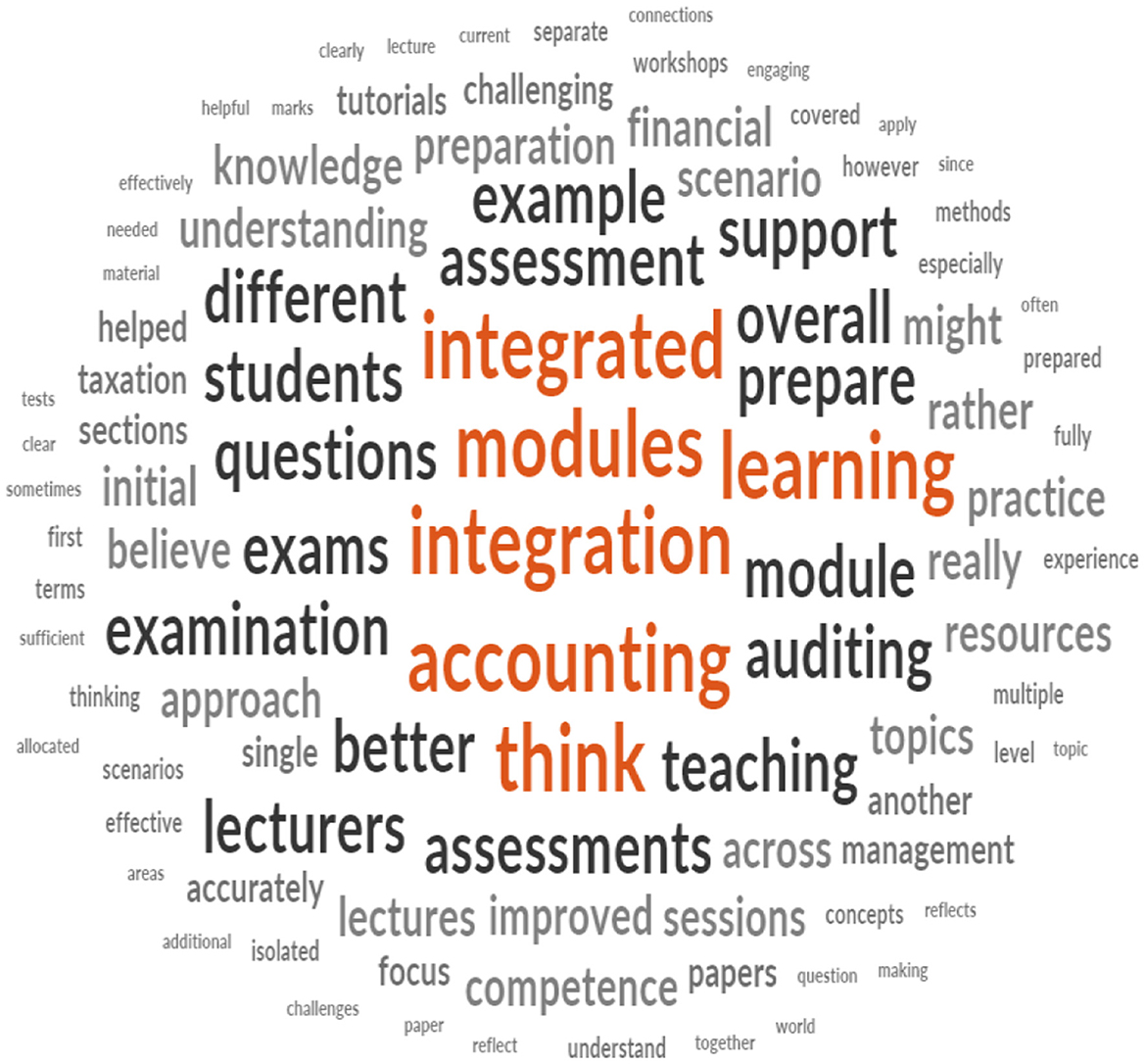
The word cloud in Figure 1 illustrates the frequency and prominence of key terms emerging from participants’ qualitative responses regarding the integration of learning in accounting education. The most frequently occurring words “integrated,” “learning,” “modules,” “accounting,” “integration,” and “teaching” reflect a dominant focus on the pedagogical shift toward integrated learning approaches within accounting curricula. The recurrence of these terms suggests that participants strongly associate their educational experience with the implementation of integrated modules and the perceived coherence among traditionally distinct accounting disciplines such as financial accounting, financial management, auditing, and taxation.
The prominence of words such as “students,” “lecturers,” “teaching,” “support,” and “resources” underscores the pivotal role of teaching practices and lecturer facilitation in promoting meaningful integration. This finding aligns with literature emphasizing the importance of instructional design and educator engagement in fostering deep learning and knowledge transfer across disciplinary boundaries (; ). Furthermore, the frequent appearance of “assessment,” “exams,” “questions,” and “examination” points to a strong concern with evaluation methods, suggesting that students critically reflect on how integrated teaching is mirrored in assessment structures. This resonates with prior studies indicating that assessment alignment is crucial for sustaining the intended learning outcomes of integrated curricula ().
In addition, terms such as “think,” “understanding,” “improved,” “better,” and “competence” reveal a generally positive perception of integrated learning, implying that students view this approach as enhancing conceptual clarity, higher-order thinking, and professional preparedness. However, the inclusion of words like “challenging,” “sometimes,” and “difficult” indicates that some students encountered difficulties in adapting to integrated assessments or managing the cognitive demands of cross disciplinary learning. These mixed sentiments suggest that while integration promotes holistic understanding and competence development, its successful implementation depends on adequate pedagogical support, resource provision, and coherent assessment design.
Overall, the word cloud demonstrates that the discourse surrounding accounting education is increasingly oriented toward integration as a means of improving student learning outcomes, professional competence, and curriculum relevance. The findings support the growing body of evidence advocating for integrated and problem-based learning approaches in professional programmes (; Shulman, 2005), emphasizing the need for institutions to strengthen the alignment between curriculum integration, teaching practice, and assessment strategies.
Discussion
This study explored PGDA students’ first-hand experiences of integration in their accounting curriculum. It focused on students’ perceptions of their initial exposure to the integrated approach, implemented as a curriculum enhancement across Big Four accounting disciplines. The findings indicate that the integration of accounting modules is widely recognized as pedagogically valuable, as it allows learners to connect concepts across contexts rather than learning them in isolation, enhancing their understanding and application of accounting knowledge. There is clear evidence from students perception that when students recognized connections between financial accounting, auditing, taxation, and financial management, they developed a more holistic and professionally realistic understanding of the accounting discipline, engaging meaningfully across disciplinary boundaries. This finding is consistent with constructivist research demonstrating that learning is deepened when students work with authentic, complex problems that resemble professional practice (; ). Such integration also responds directly to calls from professional bodies and accrediting organizations for accounting education to reflect real-world business complexity and to develop cross-cutting competencies (). Empirical studies further confirm that integrated curricula combining technical, reflective, and collaborative learning support the construction of coherent and transferable knowledge frameworks (; Mandilas et al., 2024).
The effectiveness of integration is enhanced when curricula are intentionally designed to support progressive knowledge construction through scaffolding (; ). While the findings of the study noted that integration was introduced later in the programme, this should be viewed as an opportunity for curriculum strengthening rather than a limitation. Earlier and more sustained exposure to integrated learning would allow students to iteratively refine and reorganize their understanding across modules, thereby strengthening interdisciplinary judgement and applied problem-solving skills that are essential in modern accountancy (; Pincus et al., 2017; Sincuba and Solundwana, 2025). Constructivist scholarship consistently shows that when integration is introduced progressively, students are better positioned to develop robust professional schemas (Prince et al., 2020).
Collaboration among lecturers plays a critical enabling role in realizing the social dimension of constructivist learning. Integration is most effective when knowledge is co-constructed through dialogue, shared pedagogical intent, and coordinated learning activities. Students’ perceptions of siloed teaching highlight the importance of strengthening cross-disciplinary collaboration rather than questioning the value of integration itself. Research in accounting education demonstrates that team-based teaching, co-designed assessments, and shared learning outcomes enhance coherence and deepen student learning (Mandilas et al., 2024; Ndovela et al., 2023; Stumke, 2023). Social constructivist theory further supports such collaborative approaches, emphasizing learning as a collective and interactive process (Prince et al., 2020).
Assessment alignment further amplifies the benefits of integration. From a constructive alignment perspective, assessments that require synthesis across domains reinforce the importance of integrated thinking and promote deeper engagement (; ). Authentic, project-based, and reflective assessments support higher-order thinking, professional judgment, and metacognitive skills for connecting accounting concepts (Makrakis, 2023; Mandilas et al., 2024).
Students reported stronger holistic thinking, deeper conceptual understanding, and improved preparedness for the IAC. These outcomes align closely with experiential and constructivist learning cycles, where learners engage, reflect, conceptualize, and apply knowledge in authentic contexts (). Collectively, the evidence suggests that integrated, constructively aligned curricula play a central role in shaping professional competence and identity, ensuring that aspiring Chartered Accountants graduate with the integrated problem-solving capacities increasingly demanded by the profession. The next section presents the conclusion of the study.
Conclusion
The main aim of the study was to examine lived experiences of PGDA students based in integration of financial accounting, financial management, taxation, and auditing. To do this, thematic analysis was done. The thematic analysis results across the 11 interview transcripts reveals that the integration of accounting modules is both pedagogically valuable and operationally challenging. Students understand and appreciate integration as a mechanism for holistic thinking, professional preparation, and deeper conceptual understanding. However, the current implementation exhibits limitations, delayed introduction, uneven assessment weighting, and inconsistent lecturer collaboration, which dilute its potential impact. Overall, integration fosters critical, reflective, and interdisciplinary thinking aligned with the professional competencies expected in the accounting field and adequately prepares students for the IAC examination. Its success, however, depends on sustained institutional commitment, curricular coherence, and pedagogical collaboration to ensure that integration moves beyond a structural reform to become a transformative educational practice.
To ensure maximum leverage of integration it is recommend that interdisciplinary connections introduced early in the curriculum and ensure that all modules contribute meaningfully to the integrated framework, training, resources, and structured collaboration opportunities to deliver integrated content effectively are provided to the lecturers through commitment to resource allocation, curriculum design, and pedagogical innovation to sustain integration efforts, and design assessments that reflect the interconnected nature of accounting disciplines and reward interdisciplinary thinking. This study contributes to the body of knowledge as the first student’s voice on how pedagogical transformation could be developed for preparation of professional examination. The study unearth lived experiences of students about integration, practical recommendations for academics that aligns with International Education Standards (IES)’s professional competency expectations. The study has several limitations. First, the study adopted a qualitative approach based on a relatively small, purposively selected sample of 11 participants from a single university, which limits the generalisability of the findings. Although qualitative research provides rich, in-depth insights into participants’ experiences, the findings are context-specific and may not be transferable to other institutional or cultural settings. The reliance on one university also means that particular institutional practices, curriculum structures, and teaching approaches may have influenced the outcomes. Second, the study focused exclusively on the integration of the Big Four accounting disciplines within a curriculum enhancement design in South Africa. Future research could explore integration across other disciplines, professional programmes, or international contexts to broaden understanding. Third, the study examined students’ perceptions only; the perspectives of lecturers were not included. Incorporating academic staff viewpoints in future studies may provide a more comprehensive understanding of integration practices. Finally, while the study explored students’ lived experiences of integration, it did not examine the relationship between integration and measurable academic performance outcomes. Future research could investigate whether integrated curricula are associated with improved academic achievement. Further, future research could adopt quantitative or mixed-method approaches, involving multiple universities and larger samples, to test the consistency and generalizability of these findings and to provide a more comprehensive understanding of the phenomena.
Statements
Data availability statement
The original contributions presented in the study are included in the article/supplementary material, further inquiries can be directed to the corresponding author.
Ethics statement
The studies involving humans were approved by Human and Social Science Ethics Committee. The studies were conducted in accordance with the local legislation and institutional requirements. The participants gave consent verbally during the interviews.
Funding
The author(s) declared that financial support was not received for this work and/or its publication.
Conflict of interest
The author(s) declared that this work was conducted in the absence of any commercial or financial relationships that could be construed as a potential conflict of interest.
Generative AI statement
The author(s) declared that generative AI was used in the creation of this manuscript. Generative AI was used for English refinement only.
Any alternative text (alt text) provided alongside figures in this article has been generated by Frontiers with the support of artificial intelligence and reasonable efforts have been made to ensure accuracy, including review by the authors wherever possible. If you identify any issues, please contact us.
Publisher’s note
All claims expressed in this article are solely those of the authors and do not necessarily represent those of their affiliated organizations, or those of the publisher, the editors and the reviewers. Any product that may be evaluated in this article, or claim that may be made by its manufacturer, is not guaranteed or endorsed by the publisher.
Supplementary material
The Supplementary Material for this article can be found online at: https://www.frontiersin.org/articles/10.3389/feduc.2026.1731283/full#supplementary-material
References
-
1
AkibE.ImranM. E.MahtariS.MahmudM. R.PrawiyogyA. G.SupriatnaI.et al. (2020). Study on implementation of integrated curriculum in Indonesia. IJORER: Int. J. Recent Educ. Res.1, 39–57. doi: 10.46245/ijorer.v1i1.24
- CrossRef
- Google Scholar
- View reference in article
-
2
AlbrechtW.SackR. (2000). Accounting Education: Charting the Course Through a Perilous Future. Sarasota, FL: American Accounting Association.
- Google Scholar
- View reference in article
-
3
AlmullaM. A. (2023). Constructivism learning theory: a paradigm for students’ critical thinking, creativity, and problem solving to affect academic performance in higher education. Cogent Educ.10:2172929. doi: 10.1080/2331186X.2023.2172929
-
4
AlvessonM. (2003). Methodology for close up studies–struggling with closeness and closure. High. Educ.46, 167–193. doi: 10.1023/A:1024716513774
-
5
AndiolaL. M.MastersE.NormanC. (2020). Integrating technology and data analytic skills into the accounting curriculum: accounting department leaders’ experiences and insights. J. Account. Educ.50:100655. doi: 10.1016/j.jaccedu.2020.100655
- CrossRef
- Google Scholar
- View reference in article
-
6
ArikS.YilmazM. (2020). The effect of constructivist learning approach and active learning on environmental education: a meta-analysis study. Int. Electron. J. Environ. Educ.10, 44–84. Available online at: https://izlik.org/JA43SM32WM (Accessed June 21, 2025).
- Google Scholar
- View reference in article
-
7
BadaS. O.OlusegunS. (2015). Constructivism learning theory: a paradigm for teaching and learning. J. Res. Method Educ.5, 66–70. doi: 10.9790/7388-05616670
-
8
BaracK.Du PlessisL. (2014). Teaching pervasive skills to South African accounting students. South. Afr. Bus. Rev.18, 53–79. doi: 10.25159/1998-8125/5645
- CrossRef
- Google Scholar
- View reference in article
-
9
BiggsJ.TangC. (2011). Train-the-trainers: implementing outcomes-based teaching and learning in Malaysian higher education. Malays. J. Learn. Instr.8, 1–19. doi: 10.32890/mjli.8.2011.7624
- CrossRef
- Google Scholar
- View reference in article
-
10
BilenbergB.BishtA.MiljkovicV.BachhuberF.HellmannC.PeltomaaL.et al. (2025). “Integration of wafer and plate-based NIL for scalable manufacturing of high-quality AR waveguides,” in Optical Architectures for Displays and Sensing in Augmented, Virtual, and Mixed Reality (AR, VR, MR) VI (San Francisco, CA).
- Google Scholar
- View reference in article
-
11
BloxhamS.BoydP. (2007). Developing Effective Assessment in Higher Education: A Practical Guide: A Practical Guide. London: McGraw-Hill Education.
- Google Scholar
- View reference in article
-
12
BraunV.ClarkeV. (2006). Using thematic analysis in psychology. Qual. Res. Psychol.3, 77–101. doi: 10.1191/1478088706qp063oa
- CrossRef
- Google Scholar
- View reference in article
-
13
CampbellS.GreenwoodM.PriorS.ShearerT.WalkemK.YoungS.et al. (2020). Purposive sampling: complex or simple? research case examples. J. Res. Nurs.25, 652–661. doi: 10.1177/1744987120927206
-
14
CoetseeD.StegmannN. (2012). A profile of accounting research in South African accounting journals. Meditari Account. Res.20, 92–112. doi: 10.1108/10222521211277807
-
15
CoetzeeS. A.SchmulianA. (2013). The effect of IFRS adoption on financial reporting pedagogy in South Africa. Issues Account. Educ.28, 243–251. doi: 10.2308/iace-50386
-
16
CrawfordL.HelliarC.MonkE.StevensonL. (2011). SCAM: design of a learning and teaching resource. Account. Forum.35, 61–72. doi: 10.1016/j.accfor.2010.08.008
-
17
DasooN.BornmanM.RhodesR. J. (2020). Impacting accounting education using integrated information and communication technologies. J. Econ. Financ. Sci.13, 1–9. doi: 10.4102/jef.v13i1.540
- CrossRef
- Google Scholar
- View reference in article
-
18
De LangeP.JacklingB.GutA. M. (2006). Accounting graduates’ perceptions of skills emphasis in undergraduate courses: an investigation from two Victorian universities. Account. Finance46, 365–386. doi: 10.1111/j.1467-629X.2006.00173.x
- CrossRef
- Google Scholar
- View reference in article
-
19
du ToitE.MarxB.SmithR. (2024a). “A model to develop integrated thinking skills of prospective professional accountants,” in Advances in Accounting Education: Teaching and Curriculum Innovations (Bingley: Emerald Publishing Limited),161–185.
- Google Scholar
- View reference in article
-
20
du ToitE.MarxB.SmithR. J. (2024b). Barriers to the development of integrated thinking skills of prospective chartered accountants. South Afr. J. Econ. Manag. Sci.27:5325. doi: 10.4102/sajems.v27i1.5325
-
21
EloffA.-M. (2016). The integration of information and information technology in accounting education: effects on student performance. J. Econ. Financ. Sci.9, 409–425. doi: 10.4102/jef.v9i2.49
-
22
FreemanS.EddyS. L.McDonoughM.SmithM. K.OkoroaforN.JordtH.et al. (2014). Active learning increases student performance in science, engineering, and mathematics. Proc. Natl. Acad. Sci. U.S.A.111, 8410–8415. doi: 10.1073/pnas.1319030111
-
23
FuschP. I.NessL. R. (2015). Are we there yet? Data saturation in qualitative research. Qual. Res.20, 1408–1416. doi: 10.46743/2160-3715/2015.2281
- CrossRef
- Google Scholar
- View reference in article
-
24
HarveyA.TreeD. (2025). From silos to synthesis: ensuring interdisciplinary education through synoptic assessment. Biochemist47, 27–34. doi: 10.1042/bio_2025_104
- CrossRef
- Google Scholar
- View reference in article
-
25
JacklingB.De LangeP. (2009). Do accounting graduates’ skills meet the expectations of employers? a matter of convergence or divergence. Account. Educ.18, 369–385. doi: 10.1080/09639280902719341
- CrossRef
- Google Scholar
- View reference in article
-
26
JayasingheK. (2021). Constructing constructivism in management accounting education: reflections from a teaching cycle with innovative learning elements. Qual. Res. Account. Manag.18, 282–309. doi: 10.1108/QRAM-05-2020-0067
- CrossRef
- Google Scholar
- View reference in article
-
27
JohanssonE.KanapathippillaiS.KhanA.DellaportasS. (2023). Formative assessment in accounting: student perceptions and implications of continuous assessment. Account. Educ.32, 597–625. doi: 10.1080/09639284.2022.2091411
- CrossRef
- Google Scholar
- View reference in article
-
28
JoyntC. (2022). How to assess the effectiveness of accounting education interventions: evidence from the assessment of a bridging course before introductory accounting. Meditari Account. Res.30, 237–255. doi: 10.1108/MEDAR-01-2022-1571
- CrossRef
- Google Scholar
- View reference in article
-
29
JoyntC. (2023). Factors that influence first-year students’ academic performance in Introductory Accounting: a systematic literature review and avenues for future research. Int. J. Afr. High. Educ.10, 21–49. doi: 10.6017/ijahe.v10i1.17185
- CrossRef
- Google Scholar
- View reference in article
-
30
KanaparthiV. (2024). Transformational application of artificial intelligence and machine learning in financial technologies and financial services: a bibliometric review. arXiv [Preprint]. arXiv:2401.15710. doi: 10.48550/arXiv.2401.15710
- CrossRef
- Google Scholar
- View reference in article
-
31
KavanaghM. H.DrennanL. (2008). What skills and attributes does an accounting graduate need? Evidence from student perceptions and employer expectations. Account. Finance48, 279–300. doi: 10.1111/j.1467-629X.2007.00245.x
- CrossRef
- Google Scholar
- View reference in article
-
32
KirschnerP. A.SwellerJ.KirschnerF.Zambrano RJ. (2018). From cognitive load theory to collaborative cognitive load theory. Int. J. Comput. Collab. Learn.13, 213–233. doi: 10.1007/s11412-018-9277-y
-
33
KreijkesP.GreatorexJ. (2024). Differential effects of subject-based and integrated curriculum approaches on students’ learning outcomes: a review of reviews. Rev. Educ.12:e3465. doi: 10.1002/rev3.3465
- CrossRef
- Google Scholar
- View reference in article
-
34
Larios SoldevillaO. A.Mendoza IbarraV.Moscoso CuaresmaJ. R.Urdanegui SibinaR.StoneD.Huamani CerrónA.et al. (2025). Transforming accounting education: integrating technological, soft and research skills in education. Cogent Educ.12:2478304. doi: 10.1080/2331186X.2025.2478304
-
35
LeedyP. D.OrmrodJ. E. (2001). Practical Research and Design. Upper Saddle River, NJ: Merryll Prentice Hall.
-
36
MacredieR. D.ShepperdM.TurchiT.YoungT. (2022). Exploring student engagement and outcomes: experiences from three cycles of an undergraduate module. arXiv [Preprint]. arXiv:2212.11682. doi: 10.48550/arXiv.2212.11682
- CrossRef
- Google Scholar
- View reference in article
-
37
MakrakisV. (2023). Using the DREAM methodology for course assessment in the field of ICT-enabled education for sustainability. Eur. J. Investig. Health Psychol. Educ.13, 1378–1391. doi: 10.3390/ejihpe13070100
-
38
MakrakisV.Kostoulas-MakrakisN. (2023). A participatory curriculum approach to ICT-enabled education for sustainability in Higher Education. Sustainability15:3967. doi: 10.3390/su15053967
-
39
MalanM.ElsG.KarstenI. (2025). Developing self-regulated learning in accounting students: a guide for educators. J. Manag. Bus. Educ.8, 37–57. doi: 10.35564/jmbe.2025.0003
-
40
MandilasA.KourtidisD.PanagiotidouE. (2024). “Curriculum for Accounting Education in Higher Education Institutions. An exploratory study of professors’ perceptions,” in Ethics and Sustainability in Accounting and Finance, Volume IV, (Berlin: Springer), 71–82.
-
41
MarounW. (2017). Assuring the integrated report: insights and recommendations from auditors and preparers. Br. Account. Rev.49, 329–346. doi: 10.1016/j.bar.2017.03.003
-
42
MarriottP.MarriottN. (2003). Are we turning them on? A longitudinal study of undergraduate accounting students’ attitudes towards accounting as a profession. Account. Educ.12, 113–133. doi: 10.1080/0963928032000091738
-
43
MatinhoD.PietrandreaM.EcheverriaC.HeldermanR.MastersM.ReganD.et al. (2022). A systematic review of integrated learning definitions, frameworks, and practices in recent health professions education literature. Educ. Sci.12:165. doi: 10.3390/educsci12030165
-
44
McLeodS. (2024). Metasynthesis of qualitative research. Simply Psychology. Available online at: https://www.simplypsychology.org (Accessed August 17, 2025).
-
45
McLureF. I.TangK.-S.WilliamsP. J. (2022). What do integrated STEM projects look like in middle school and high school classrooms? A systematic literature review of empirical studies of iSTEM projects. Int. J. STEM Educ.9:73. doi: 10.1186/s40594-022-00390-8
-
46
MitchellV. L. (2006). Knowledge integration and information technology project performance. MIS Q. 919–939. doi: 10.2307/25148759
-
47
MokhampanyaneM. (2023). “Mechanisms for improving academic performance of first-year accounting students: a phenomenological perspective,” in ICERI2023 Proceedings (Seville).
-
48
MpanzaS. S. (2025). Reshaping Accounting Education Curricula Through Artificial Intelligence and Data Analytics: a South African context. Int. J. Appl. Res. Bus. Manag.6. doi: 10.51137/wrp.ijarbm.2025.smrt.45904
-
49
MsafiriM. M.KangwaD.CaiL. (2023). A systematic literature review of ICT integration in secondary education: what works, what does not, and what next?Discov. Educ.2:44. doi: 10.1007/s44217-023-00070-x
-
50
MsomiT. S.AgyemangJ. K. (2022). Investigating the impact of financial resources, academic workload, and data accessibility on scholarly productivity: a case study of accounting lecturers in South African Universities of Technology. Afr. J. Inter/Multidiscip. Stud.7, 1–14. Available online at: https://ojs.sabinet.co.za/index.php/ajims/article/view/3785 (Accessed January 13, 2026).
-
51
MurthyU. S.RaglandL. (2009). Towards an understanding of accounting information systems as a discipline: a comparative analysis of topical coverage in AIS and MIS courses. AIS Educ. J.4, 1–15. doi: 10.3194/aise.2009.4.1.1
-
52
NdovelaS. G.HlongwaneN. F.NgwenyaJ. C. (2023). Collaborative teaching strategies used to enhance learning of accounting concepts. Int. J. Res. Bus. Soc. Sci.12, 467–475. doi: 10.20525/ijrbs.v12i8.2969
-
53
NgwenyaJ. C. (2016). Rural as potential, not pathology: a case of rural Accounting teachers’ practices in South Africa. J. Hum. Ecol.53, 39–48. doi: 10.1080/09709274.2016.11906954
-
54
O’FlahertyJ.PhillipsC. (2015). The use of flipped classrooms in higher education: a scoping review. Internet High. Educ.25, 85–95. doi: 10.1016/j.iheduc.2015.02.002
-
55
PhesaM.LemmaT. T.MatemaneR. (2025). Readability of professional accounting examinations – evidence from South Africa. Account. Educ. 1–24. doi: 10.1080/09639284.2025.2480550
-
56
PhesaM.SibandaM.GumedeZ. (2024). Assuring the chairperson’s statement in the integrated report: an auditing framework to curb the use of impression management in corporate reporting. Int. J. Res. Bus. Soc. Sci.13, 663–683. doi: 10.20525/ijrbs.v13i5.3041
-
57
PincusK. V.StoutD. E.SorensenJ. E.StocksK. D.LawsonR. A. (2017). Forces for change in higher education and implications for the accounting academy. J. Account. Educ.40, 1–18. doi: 10.1016/j.jaccedu.2017.06.001
-
58
PrinceM.FelderR.BrentR. (2020). Active student engagement in online STEM classes: approaches and recommendations. Adv. Eng. Educ.8, 1–25.
-
59
RebeleJ. E.PierreE. K. S. (2015). Stagnation in accounting education research. J. Account. Educ.33, 128–137. doi: 10.1016/j.jaccedu.2015.04.003
-
60
RejaU.ManfredaK. L.HlebecV.VehovarV. (2003). Open-ended vs. close-ended questions in web questionnaires. Dev. Appl. Stat.19, 159–177.
-
61
Retief VenterE.de VilliersC. (2013). The accounting profession’s influence on academe: South African evidence. Account. Audit. Account. J.26, 1246–1278. doi: 10.1108/AAAJ-06-2012-01027
-
62
ShulmanL. S. (2005). Signature pedagogies in the professions. Daedalus134, 52–59. doi: 10.1162/0011526054622015
-
63
SincubaL.SolundwanaO. (2025). Strategies to support accounting matriculants’ journey toward successful tertiary education and professional careers. TWIST20, 184–192. Available online at: https://twistjournal.net/twist/article/view/791 (Accessed May 9, 2025).
-
64
SitholeB. M.PereiraL. (2019). Towards constructivist learning and teaching in accounting education. J. Emerg. Trends Educ. Res. Policy Stud.10, 1–9. Available online at: https://hdl.handle.net/10520/EJC-149b24258d
-
65
South African Institute of Chartered Accountants (SAICA) (2023a). South African Chartered Accountants Lead in Global Trustworthiness. Available online at: https://www.saica.org.za/news/south-african-chartered-accountants-lead-in-global-trustworthiness (Accessed December 17, 2025).
-
66
SteenkampL.BaardR.FrickB. (2012). A holistic investigation into a tutor programme in first-year Financial Accounting. Meditari Account. Res.20, 68–87. doi: 10.1108/10222521211234237
-
67
StumkeO. (2023). Information communication technology integration via Bloom’s taxonomy in accountancy curriculum. Transform. High. Educ.8:283. doi: 10.4102/the.v8i0.283
-
68
SuputraI. N.BasukiA.GunawanA.Baghiz SyafruddinA. (2024). Does work-integrated curriculum transformation affect learning experience, student competencies, and learning interactions? the role of teaching strategy moderation. Cogent Educ.11:2375676. doi: 10.1080/2331186X.2024.2375676
-
69
Van der MerweM. (2013). Perceived levels of teacher efficacy and locus of control at secondary schools in Lejweleputswa school district (dissertation/master’s thesis). Welkom: Central University of Technology.
-
70
YangL.LiuY.CaoQ. (2024). Toward interdisciplinary integration of architecture and climatology. Innov. Energy1:100054. doi: 10.59717/j.xinn-energy.2024.100054
Keywords
constructive learning theory, Initial Assessment of Competence, integration, pedagogical transformation, Postgraduate Diploma in Accounting
Citation
Phesa M (2026) Integration of core accounting disciplines within the postgraduate accounting curriculum: evidence from South Africa. Front. Educ. 11:1731283. doi: 10.3389/feduc.2026.1731283
Received
24 November 2025
Revised
21 February 2026
Accepted
23 February 2026
Published
10 March 2026
Volume
11 – 2026
Edited by
Vassilios Makrakis, University of Crete, Greece
Reviewed by
Naod Mekonnen, Wollo University, Ethiopia
Nurulhuda Abd Rahman, Universiti Teknologi MARA Cawangan Selangor, Malaysia
Updates
Copyright
© 2026 Phesa.
This is an open-access article distributed under the terms of the Creative Commons Attribution License (CC BY). The use, distribution or reproduction in other forums is permitted, provided the original author(s) and the copyright owner(s) are credited and that the original publication in this journal is cited, in accordance with accepted academic practice. No use, distribution or reproduction is permitted which does not comply with these terms.
Disclaimer
All claims expressed in this article are solely those of the authors and do not necessarily represent those of their affiliated organizations, or those of the publisher, the editors and the reviewers. Any product that may be evaluated in this article or claim that may be made by its manufacturer is not guaranteed or endorsed by the publisher.
