

Employers in the UAE will measure anything except the one thing that decides whether their people can actually do the job. A panel at the Future Workforce Summit finally said so out loud
Walk into any boardroom in Dubai and ask for the numbers.You will get utilisation, engagement, attrition, time-to-hire, and cost per head. Ask how many of those heads are physically well enough to perform, and the room goes quiet. It is not that the answer is unknown. It is that nobody has thought to ask.
Here is the answer anyway. One in three adults in this country — some 2.5 million people — lives with obesity. It is not a lifestyle footnote; it is a chronic condition that sits upstream of diabetes, heart disease, joint pain and mental strain, and downstream of all four is an employee who is at the desk but not at their best. Whiteshield, in a national study commissioned by Eli Lilly, has done the arithmetic the corporate sector has avoided: bring obesity down from a third of adults to 18% by 2031 and the UAE gains $51 billion in GDP, $1.5 billion in healthcare savings, and between two and five productive working days a year for every person who gets well. Per person, that is 6.8 more years of healthy life. Per employer, it is the largest productivity lever nobody is pulling.
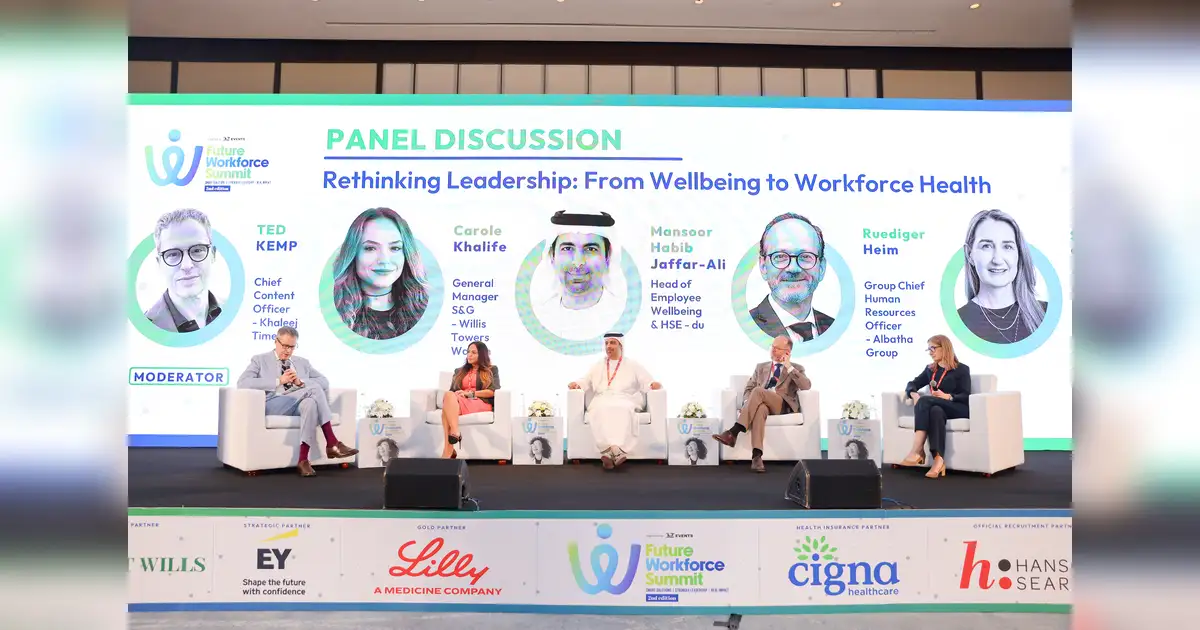
On Thursday, four people who ought to know sat on one stage at the Future Workforce Summit and, from four very different seats, arrived at the same conclusion.
Dr Mansoor Habib Jaffar-Ali, who runs employee wellbeing at du, opened with the frame the rest would work inside: wellbeing is a must-have, not an add-on, and as artificial intelligence moves work from the physical to the mental, protecting people is the new personal protective equipment. He did not argue it in the abstract. He told the story of an employee paralysed by a stroke, brought back after seven months on reduced hours with a rewritten job description, and still with the company 14 years on. That is not charity. That is an asset recovered.
Ruediger Heim, Group CHRO of Albatha, gave the cost its proper name. Presenteeism — people who are, in his words, present physically but mentally not there — is the line item no dashboard carries, and yet it can be read in the early-warning signals every HR team already collects: absenteeism, engagement, turnover, grievances, accidents. This, he said flatly, is no longer a soft HR topic. Albatha is now exploring obesity-care coverage with Willis Towers Watson. A family conglomerate moving first tells you the arithmetic has changed.
You already pay for obesity. The only question is whether you pay at the back end, in claims and lost days, or at the front end, in care that gives you the worker back.
Carole Khalife sees the same thing from the insurer’s side of the table: chronic conditions, obesity chief among them, driving the claims pattern year after year. Her advice was practical and a little pointed — treat your people as a long-term <a href="https://bitcomme.com/zacks-investment-ideas-feature-highlights-apple-taiwan-and-alphabets/” title=”Zacks Investment Ideas feature highlights: Apple, Taiwan and Alphabet's”>investment and fund their health accordingly, but do the needs assessment through a broker or insurer, because employees will not tell their employer the private truth about their bodies. She is right, and it explains why so many in-house wellness surveys return nothing useful.
It fell to Sandi Coleman, Eli Lilly’s Associate Vice-President, Human Resources, Gulf, to close the financial loop. Health costs across the Middle East and Africa are rising by around 11%, she said, citing [source], with obesity, diabetes and cardiovascular disease among the main drivers — and the bill does not stop at premiums. It arrives as sick days, lost productivity and disengagement. Her point was a practical one: stop asking for more budget. Audit the benefits you offer simply because you always have. Then take what you are already spending back to your insurer and ask what else it could buy. Lilly has done exactly that for its own employees and their dependants, working with its insurer and providers to bring obesity care into the plan through direct billing.
Government sets policy. Insurers price risk. But the only institution that sees a human being eight hours a day, five days a week, is the employer — and the decision to treat obesity as what it is, a chronic disease deserving covered, clinically governed, stigma-free care, is not made in a ministry. It is made in a benefits renewal meeting, usually in about forty minutes, usually by rolling over last year.
Every large employer in the UAE already pays for obesity. The only question is whether it pays at the back end, in claims and absence and early exits, or at the front end, in care that returns a healthier, more present worker. Whiteshield has shown the return. Lilly has shown the mechanism. Albatha has shown the willingness. What remains is for the rest of the room to stop measuring everything except the thing that matters.
