

Event transcript
Uncorrected transcript: Check against delivery
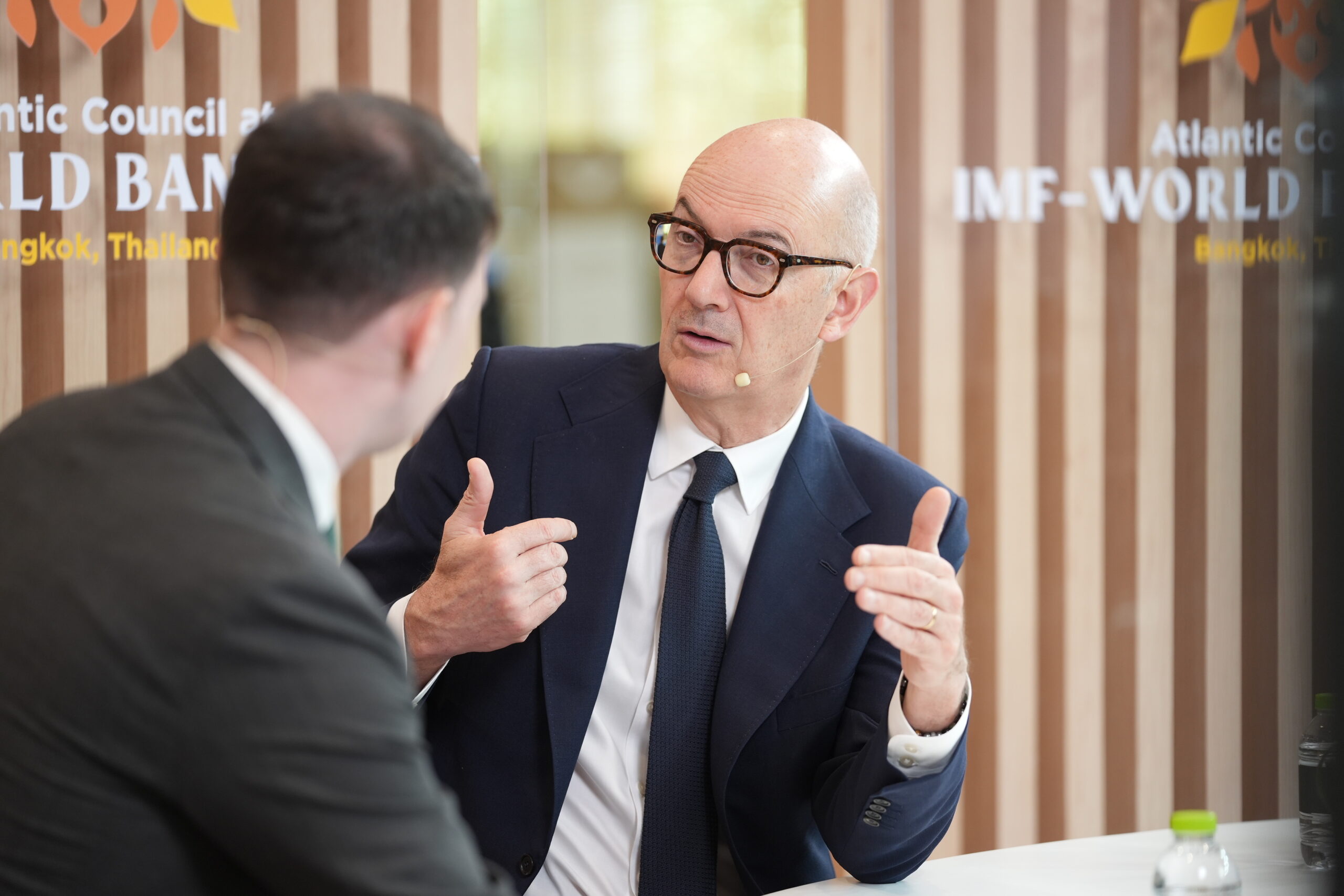
CHARLES LICHFIELD: Welcome back to day five at the Atlantic Council’s presence at the IMF-World Bank meetings in Bangkok. I’m Charles Lichfield.
This interview I’ve been very much looking forward to. Very grateful to the minister of economy and finance of France, Roland Lescure, for coming to see us. Busy schedule for you.
There are many things we want to discuss. You have—you’re coming to the end of a successful G7 presidency. There’s a lot of things going on in EU policy. But I thought we’d start with France’s domestic situation.
There’s been some positive news from the WEO, a little uptick, uptick in growth projections for most of the eurozone. France, a little bit less optimistic. So maybe you can give us a snapshot of the economic situation, especially on growth, and then we’ll go to fiscal. Over to you.
MINISTER ROLAND LESCURE: I will. Thank you. Thanks for your invitation. And well done to the Atlantic Council for being here, because a lot of—a lot is happening here, and it’s good to be here.
Well, we’ve had hits this year. And some of them have hit everyone alike, like the Strait of Hormuz, but we had two specific domestic shocks.
One was political uncertainty. And we spent the first six weeks of this year not having a budget, and that rose uncertainty for investors. That’s why I keep on telling parliamentarians that this year is different. We need a budget by the end of the year.
We also had dramatic heatwaves. And it happened before, but, like, we had one every three or four years. This time we had four in one year. And this affected farming. This affected some industrial sectors as well that had to kind of shut down their factories for a few days and weeks.
So we’ve had growth under what we had planned. We were expecting 1 percent. We’re getting .5 (percent).
I want just to recall that over the last three years France’s growth has been twice the one in Germany. Over the last ten years, we’ve grown twice faster than Germany and faster than Italy or the UK. So, yes, we’re having a bit of an air pocket this year, but on the whole France has been pretty resilient.
LICHFIELD: OK. But in terms of air pockets, I mean, there’s been a lot of coverage of a global bond market rout. It hasn’t just affected France, but I think the headlines have targeted France because the spread with Germany has gone on—up particularly.
LESCURE: Yeah.
LICHFIELD: Maybe you could tell us a little bit about the weeks ahead. You’re currently trying to pass your budget. You said that you’ve told parliamentarians that they have to pass a budget this year, you can’t afford to spill over into the next year. But I think English-language audiences have some difficulty understanding the sequence of this.
LESCURE: Yeah.
LICHFIELD: You’re currently in commission. The commission –
LESCURE: It’s actually started. They’re in session. Yeah.
LICHFIELD: Oh, sorry, in committee.
LESCURE: Yeah. Yeah.
LICHFIELD: And a lot of your measures have been rejected, which may be quite worrisome to people who are following it. But then you move on to the general session. So if you could tell us a little bit about the sequence.
LESCURE: So the general session has just started. So what people have to understand is that we tabled a budget two weeks ago which is quite an ambitious budget—you know, 5 percent deficit, 2.1 (percent)—sorry—primary deficit after ’28. So major expenditure cuts, pension freeze, public salary freeze. And this is the starting point.
But we have a constitutional rule by which after 70 days if we don’t like the way the debate has been going, we can just revert back to the original budget and say: This is it. No vote. We’re going to apply this. So this original budget is like a guardrail on the highway of budgetary discussions.
They can go all over the place, and usually in committee they do. Session has just started. Then we got to go to the Senate, go back to Parliament. If we find a way of having a compromise with political forces that keeps the budget deficit under 5 percent, we can use another guardrail that’s called the 49.3 article of the constitution that allows us to say: This is the budget. A bit of compromise on these and these measures. Take it or leave it. If you don’t like it, make us fall. So we have these two guardrails that are preventing any slide.
LICHFIELD: But given the guardrails—given the guardrails, why do you think that the French budget has been a concern? I mean, the English-language coverage has said that the parliament may undo the budget and there may be a problem going into next year. So there are these –
LICHFIELD: There are these guidelines, and yet it seems people are still concerned. Why do you think that is?
LESCURE: Yeah, and thank you for giving me the opportunity to explain them, because it’s not very clear. These are constitutional articles, some of which—actually, the executive order, the ordinances—have never been used before. So we have to explain that these guardrails are there, that five means five, and that we’re not going to go above it. And then –
LICHFIELD: When you say—you said that there’s a big effort on the primary side, and yet you’re still at five (percent). So how do you explain that?
LESCURE: Yeah, 2.9 (percent) is—2.9 (percent) is a—
LICHFIELD: There’s a big—there’s a big effort on the structural deficit, and yet the deficit’s still going to be quite high.
LESCURE: Because rates are where they are. You know, we used to borrow at zero percent. We now borrow between 4, 5 (percent), and 5 (percent) on the 10 years. Obviously, this is putting pressure. And to be fair, the bond market is doing its job to put pressure on French politicians to behave.
LICHFIELD: Do you think they’re listening?
LESCURE: I think they do, yeah. I mean, I’ve had a few potential finance ministers in my office over the last few weeks from all different parties.
LICHFIELD: So people who might take over next year.
LESCURE: Yeah. They like the office. You know, they look at it and take the measuring tape to see where they’re going to put their art. But I’m telling them, you’re going to inherit the office. You’re also going to inherit one of two things: either a budget which I would have done the heavy lifting for which will put you on the right tracks, or a mess. What do you choose? And guess what? They’d rather inherit a budget.
So at the end of the day, this is political life. There’s going to be political debates, some of which will probably lead to improvements in the budget, some of which will just bring us in places we don’t want to be. Those guardrails are going to help us. And at the end of the day, because of those guardrails but also because of the presidential election coming, we’re going to be OK and we’re going to have this budget. And I think it’s going to be 5 (percent) or less.
LICHFIELD: All right. One particular measure that I’m curious about personally, which is on pensions, which is 25 percent of your public spending. There does seem to be a consensus shaping in France about the need for pensioners to make more of an effort. Obviously, this has been completely dismantled at the committee stage. But could you tell us a little bit about what effort you think would be fair to ask from pensioners?
LESCURE: Well, 80 percent of the expenditures rise in public spending over the last decades have been health and pensions. The demographic is what it is. We’ve got more retirees and less people working. So, obviously, the balance of the pay-as-you-go system has been disbalanced. So we need to rebalance it.
The main way of doing it is to do pension reform. We voted one. We suspended it for one year, but next year it’s still going on unless someone who’s just been elected finds better.
LICHFIELD: But pension reform is about the age, and about –
LESCURE: Exactly. And that’s about making active people work more.
LICHFIELD: Yes.
LESCURE: But it’s only fair that, as you said, 25 percent of the population also contributes to the effort. So the way we’re doing it is by, basically, not indexing pension on inflation. So we’re not going to cut pensions. Other countries had to do it. You know, Greece had to do it. Portugal had to do it. We’re not going to do that. We’re just going to say, inflation is about 2 percent; well, this time around no rise in pension except for very small ones.
What does this mean? That means 5.4 billion expenditure saves, which is about 10 percent of the—of the overall effort. So to ask 25 percent of the population to do 10 percent of the effort is only fair. And that’s why I feel that this measure, which is also important symbolically for the markets because they know pension is an issue, is an important measure on which I’m going to stick.
LICHFIELD: OK. Thanks for explaining that.
One last question on the domestic situation. We’ll move on to the G7 shortly. But you’ve been in London recently talking to bond investors. And every time you’ve been asked in French media about this, you’ve said: Every auction has gone well. People have bought French debt. So—and you’ve also explained to us why in the next few weeks there isn’t that much uncertainty; there are guardrails. So by default you have to assume that the uncertainty comes from the election itself.
You’re one of the few French politicians who isn’t running next year, so it gives you a slightly more neutral voice. But my impression is not that the bond market situation has filtered through into candidates’ proposals. Is there anything that can be done to make them slightly a bit more realistic in their campaign? Because this is—my perception is that is what’s costing you in the bond markets more than the budgetary process.
LESCURE: No, it’s probably beginning to play. I think people are protecting themselves. It’s too early to say really what the race is going to be about because we don’t have all the candidates. We now have the extreme left, the extreme right, center left. And we still need to sort out the center right, which is where I’m at.
The sea change in Marine Le Pen’s at least words has been quite dramatic. You know, two weeks ago she said we need fiscal consolidation. Well, I can tell you one thing: When a populist candidate starts talking about fiscal consolidation, it probably means that it’s becoming beginning to be popular, that people get it, that it’s important to send that message. So I would tend to say that, no, everyone gets it now.
LICHFIELD: On the far left?
LESCURE: They have to be credible.
Far left, never going to get it.
LICHFIELD: I see.
LESCURE: Tax and spend is the only way out. They’re not going to be elected, even though they think they are. One of them was in my office taking the measurings. But on the whole today we have about 80 percent of potential voters that are for fiscal consolidation.
I mean, we need to—they need to convince markets and voters that they mean business, and that’s when we hit the fan. I mean, I don’t think National Front’s proposals are very credible now. They’re going to have to learn the hard way if they get elected. I’m convinced that they won’t, or at least there are lots of scenarios in which they don’t.
LICHFIELD: In which they don’t win.
LESCURE: Yeah, in which they don’t win. I mean, the pictures today of polls are very imperfect. We know that the race is never going to start really before January kicks in. And by then we’ll have four main candidates—center to center right, center left, extreme left, extreme right—and the real race will begin.
And French people are not silly. They understand that pressure, and they’re going to look at the programs and say: Who’s actually going to reassure me on the fact that we are on the right path?
LICHFIELD: So thank you for engaging candidly with the questions on the domestic situation.
LESCURE: Thank you.
LICHFIELD: I do want to talk about France’s successful G7 presidency, which you hosted in Evian. But you’re still the president, so you still do have the presidency, so there are still some policy decisions we’ll come to that you’re impacting. But first of all, on the focus in Evian, the global imbalances agenda, I think some success in that China at least did dial into a video call and engage a little bit. We’re starting to see a negotiation between the EU and China where China have offered some concessions, obviously because there was the threat of EU retaliation. But maybe if you could just tell us the general philosophy in this approach on global imbalances; and whether in the U.S. and with the U.S. administration, which we engage with all the time, you’ve had some sort of echoes, whether they’ve engaged constructively.
LESCURE: Well, those conversations took place. To be fair, when I took over G7 finance ministerial presidency nearly a year ago, I was worried that this was going to be the last G7, 51 years after creating it. It’s happened. We’ve made some progress. We’ve made some progress on very specific issues like the financing of Ukraine, including the repairing of Chernobyl. Yesterday, we announced 2.5 billion on helping the poorest country to get fertilizers to make sure they can grow their crops.
But also the conversation on global imbalances. As you said, China has been in the room virtually. We’ve had discussions with Brazil, with India, with Mexico, and others. So I think that the realization that we are all in it together—that we may have different political agendas, or that we may have different domestic agendas, but that at the end of the day these big global imbalances, they’re not sustainable, and that we need to fix them, we need to sort them out, and even if at the margin if we’re doing it by cooperating we’re going to do better than if we close ourselves.
And again, you alluded to it, the negotiations between the EU and China last week, the talks we’re having with them on different issues. I’m going to go to Beijing between now and Christmas to have the economic dialogue with my Chinese counterpart. Very excited about it.
The global economy is a common good. And our common ability to show our citizens that we better work together to make it on a better path is also a way of defeating populists, of telling them that retrenchment is not the way forward. I jumped into politics 10 years ago—I had a completely different life before—exactly for these reasons, and I’m going to push that agenda until I leave politics.
LICHFIELD: Very good.
So you mentioned at the beginning of your answer on the G7 that you took over the presidency fearing it might be the last G7. Sounds a bit concerning, perhaps alluding to some of the policies the U.S. was taking which put itself apart, a bit of an outlier with other G7 countries. So, I mean, up until the end of your presidency we’ve seen this, in that on the one hand, the positive hand, you’ve had this agreement on releasing strategic reserves of oil, very good; on the other hand you have the U.S. engaging with Russia on a diesel deal, which I believe the EU disapproves of. So hasn’t that been still a problem throughout your presidency?
LESCURE: Well, three weeks ago the talk of the town was diesel ban from the U.S. We’re not having this. And Donald Trump—I was at the G7 presidency summit just beside my president when we had this VTC—was very clear about it: No diesel ban. Obviously, other things have happened since then. I don’t know the impact it’s going to have on the market.
What I can tell you is that the release of our strategic reserves in diesel is going to help gasoline prices at the pump for French consumers. The alternative, diesel ban, would have been hard for them. So we are showing, and hopefully we’re showing French consumers and French citizens, that we can take decisions at the global level that sometimes seems very far away from the day-to-day issues that is impacting their day-to-day life. And this is, again, the best way of showing people that multilateralism works.
You know, yes, it’s a difficult world. Yes, it’s a complex world. Yes, it’s certainly an unpredictable world, and some decisions sometimes surprise us. But at the end of the day, if we keep on engaging, including in places like this—we’ve been talking to the Americans. We’ve been having talk with the Chinese. We’re meeting with the Thailandese, and thanks for hosting us here.
This was created 35 years ago, this place, to host the annual meeting of the IMF and the World Bank. It’s still here 35 years later. It’s happening here. We’re having this talk. So I’m a, you know, essential optimist. But I’m also very determined to make sure that that optimism filters through reality, and I’m hoping to contribute to that.
LICHFIELD: Thank you.
Final question from me. France has driven some initiatives at the EU level on made in Europe, on trying to address some excessive openness of European policy, and it seems that you are winning these debates within the EU. Good news for France. But then this—your visit here is an opportunity for you to talk to the Global South. It’s one of the main virtues of these meetings: You might meet some of your counterparts you see a bit more rarely. Are they concerned about European protectionism? Is that a question you’re getting?
LESCURE: Yeah, they ask questions. And I reassure them, I hope, on the fact that it’s not about protectionism; it’s about having a fair, level playing field.
You know, there’s a made in America, and it’s been around for 20 years. The British are talking about made in the UK. China is, obviously, making things in the UK.
LICHFIELD: In China.
LESCURE: And any other countries—yeah, made in China, sorry. And any emerging country I meet here, they admit that they also have some kind of made locally provisions in their public tenders. It’s not about closing the markets. We welcome everyone. But Europe has probably been the most open zone for a long time. And we need to stay open. We need to reassure our citizens that open doesn’t mean killing the industry, because at the end of the day, again, if we don’t do that—if we don’t reassure them—we’re going to have solutions that go way over the back—you know, the back—the dark side of that equation and start having heavy protectionist measures.
So it’s about a fine line. It’s about fair level. It’s about having frank conversations—and again, in this place we can have them—to reassure everyone on the fact that multilateralism still works.
The rules have changed since the world is flat—early ’90s, early 2000s: We’re all in it together; everything is going to be fine. Everything’s not fine. There’s tensions. There’s inequalities. There’s the environment. We need to take all this onboard to make sure that we’re still open with each other without maybe being so naïve that we were before.
LICHFIELD: Well, thank you very much for your time.
LESCURE: Well, thank you.
LICHFIELD: I know this is a very, very busy set of meetings for you. So we wish you good luck in the days and weeks ahead. Thank you very much for coming to see us at the Atlantic Council.
LESCURE: No, thanks for inviting me.
LICHFIELD: And thanks to everyone for tuning in. This has been the last live event from me. It’s been great to be here in Bangkok. See some of you back in D.C. Thank you.
LESCURE: Take care.
