

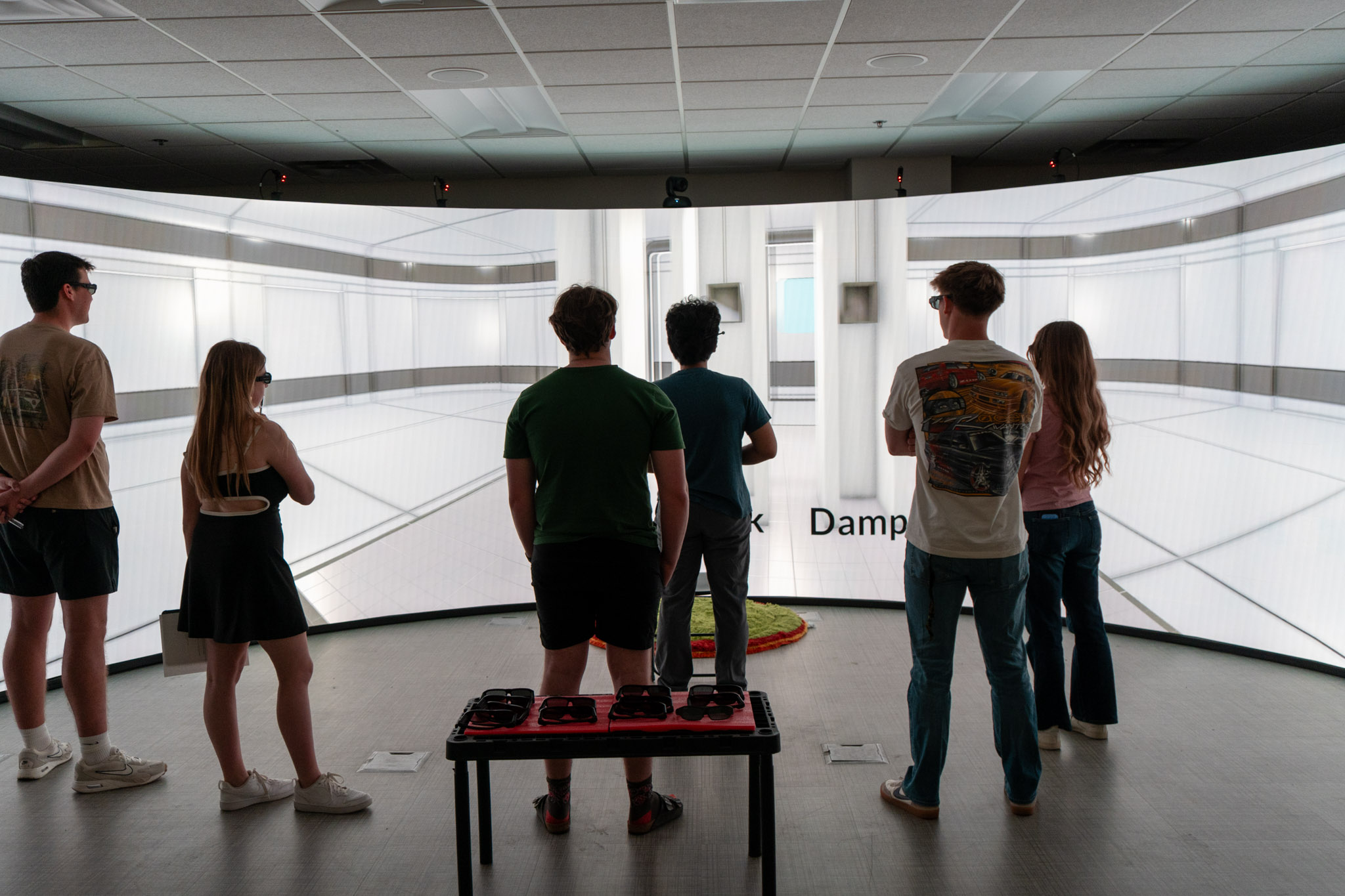
A purple virtual car rolled down a slope across a 36-foot curved screen as University of St. Thomas College of Engineering students watched through 3D glasses at the college’s new data visualization studio. The simulation brought to life an inertia car experiment the students had completed earlier in the semester for Professor Michael Hennessey’s 300-level dynamics course. Another simulation demonstrated how different cable materials affect elevator motion.
Utsav Manandhar, spatial computer developer, guided the students inside the 3D studio through the simulations developed for Hennessey’s course.
Watch Utsav Manandhar walk a class through several simulations designed for a 300-level dynamics course in the College of Engineering.
“The data visualization studio allows us to have an immersive experience for our students and researchers as they’re trying to understand three-dimensional data and discover insights they might not be able to see on a two-dimensional screen,” said Kundan Nepal, an electrical and computer engineering professor in the College of Engineering.
The space, funded through a $1 million grant from the U.S. Army Research Lab, features motion-tracking sensors, stereoscopic 3D technology that allows users to interact with virtual models and simulations, as well as the 36-foot semicircular LED display. The grant strengthens the research infrastructure at St. Thomas and allows faculty to support partnerships with industry and government collaborators.

“One advantage we have is that up to 28 people can experience the immersive 3D environment at the same time, which makes it ideal for presentations and classes,” said Manandhar, who collaborated with Hennessey and student designers to develop experiences for the space.
Unlike traditional virtual reality systems that often isolate users inside individual headsets, the visualization wall allows an entire class to share the same immersive experience simultaneously. Plus, the glasses allow the user to maintain their peripheral vision to avoid bumping into another user as opposed to a set of goggles that completely blocks a user’s field of vision.
“Everybody sees the same thing, but they can also see each other,” Hennessey said. “It’s more like virtual reality for everybody.”
Hennessey, who joined St. Thomas in 2000 and specializes in simulating and visualizing dynamic systems, can attest to how far technology has come to enhance the teaching experience.
“In the old days, it was making animations on a 2D screen,” Hennessey said. “Recent advances in visualization technology … make it possible to bring content into a VR scenario, and people can be immersed in virtual reality looking at content that you created.”
Technological advances will continue to play a larger role in engineering education at St. Thomas as immersive tools become more common in engineering industries, Hennessey said.
He added: “Our students will be prepared.”
