

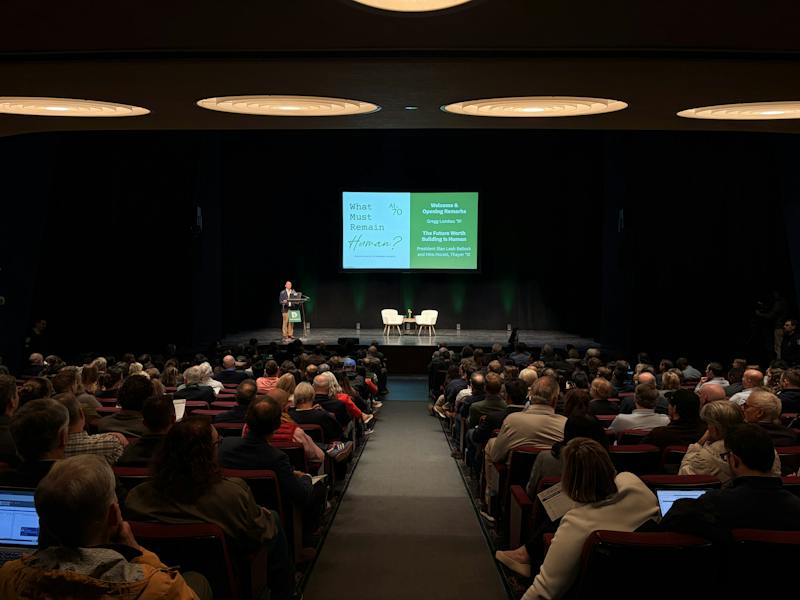
The two-day conference, which celebrated the 70th anniversary since the term “artificial intelligence” was coined at Dartmouth, featured 36 events with professors, researchers, technology executives and more.
On Oct. 29 and Oct. 30, Dartmouth hosted “AI at 70: What Must Remain Human?,” a conference commemorating the 70th anniversary of the 1956 Dartmouth Summer Research Project on Artificial Intelligence, for which the term “artificial intelligence” was coined. This year’s conference brought technology executives, policymakers, researchers, artists and community members to Hanover to examine artificial intelligence’s growing influence on society and the role of human judgment in its development.
Over 1,000 people registered for the two-day conference, which featured 36 scheduled events across campus. Livestreams of select conference sessions were collectively viewed over 23,000 times as of Nov. 2, according to College spokesperson Amy Olson. Programming explored AI’s implications for creative expression, higher education, medicine, national security, public policy and the future of work through public panels, question and answer sessions and short talks. The conference concluded with an Anthropic-sponsored student hackathon on Oct. 31.
The College officially announced the conference, organized by the Faculty Leadership Group on Artificial Intelligence, on Aug. 25. Established in fall 2025, the group was tasked by the Office of the Provost with developing a strategy for AI to “meaningfully accelerate Dartmouth’s mission” and identify where “deliberate restraint” was necessary to protect the College’s values and educational practices.
The group’s formation followed efforts by Beilock and other senior College leaders to position Dartmouth as a leader in AI research and education. In December 2025, Dartmouth became the first Ivy League institution to partner with Anthropic and Amazon Web Services to provide campus-wide access to AI tools. At the time, Beilock said the partnership would help Dartmouth “show the world how to use it wisely in pursuit of knowledge.” On Sept. 5 of this year, Beilock published a guest essay in The Atlantic titled “Why I Want More AI at Dartmouth,” in which she argued that “universities that hide from the technology will merely secure their irrelevance.”
On Sept. 21, The Dartmouth found in an investigation that all of then-Provost Santiago Schnell’s independently authored publications from this year — including op-eds and academic articles — were flagged as “AI-written” by “near-zero error” AI detector Pangram. Beilock convened an independent, faculty-led committee to investigate whether Schnell’s alleged AI use had violated College policy. On Oct. 28, the committee found that Schnell had violated Dartmouth policies by using AI without proper disclosure to the publishers of his work, including The Washington Post. Schnell’s resignation was announced by Beilock in an email to campus the same day.
The conference opened Thursday morning with remarks from engineering professor Peter Chin — who helped organize the conference as a member of the Faculty Leadership Group on AI — and Board of Trustees chair Gregg Lemkau ’91 in the Moore Theater.
Lemkau said in his opening remarks that there is “no better place to examine where AI is headed than the place where AI was born.”
Chin wrote in an email statement to The Dartmouth after the event that the conference was intended to encourage curiosity and intellectual disagreement.
“If someone came to this conference looking for a magic answer for all their AI questions or a solution to all their concerns, we will have disappointed them,” Chin wrote.
Following Chin’s opening remarks, Beilock and AI research company Thinking Machines Lab chief executive officer Mira Murati Th’12, who formerly served as chief technology officer and interim chief executive officer at OpenAI, discussed human judgment, human-AI collaboration and the concentration of technological power among major AI labs.
Murati discussed the importance of developing autonomous AI systems that support human collaboration while keeping “human understanding” at the “center” of decision making.
“In order to be in control of a decision, there needs to be meaningful understanding of the decision,” Murati said.
Gillibrand discusses government oversight of AI
Sen. Kirsten Gillibrand ’88, D-N.Y., joined trustee emerita Erica Ruliffson Schultz ’95 on Thursday morning to discuss federal AI regulation, military applications of AI and economic protections for workers.
Gillibrand, who sits on the Committee on Armed Services, said during the talk that human involvement in decisions involving offensive military weapons should be required “100% every single time.”
“You do not need AI to choose your targets for you without any human oversight,” Gillibrand said. “You will lose your humanity and that is not a price we should be willing to pay.”
Gillibrand also called for a “jobs guarantee in the United States” to protect people from losing jobs to AI and a “price” for businesses running data centers.
Attendee Azizul Hakim Th’27, who studies AI engineering, said in an interview after the event that he appreciated Gillibrand’s acknowledgment of uncertainty surrounding policymaking.
“Just having that honesty was important,” Hakim said, adding that discussion of government regulation is largely absent from his technical coursework. “This is definitely giving us a practical aspect of what AI might look like in 10 years when those bills are passed. That might be something we think about when making guardrails.”
Thayer dean and professors analyze role of AI in product design
Thayer School of Engineering dean Douglas Van Citters ’99 Th’03 moderated a discussion titled “Who Signs the Drawing? Design Judgment and Accountability in the Age of AI and Autonomous Systems.” The panelists — engineering professor and associate dean for undergraduate education Vicki May, engineering professor Laura Ray and Thayer lecturer Sam Raymond — discussed the role of AI in designing products.
Ray wrote in an email statement to The Dartmouth following the event that the discussion was “fantastic,” but she was unsure whether she and the other speakers “answered the question ‘Who Signs the Drawing?’ directly.”
“It’s clear that progress is being made towards efficiencies gained with AI, but with some reservations/losses,” Ray wrote. “What draws individuals to engineering as a profession is creativity and invention, which is being lost to some extent, and we do not want to see that disappear with AI.”
Technology executive considers future of AI development
Irving Institute for Energy and Society faculty director and engineering professor Geoffrey Parker moderated a conversation with MITRE chief technology officer and technology and engineering senior vice president Charles Clancy. MITRE is a nonprofit national security adviser for the federal government.
Clancy said the future of AI is “cloudy,” and if someone claims to know what it is, they are “probably making it up.”
“If you look behind you and you wonder, ‘Is it possible to go back?’ I’d say no,” Clancy said. “We’re in this prisoner’s dilemma of continuing to build AI, and there’s really no off-ramps for anyone slowing down, for a whole range of economic and geopolitical reasons.”
In an interview with The Dartmouth after the event, Clancy said he predicts that AI development will “slow.”
“We’ve been in this private capital-fueled growth phase of AI that is growing at a rate that is not really substantiated by the underlying economics, and so we’re going to hit an equilibrium,” he explained.
In an interview after the event, Parker told The Dartmouth that he believes the shortage of energy resources is the “key challenge” for “scaling out” AI infrastructure.
“One of the things that fascinates me is the degree to which we can use a boom, like this AI data center buildout, to improve the technology, to improve the infrastructure and to accelerate the decarbonization of our energy systems,” he said.
Ezra Klein discusses criticisms of AI use
In a discussion moderated by film and media studies department chair Roopika Risam and Jacqueline Cohen ’30, New York Times journalist Ezra Klein said she would be “pretty skeptical of trying to bring AI too heavily into education” if he were an educator.
“Lots of people use it on their own,” Klein said. “I’m worried about them being not capable of doing the things that human beings are supposed to be able to do.”
NYU computer science professor delivers keynote address and receives “AI at 70 Award”
At an afternoon session in the Moore Theater, Chin presented New York University computer science professor Yann LeCun with the inaugural “AI at 70 Award.” The award recognizes a person who has “pushed us in new directions and done so much without ever losing sight of the question that we’re asking today: ‘What must remain human?,’” Chin said while introducing the award?.
After receiving the award, LeCun gave the keynote presentation on the limitations and future of AI, arguing that large language models are “never going to reach human-level intelligence.”
“Regurgitating known knowledge is not intelligence,” LeCun said, adding that diffusion models, which use generative AI to generate audio and video, “don’t understand the underlying nature of the world.”
LeCun explained that his “solution” to helping AI approach human-level intelligence is using joint-embedded predictive architecture, a non-generative framework that can “predict an abstract representation” of what instead of pixels.
“Models of the world are not going to be world simulators or digital twins,” he said. “They’re going to be abstract versions of it, and we should make them action condition predictors in abstract representation space so that we can plan with them.”
Nonprofit leaders weigh AI use in social change
Social Entrepreneurship and Innovation at Dartmouth senior fellow Katherine Milligan ’98 moderated a panel discussion that featured former Paraguayan government chief of staff and non-profit founder Martin Burt, AI-powered social impact platform Haqdarshak founder and chief executive officer Aniket Doegar and global health technology and consulting firm BroadReach founding partner John Sargent ’93.
Burt, Doegar and Sargent discussed applications of AI in their projects, which address multidimensional poverty, access to government benefits in Southeast Asia and access to healthcare resources in sub-Saharan Africa respectively.
Burt claimed that “any family in the world” can “graduate” into the middle class within five years using his “poverty measurement” tool Poverty Spotlight, which uses traffic light symbols to help a user visualize their level of poverty.
“I can measure whether you have electricity and drinking water and public transport, but I cannot measure your motivation and your self-esteem,” he said. “This is the only poverty measurement in the world that allows the poor to count their blessings. Remember, if you don’t count your blessings, they don’t count.”
Attendee Jeff Adams asked the panelists if they consider how “underserved” and “vulnerable communities” might become “victims of billionaires and large companies” that are “sucking up their data.”
“Other than signing a contract that says you won’t train on their data, is that something that you think about in your business models?” Adams asked.
Doegar said India, where his startup operates, is “working with frontier models to collect data,” and that people are “happily giving” the data because “a large part of the world has nothing to lose.”
“So where we stand right now here in the U.S. compared to a rural village in India, we’re not thinking of data that much,” he said.
AI infrastructure in Mumbai has become a “prominent flashpoint,”
“Interviews with more than two dozen residents and a review of official correspondence show growing concerns it will strain local power and water supplies and generate noise harmful to health, particularly for children and the elderly,” Reuters reported.
Diplomats discuss autonomous AI in warfare
John Sloan Dickey Center for International Understanding diplomat-in-residence Erica Barks-Ruggles moderated a conversation between OpenAI head of national security policy Sasha Baker ’05 and King’s College London security and technology lecturer James Patton Rogers about the integration of autonomous AI in security and warfare.
Baker said a report on autonomous warfare in Ukraine was “circulated widely within the Pentagon,” but “kind of got put on a shelf somewhere.”
Rogers said there is “pushback” against the adoption of autonomous jet fighters and bombers within the U.S. Air Force, which is built on “a culture enshrined on pilots and humans leading the way.”
Rural business experts present impacts of AI development on rural areas
The Vermont-based non-profit Center on Rural Innovation and the Tuck School of Business Center for Private Equity and Venture Capital co-hosted “Rural Opportunity in the Age of AI: A New Frontier for Innovation and Investment” at 4 p.m. on Oct. 29 at the Hanover Inn. The event was moderated by CORI chief investment officer Jay Bockhaus and featured power line patrol and outage mitigation firm Fast Forward chief executive officer Dusty Birge, Backers + Builders chief executive officer Donna Harris, economics professor Paul Novosad and Vermont Community Foundation president and chief executive officer Daniel Smith where they discussed opportunities for rural entrepreneurs to make use of AI.
Bockhaus wrote in an email statement following the event that rural areas have been “negatively impacted by offshoring and automation.”
“We believe this is an important moment for rural innovators to embrace the current opportunities of AI in order to grow entrepreneurship and improve economic outcomes in small towns,” Bockhaus wrote.
An evening panel in Loew Theater moderated by Risam featured 2026 Roth visiting scholar and musician Nona Hendryx; musician Paul Miller, known by his stage name DJ Spooky; and film and media studies professor Jacqueline Wernimont. Risam said in her opening remarks that the panel would discuss “what it means to be an artist” in the age of AI, including the technology’s implications for creativity and the ability of artists to “keep making their living with art.”
The session began with Hendryx demonstrating Cyboracle Prime, an interactive AI system inspired by the Afrofuturist movement that generates “personal bespoke songs” from participants’ responses to generated prompts about their experiences and musical preferences.
“It’s a collaborative music-making experience with AI,” Hendryx explained.
DJ Spooky said “remix culture” and the reinterpretation of existing material is central to artistic expression, comparing AI-generated work to established creative practices.
“Sampling is the root” of remix culture, he said, calling for an “acceptance of collage” of AI and human work as creativity continues to evolve alongside technology.
In an email statement to The Dartmouth, Risam wrote that she believes distinctions between AI systems are important when considering artistic ownership and creative control.
“There are many artists working with generative AI who don’t use frontier models and who draw on only visual and sonic materials they hold the rights to use,” Risam wrote.
Thursday’s programming also featured a panel on AI and biomedical research, a panel on AI and race in writing, a panel on AI and business administration and a panel on AI and networking alongside a showcase of student projects created using AI.
Presidential panel on AI in higher education
Beilock opened the second day of the conference by moderating a panel about the increasing integration of AI into academic and professional settings on Friday morning.
The panel featured Bank of America chief financial officer Alastair Borthwick Tu’93, University of Delaware president Laura Carlson ’87, Department of Energy official Kristen Ellis and Roger Friedlander ’27.
Beilock addressed Schnell’s resignation in her opening remarks.
“Our provost resigned as a result of work that he was doing around AI, and really not being transparent and open about what he was doing,” Beilock said, adding that when universities are “at the front of a field,” there “will be missteps and learning.”
Beilock said universities — rather than government agencies or technology companies — should determine how AI is incorporated into teaching and learning.
“It is not up to the government, it’s not up to the AI companies to decide how we use AI, how we teach the next generation to learn, to think, to be uncomfortable,” Beilock said.
The subsequent panel discussion considered the purpose of universities when information and intellectual tasks are increasingly accessible through AI systems. Carlson discussed the continued importance of human judgement and ethical reasoning for higher education, while panelists debated how institutions could prepare students for technological changes in research and professional life.
Attendee Grant Summermatter ’23 Th ’24, who is currently pursuing an engineering Ph.D. at Thayer, said he was “glad” Beilock addressed Schnell’s resignation but wished the panel had “talked more” about the issue.
Adam Gronewold Th ’25, also expressed dissatisfaction with the discussion’s limited discussion of Schnell’s resignation. He criticized the use of a QR code for audience questions rather than allowing attendees to question panelists directly.
“If she really wanted to talk about the issues in a serious fashion, I think she would treat it like a real ‘brave space’ and take different questions directly,” Gronewold said, referencing a facilitation technique to encourage dialogue across difference in Dartmouth Dialogues programming.
A College spokesperson did not respond to requests for comment.
Economics professor presents results of student AI use and perspectives survey
Economics professor Bruce Sacerdote ’90 presented the results of a survey measuring Dartmouth students’ uses and perspectives on AI. The survey began collecting data in June this year and closed in MONTH, and received responses from 1,533 undergraduates and the then-incoming class of 2030.
Sacerdote said the survey, which began in 2026, will “likely” be annual and longitudinal, meaning it will collect data from the same individuals multiple times throughout their years at Dartmouth.
According to Sacerdote, 70% of respondents indicated that they believe take-home essays, problem sets and quizzes have “become increasingly unfair” due to students’ use of AI. In response, Dartmouth faculty are “changing how students are assessed and how exams are given,” Sacerdote said.
Ninety-two percent of respondents agreed that using AI for writing “can hurt the development of writing skills,” and 17% report using AI to draft essays or papers.
Sixty-six percent of Dartmouth students reported using AI to explain difficult concepts, and 62% agreed that a “back-and-forth interaction with AI” results in a “better decision or work product” than working alone would achieve.
The survey measured significant differences between humanities and “sciences” students’ perspectives on AI. Seventy percent of sciences students agreed that using AI helped them understand course concepts more deeply, while only 48% of humanities students agreed. Sacerdote said Dartmouth’s developing AI policies “have to be thoughtful and specific to the division, the course, the discipline, the subdiscipline.”
“We’ve talked about experiential learning here for years,” he said. “This is experiential learning just in another domain.”
Evergreen director discusses platform functions and testing
On Oct. 30, seven speakers gave short talks on AI’s role in student wellbeing, careers, energy use, data, creativity and science, titled the “Around the Green” series. During the event, Dartmouth Center for Technology and Behavioral Health director and Evergreen founding director Lisa Marsch said the platform, announced in October 2025 as the world’s first campus wellness AI, is designed so that it will be able to flag small changes in users’ sleep, eating and social routines that tend to come before a crisis, so it can meet students “upstream.”
“In 2027, we have the ambitious goal of recruiting 600 undergraduates at Dartmouth to test the fully generative AI version that integrates sensing, full personalization and adapting interventions,” Marsch said, adding that more than 300 undergraduate Dartmouth students helped build the “privacy first” platform. The team is currently running a randomized controlled trial of 200 students using a non-generative model.
As part of the ongoing trial, students can “choose to integrate various data streams into the app.”
“They might choose from wearables to integrate their sleep data, or their activity data,” she said. “They may choose to integrate from Canvas their course schedules or their assignments. They may choose to integrate from Dartmouth data systems their nutrition value, the data of what they’re eating in dining halls.”
The Evergreen team’s goal is to “bring it to the world,” Marsch said.
“Once we build Evergreen and systematically evaluate it, and it can show value, we don’t just want to keep it at Dartmouth,” Marsch said. “We know that every student deserves support before a crisis and not just after one.”
Career center director on AI in the job market
Center for Career Design inaugural executive director Joe Catrino opened his short-form talk for the Around the Green series by saying that he spent the last month on the West Coast asking hiring managers to explain what “AI fluency” means to them in regards to job applicants.
“These are people that are actually deciding what ’ready for work’ means,” Catrino said. “And guess what? Nobody could define AI fluency. They all had lots of definitions, lots of terms that they thought applied to this idea of AI fluency, but no one could define it.”
Catrino said that, based on his experience, hiring managers are looking for “human skills” when evaluating candidates for entry-level roles: the ability to “identify a problem, iterate solutions, find something real and learn from the feedback.”
“These people that are the epicenter of artificial intelligence, from the West Coast and the Silicon Valley, they were talking about durable skills and notice. None of those skills are technical,” Catrino said. “They’re not technical at all.”
Catrino added that human skills are “deeply embedded in a liberal arts education.”
“Our students have those skills,” Catrino said. “Now we want them to apply those skills. We want them to get out there and do internships, go to the DALI Lab, do a technical project, build something, see it through. That’s what employers want.”
Administrators discuss AI and research computing at Dartmouth
Wernimont and biomedical data science lecturer and research engagement and data science director Carly Bobak discussed energy consumed by data centers, cooling to run campus computers and ways to better monitor AI energy use on campus. Bobak said there is currently “critical infrastructure stress” on campus.
“The use of cooling to actually running computers is about one-to-one,” Bobak explained. “Cooling also experiences a lot of extra stress seasonally, particularly in a place like New England. So we saw, while measuring over the summer, a lot of dangerous cooling spikes as we were trying to support our research computing infrastructure across campus.”
Bobak said her office identified “significant transparency gaps” after attempting to measure the energy consumed by AI at Dartmouth.
“As we’ve partnered with really amazing tools that are enabling a lot of research on campus with Claude, there’s an inability to actually measure or think about what that means for AI and energy use of our research on campus,” Bobak said.
AI computing researcher discusses risks of AI-to-scientist communication
University of Massachusetts Lowell AI computing research director Anna Rumshisky said there is “a lot of magical thinking” about AI agents, including the belief that AI can “very quickly create an enormous amount of knowledge” that human culture cannot keep up with.
Rumshisky said her lab is working to keep people involved by piloting “communication scenarios” in which scientists interact with AI models. Data from these sessions will be used to build AI models that imitate how humans interact, which could then help guide other AI systems.
“The goal is to train human simulator models that can then be used to align the models,” Rumshisky said.
Russian professor asks: will AI-human collaboration be “chess,” or “vibe-voding”?
Russian language and culture professor Mikhail Gronas posed a question to attendees at his talk about the path that AI-human collaboration will take: the “chess path,” where people draw lines around what only humans can do as in the contemporary chess community, or the “vibe-coding path,” where people increasingly “delegate” their work to AI.
“AI is better — it’s just better,” Gronas said. “So what we can do is demarcation. You cannot use AI while playing chess. Humans are being humans.”
Gronas said, in his experience, AI is still used as “sort of an oracle” to analyze games, but the rule is that it stays out of the match itself.
“We enjoy the game,” Gronas said. “But we don’t allow AI.”
Friday’s programming also featured a panel on the history of AI, a conversation between Amazon senior vice president Peter DeSantis ’98 and College trustee Will Griffith ’93, a panel on AI and business, a conversation between Anthropic head of strategic initiatives Michael Breen ’02 and Tuck dean Matthew Slaughter, a panel on AI and the truth-value of images, a panel on AI and pedagogy, a panel on AI and biosecurity, three Around the Green talks, a student hackathon using Anthropic’s Claude and a panel on AI, musical discovery and Late Romantic composer Antonín Dvořák accompanied by a performance from the Dartmouth Symphony Orchestra. The results of the hackathon were presented on Saturday.
Correction Appended (Nov. 3, 8:30 a.m.): A previous version of this article erroneously referred to Risam using male pronouns. She uses female pronouns. The article has been corrected.
Kay Alvito ’29 is a news reporter from Rio de Janeiro, Brazil studying comparative literature and creative writing. On campus, she is very involved with the arts as a member of the Rude Mechanicals classical theatre company and the dance group Street Soul.
Sahil Gandhi ’29 is a reporter from Staten Island, N.Y., and is majoring in environmental studies and government modified with philosophy and economics. He loves word searches and falling down internet and Wikipedia rabbit holes.
Haley S. Rodriguez ’29 is a reporter with roots in New York City. She is studying history and biology and enjoys long-distance running, reading and sailing.
Isabela Pierry ’29 is a reporter from New York and is majoring in comparative literature and government.
