

Add The Wire As Your Trusted Source
For the best experience, openhttps://m.thewire.inon your mobile browser.
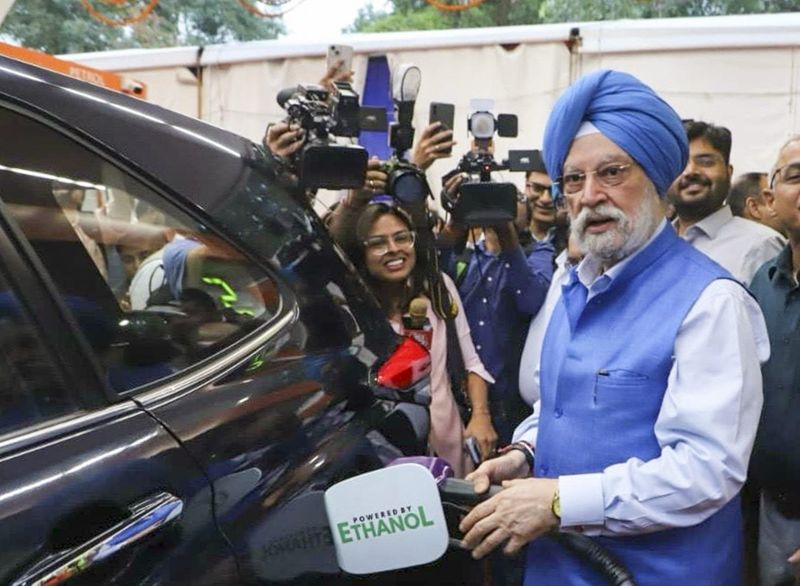
Minister of Petroleum and Natural Gas Hardeep Singh Puri launches E85 fuel, in New Delhi. @HardeepSPuri/X via PTI Photo
New Delhi: Union petroleum minister Hardeep Puri said on Friday (July 3), a fortnight after international crude oil prices fell significantly – and continue to fall steeply – that Indian consumers would not immediately benefit from the decline. The government may have plans to use the savings in other ways, such as helping oil marketing companies, which are government-owned, to recoup their losses.
According to the Economic Times, Puri said lowering consumer prices would become a legitimate issue if global oil prices continue to stay low over a sustained period.
Puri said the retail prices consumers are paying for petrol and diesel are based on supplies that arrived in India when crude prices were high. He said the marketing companies had Rs 75,000 to recover from when they did not hike prices immediately after crude rose during the West Asia conflict.
“Today the crude oil that is sold at $70 per barrel or below will arrive much later,” he said, the Hindu reports.
The Union government’s Petroleum Planning and Analysis Cell, had reported the cost of India’s crude basket as $86.31 a barrel in June 2026 (until June 24). This was a hefty fall from $114.48 a barrel in April, but just over a week later, the same agency reports a further fall – $83.22 for the entire month of June and a further steep fall to $67.72 in the first two days of July.
Oil marketing companies slashed commercial LPG cylinder prices by around Rs 180 on Wednesday, July 1. Commerical LPG had absorbed much more of the cost increase, amounting to over Rs 1,300, since March 1.
Prices of crude crossed $110 during the US/Isrel conflict with Iran, with brief swings up or down. The Hindu also reports that prices of imported crude are sealed, or agreed upon by Indian purchasers and foreign sellers, two months in advance.
This would imply that prices are unlikely to drop before September, if at all, since the United States and Iran have been able to agree to smoother passage of supplies from the Strait of Hormuz only in June. The conflict began on February 28.
Beginning May 15, state-run oil-marketing companies started raising fuel prices, which continued over multiple rounds. By early June, petrol prices were about 7.8% higher than before the war. Diesel prices were hiked about 8.6% over the same period.
Also read: Crude Prices Back to Pre-Iran War Levels. When Will Retail Fuel Costs Fall?
Puri said the overall “under-recoveries” of oil marketers are even higher, at over Rs 1.18 lakh crore, including losses of Rs 19,905 crore on petrol sales, approximately Rs 1.45 lakh crore on diesel sales and Rs 24,148 crore on LPG.
The losses were, the minister said, around Rs 75,000 crore in the April to June quarter of Financial Year 2026-27 – the war period, the Times of India reports.
Crude stocks, too, are at below 3 months’ supply, he said in response to the newspaper’s question – for 76 to 80 days, which it said was inclusive of oil in pipelines as well as “strategic reserves”.
“Stocking while prices are low, increasing storage space and intensifying outreach to bilateral partners – all that will go hand in hand,” Puri said.
Earlier in June, Union Petroleum Minister Hardeep Singh Puri said crude prices are expected to moderate, but he was ambivalent about retail and consumer prices more recently.
More than 85% of India’s fuel requirements are imported. At the same time, the government has rarely passed on benefits of lowering crude prices to consumers. When crude fell sharply in the 2014 to 2016 period (and also in 2020), the Union government raised excise, preventing consumers from seeing the full benefit of lower crude prices at the time.
Puri also admitted to a drop in mileage from using ethanol blended fuel at 20% blending, but said it was “minor”, reported NDTV.
This article went live on July third, two thousand twenty six, at nineteen minutes past two in the afternoon.
The Wire is now on WhatsApp. Follow our channelfor sharp analysis and opinions on the latest developments.
