

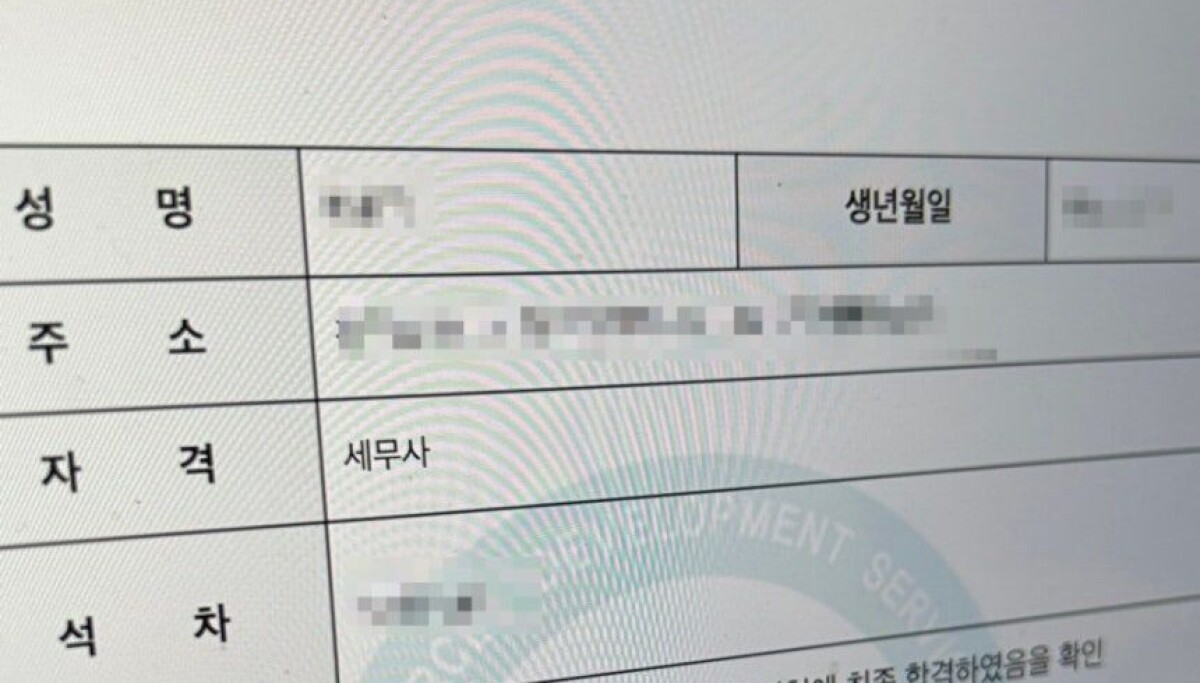
What greeted the top scorer upon completion of this year’s national tax accountant qualification exam was not congratulations for a near-perfect performance — but allegations of cheating with AI-powered smart glasses.
Suspicions of cheating have cropped up online after this year’s top scorer missed just one question out of 160 in the first-stage exam and earned full marks in the difficult introductory tax law section.
The Human Resources Development Service of Korea (HRDK), the organization administering the exam, is investigating whether proper procedures were followed during the first- and second-stage exams in April and July, the agency said Thursday. The authority is checking with test centers and proctors to see whether they noticed any signs of cheating.
The controversy centers on this year’s highest-scoring candidate in the 63rd national tax accountant qualification exam. The candidate spent roughly two years preparing for the exam and passed both stages on the first attempt, according to an article published Wednesday in a local news outlet.
A single wrong answer in public finance was all that stood between the candidate and a perfect score on the first-stage exam. The candidate earned full marks in introductory tax law, accounting and commercial law, for a total of 397.5 out of 400.
The candidate scored 663 out of 800 on the essay-based second-stage exam. On a 100-point scale, the scores were 96 in Accounting I, 95 in Accounting II, 57 in Tax Law I and 83.5 in Tax Law II. The overall average of 82.87 was more than 33 points above this year’s passing cutoff of 49.75 for candidates who took all second-stage subjects.
What has drawn the most scrutiny is the candidate’s performance in introductory tax law. Of the 16,856 people who took the subject, 74.21 percent scored below 40 points, the minimum required to avoid automatic failure. The average was only 30.18 by contrast, did not miss a single question
After the scores became public, the occupational association issued a statement calling for an investigation.
“The Korean Association of Certified Tax Accountants will urge the Human Resources Development Service of Korea and relevant authorities to thoroughly investigate the cheating allegations and take appropriate action,” the association said on Thursday. “We will also take any necessary steps based on the findings.”
Online users also questioned whether such results were possible given the exam’s difficulty and strict time limits.
“How does it make sense that the top scorer got 100 in introductory tax law while the second-highest score was only in the 80s?” one online user wrote. Another questioned how the candidate could have topped both stages on the first attempt when even instructors had described the exam as one of the toughest ever.
The skepticism soon reached the candidate’s own blog. Readers demanded to know how the candidate had managed to solve every calculation problem in the allotted time. One commenter, who said they had served as an exam reviewer last year, argued that the scores in public finance and introductory tax law were “physically impossible” because the questions are deliberately designed to make perfect scores difficult.
A tax accountant who previously passed the first round of the exam with top honors assessed the perfect score in Introduction to Accounting, stating, “There are so many tricky questions that it is impossible for even the most expert accountant to pass.” Another practicing tax accountant also remarked, “Considering the vast scope of the liberal arts exam for professional positions, the actual question format, and the time limit, it is at a level that is impossible for a human to achieve.”
Despite the allegations, no direct evidence has been made public to show that the candidate wore AI-powered smart glasses or used them to cheat.
“Allegations alone are not grounds to accuse a candidate of cheating just because they earned unusually high scores,” an HRDK official said. “But given the public scrutiny, we are looking into what happened. So far, we have found no unusual patterns or irregularities in the candidate’s scores compared to other test-takers, apart from the exceptionally high marks.”
