

CEO Julie Masino’s exit following a rebrand blunder provides a lesson: don’t assume good results will overwrite a bad narrative on their own, writes marketing executive Steve Schonberg.

This audio is auto-generated. Please let us know if you have feedback.
Editor’s note: The following guest post is an award-winning media personality and marketing and communications executive based in New York City. Opinions are the author’s own
On Aug. 10, Cracker Barrel CEO Julie Masino stepped down, handing the company to David Deno, former chief executive of Bloomin’ Brands.
My first reaction wasn’t about the balance sheet: I assumed the logo would still be the story. It was. Yet by nearly every financial measure, she left the business stronger than she found it: stock up roughly 111% since the start of 2026, Maple Street Biscuit Company sold off, debt paid down via a 26-property sale-leaseback, and same-store sales narrowed from a 7% decline to negative 2.6% as guidance rose. Eight months earlier, shareholders had already rejected an activist investor’s bid to remove her.
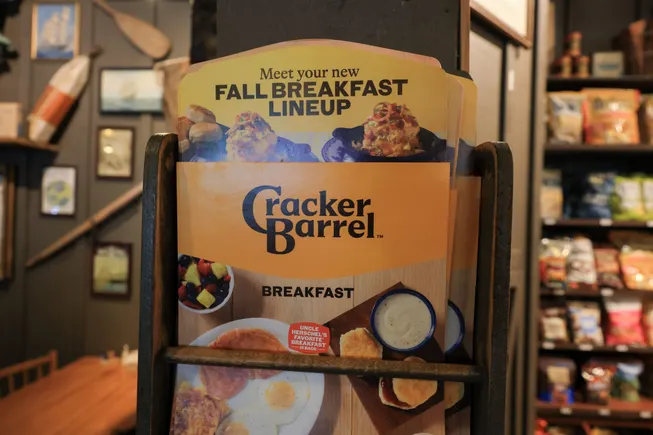
None of that is how she’ll be remembered. That will be eight days in August 2025, when Cracker Barrel swapped its overalls-clad “Old Timer” mascot for a plain wordmark, watched the backlash explode online, and reversed course. That controversy generated close to a year of national attention: cable news, late-night jokes, a Truth Social post from a sitting president. The turnaround that followed drew a fraction of the ink.
That gap isn’t an accident, and it isn’t really about Cracker Barrel. Early in my career, I saw a version of it on a children’s mouthwash brand: a small, real contamination risk, small enough that many companies would have quietly monitored it and said nothing. We recalled it anyway, got ahead of regulators and media, and did right by customers. It didn’t matter. Sales never recovered, and we pulled the product for good. Doing the right thing didn’t change the outcome — it just meant we lost with a clean conscience. That’s the job.
There’s a psychological reason a story like this calcifies. Psychologists call it schadenfreude, the pleasure we take in someone else’s misfortune, and it’s not just a figure of speech. I felt a version of it myself that first week, a small satisfaction scrolling through the backlash before I’d thought much about the store managers and servers who had nothing to do with a logo meeting.
Researchers have traced that pleasure to activity in the brain’s reward center, the same response triggered by a good meal or a win. It runs strongest toward people we already resent or envy, and a CEO dragged through a national controversy over a logo redesign doesn’t need much more reason than that.
There’s also a structural reason: negative information draws more attention and provokes stronger reactions than positive information of equal weight, across cultures and formats.
A rebrand backlash is a story. A same-store sales improvement of a few points is not, even when the second fact matters more.
A narrative set in a single week gets kept alive by a reward system that makes bad news about someone already in the crosshairs feel good to consume, and it rarely gets revisited once the facts move on. It has the shape of what we now call “cancel culture” — we fix on the salacious version of events and hold it with a death’s grip, whatever the record later shows.
The Gap lived through this in 2010: a redesigned logo lasted six days before backlash forced a reversal, and more than a decade later, that week is still the first thing most people remember about the brand.
I wasn’t in the boardroom, and don’t know everything behind the timing of Masino’s exit. But I don’t think the traffic numbers caught up with her — I think the story did. Every senior brand leader carries this exposure. Most of us don’t like to admit it.
Every RACI project management chart has an “A,” the person who is Accountable, not merely Responsible. I’ve sat in that seat, nowhere near this scale, and know the pattern: something goes wrong, whoever caused it disappears, and leadership doesn’t spend much energy on fault. They look to you for the plan. Mistakes are inevitable when humans run companies; Cracker Barrel’s was just a dramatic one.
But if you’re the accountable one, you answer for it and fix it so it doesn’t happen again. That’s who the story attaches to, not the team, not the market conditions, not the small decisions that shaped the outcome. You accept that risk, often gladly, because it comes with the authority to act. But it also means a reputation can get pinned to a single week, even one you reversed within days, for far longer than the results will bear out.
There’s something admirable in that trade. Wanting to be a brand’s champion in good times and bad, even when it costs you the job, is a form of leadership worth respecting, including in Masino’s case. But admiring the trade doesn’t mean leaders should walk into it blind.
Don’t assume good results will overwrite a bad narrative on their own, they generally won’t, not on the timeline you’d like. The recovery needs its own communications plan, not just a press release once the numbers turn. And build board and investor relationships on the underlying data, not the headline cycle: Masino’s shareholders backed her in November with the real numbers in front of them, not the loudest version of the story.
Masino fixed the business. The story never caught up. If you’re leading a brand right now, the honest question isn’t whether that could happen to you. It’s whether you’d take the job anyway.
Filed Under:Executive News,Operations,Marketing
