

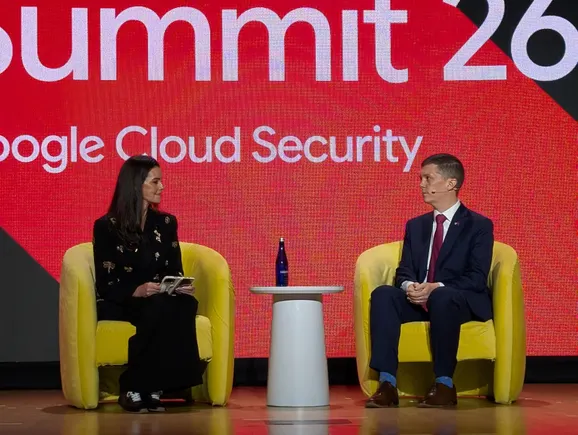
“I need people that can pivot from day to day,” the agency’s acting chief told reporters.

Eric Geller/Cybersecurity Dive
WASHINGTON — The Cybersecurity and Infrastructure Security Agency (CISA) wants to hire critical infrastructure experts with broad, rather than specialized, knowledge as it tries to help defend the infrastructure community with limited resources.
“I need to be able to hire people that are highly adaptive, because I think the threat is continuing to evolve so much, and the exposure that we have within these critical infrastructure sectors is evolving so much,” acting CISA Director Nick Andersen told reporters after speaking at Google’s Cyber Defense Summit here on Wednesday. “I need people that can pivot from day to day to be able to help meet all of these stakeholders where they are.”
Andersen’s comments come as CISA prepares to onboard roughly 250 new employees as part ofa hiring sprintmeant to fillcritical vacanciescreated by the Trump administration’ssweeping downsizing of the agencyover the past two years. As ransomware gangs and nation-state hacker groups increasingly menace infrastructure operators, in some cases aided by destabilizing advances in AI, CISA’s supporters say its mission — and its partnerships — have become more important than ever.
To support its partners throughout critical infrastructure sectors, CISA is trying to build a cadre of versatile experts whose skills and knowledge allow them to assist entities across multiple communities
“I don’t want to hire somebody that’s just going to work with the electric sector,” he said. “I want to hire somebody who can understand the operational-technology concepts and the control-system concepts that can broadly have applicability across the electricity subsector and the oil, natural gas subsector, and water and wastewater, and so forth and so on.”
CISA employees who have “a greater representative mix and understanding” of infrastructure beyond one sector will be able to develop a more comprehensive picture of the threat landscape, Andersen said, which will benefit the agency’s overall visibility.
Election security controversy
Even as it tries to restore its workforce and its reputation, CISA remains mired in controversy over its approach to election security. With the midterm elections approaching, someDemocratic lawmakers have grown frustratedthat CISA has yet to restore funding to the Elections Infrastructure Information Sharing and Analysis Center (EI-ISAC), despite Congress ordering the agency to do so in a recent spending law. The Trump administrationwithdrew funding for the EI-ISACearly last year.
Andersen declined to say whether CISA would comply with that provision of the law, telling reporters, “I don’t have a time frame on anything pertaining to funding.” He said CISA is focused on figuring out what services election officials need the most, and he added that the agency has received “a mixed bag of feedback” on the EI-ISAC.
He also suggested that CISA would meet with lawmakers and their staff to determine another way to boost election security that didn’t involve the EI-ISAC. “A big part of that for us is … having a conversation with the appropriators,” he said. “How can we partner with them on a strategy that recognizes the importance of elections infrastructure?”
CISA expects to launch its formal election security program for the midterms very soon, possibly in the next few days, Andersen said. That program will include technical services and deeper intelligence briefings. CISA has also deputized the directors of its 10 field offices to be election security advisers to the state and local officials in their jurisdictions.
Advising frontier AI labs
Recent incidents involvingAI models breaking out of their testing environmentshave unsettled Trump administration officials and raised questions about CISA’s responsibility for defending against out-of-control models. On Wednesday, Andersen said the agency sees its role as helping frontier labs develop better safeguards.
“It’s more focused on the technical elements of the conversation, and our partnership with frontier labs and with developers to say, ‘What do we need to be helping you to take into consideration for securing your own environment and being aware of this as a threat, so that we can ultimately help to secure this?’” Andersen told reporters.
“We want to be able to continue to build on the American success story that is everything that these American companies are able to produce in the market space right now,” he said. “A big part of that is making sure they’re considering their own internal security posture in a way that is fully informed by the landscape and what they are experiencing and what we’re seeing.”
Filed Under:Strategy,Leadership & Careers
