

1
Indra ensures the continuity of its services after a ransomware cyberattack on a subsidiary
2
Indra ensures the continuity of its services after a ransomware cyberattack on a subsidiary
3
Spain also stops Peter Thiel: Moncloa asks public companies not to contract with the giant Palantir
4
The Vatican digitizes 100 years of history and will boost it with AI
5
Spain’s next match: date, time, and opponent in World Cup
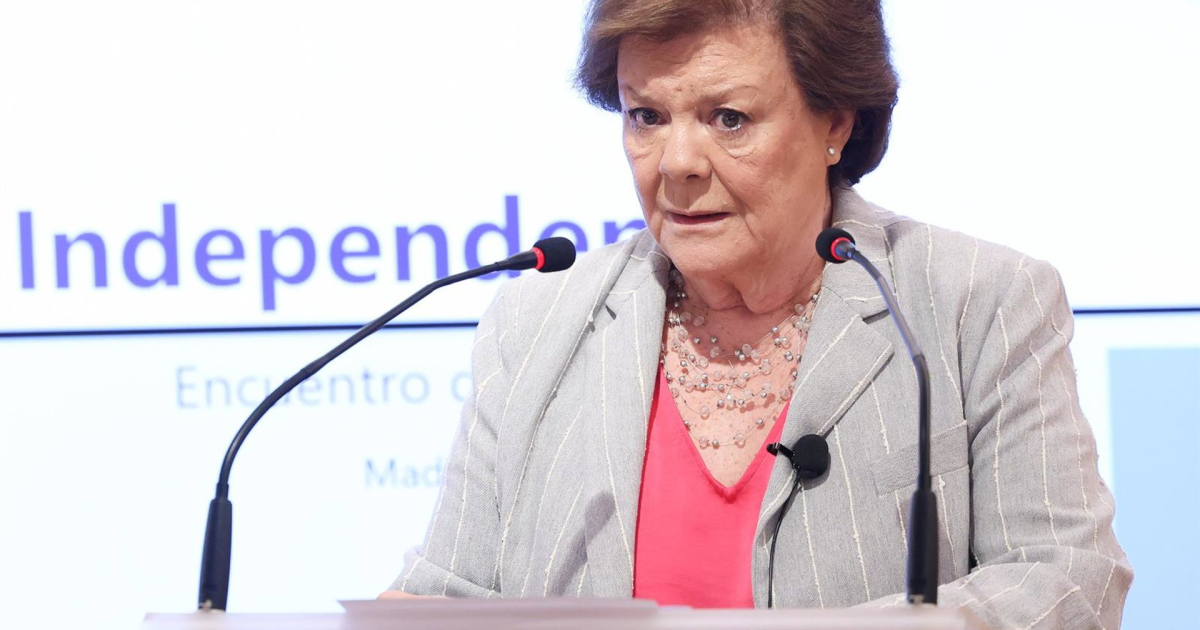
The president of the Court of Auditors, Enriqueta Chicano, has acknowledged this Thursday that “it is not easy” to determine accounting responsibility within a public administration, given that “many requirements are demanded” and it is necessary to specify an “exact amount” attributable to the responsible party.
Chicano made these statements regarding the dismissal of the file related to the ‘mask case’ in the Canary Islands, which the Court examined after the Court of Accounts of the Canary Islands detected the payment of four million euros to the company RR7 United for one million masks that were never delivered during the pandemic.
She recalled that “we do not simply sanction, we recover the money that we understand has not been handled well,” in statements made to the media before the start of the meeting of the Coordination Commission of Presidencies of the Court of Auditors and the External Control Bodies of the Autonomous Communities, held in the Parliament of the Canary Islands.
In this context, she stressed that the procedure is “adversarial” but has “all the guarantees,” since in the first place the Prosecutor’s Office decides whether to intervene, and subsequently, the matter goes to the Court of Auditors, which processes it first in the trial chamber, then on appeal, and ultimately, it can reach the chamber of third parties of the Supreme Court.
The president pointed out that, although some files “may seem very scandalous” and present “serious breaches,” in general terms the functioning of the public administration as a whole “is functioning with considerable normality.” At the same time, she admitted the “audacity” of the Court for “having pushed positions a bit on many occasions,” since one of its “clearest objectives” is to assess the effectiveness of public policies.
In this regard, she specified: “That is, if the money that is said to be spent on that has actually been spent on that and has yielded returns that actually respond to the objective.”
Chicano highlighted the “successful model” of coordination between the Court of Auditors and the regional audit offices, which allows external control to be “organized” and for areas of “greatest risk of effectiveness and efficiency” in the use of public resources to be identified. “It is a model that is working wonderfully for us,” she indicated.
He reiterated that he does not imagine “another work model” and pointed out that local administration “has a main problem” in accountability, while warning that the areas of contracting and subsidies concentrate “a lot of risk”.
Growth of public companies and challenges in control
The president also reflected on the expansion of public companies, pointing out that “there are more and more,” especially at the regional level, and that in many cases “they go a bit outside” the rules of administrative law, which requires strengthening supervision mechanisms.
He also highlighted that the “most peculiar” administrations are the city councils, as they are a level of government “very close” to the citizens but, at the same time, “worse equipped than others for internal control” due to the existing deficit of controllers.
As he explained, “tools” are being sought together with the autonomous communities to perfect and make control work more efficient, and although “non-compliance” persists that must be detected, he considers that the overall level of public administrations “is quite correct” at present.
Chicano assured that he sees “a lot of future” in improving procedures and promoting advanced analysis systems that allow “knowing where management is failing” and formulating concrete recommendations to strengthen accountability and the quality of public spending.
