

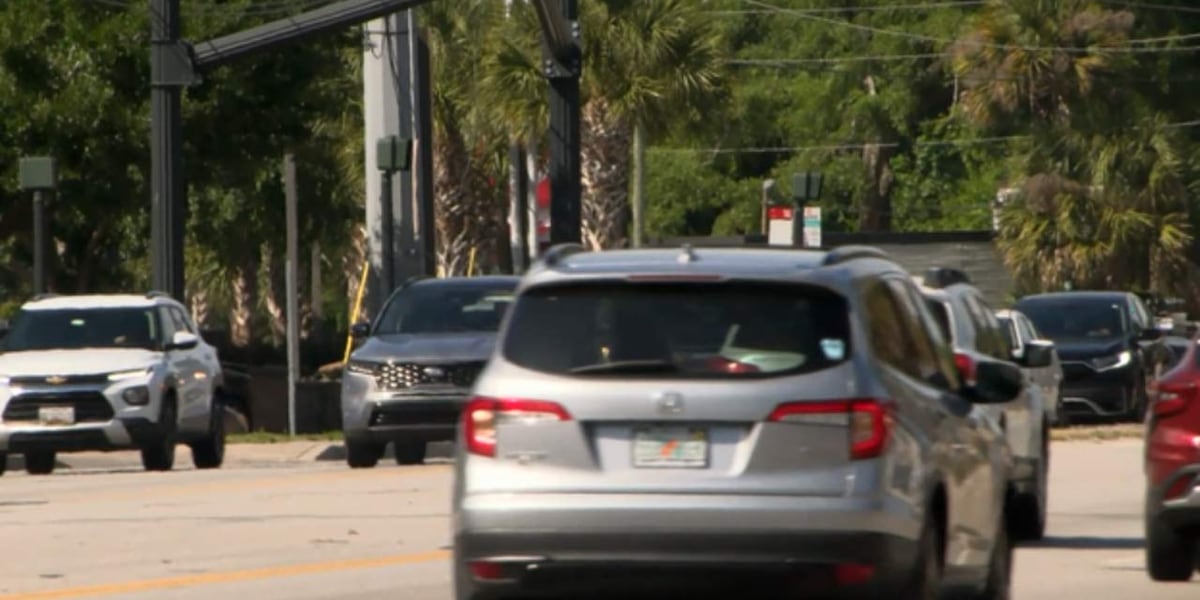
S.C. (WCSC) — Artificial intelligence could soon help keep traffic moving on two of Charleston’s busiest roadways
The City of Charleston is seeking a $2.26 million federal grant to expand its AI-powered traffic signal technology to Folly Road and the Crosstown, or Septima P. Clark Parkway. Charleston’s Ways and Means Committee is scheduled to approve the grant application Tuesday.
If approved and the city receives the funding, all 11 traffic signals along Folly Road would be upgraded with adaptive technology. The project would also bring the technology to the Crosstown.
The grant application will be submitted through the U.S. Department of Transportation’s Advanced Transportation Technology and Innovation, or ATTAIN, program, which supports projects that use advanced transportation technology to improve safety and mobility.
The proposal builds on the city’s first AI-powered traffic signal installation on Calhoun Street in February. City officials say the system is already improving both congestion and safety.
Unlike traditional traffic signals that operate on preset timing plans, the AI system analyzes traffic in real time and adjusts signal timing based on changing conditions.
City of Charleston Traffic Operations Manager James Wallace said consultants identified Folly Road as an ideal corridor because traffic patterns can change dramatically depending on the time of day, the season and travel to and from Folly Beach.
“Our consultants have identified it as a good corridor for traffic responsiveness because it has very variable traffic volumes based on time of day, season, people going to the beach, things like that,” Wallace said. “This technology allows us to use traffic responsiveness because it counts vehicles dynamically, so it can see what kind of traffic patterns it’s seeing out there and then respond accordingly.”
South Carolina Department of Transportation data shows about 70,000 vehicles travel on Folly Road each day, while nearly 80,000 vehicles use the Crosstown daily.
Wallace said one of the biggest advantages of the system is how quickly the city can respond to changing traffic conditions.
“Responsiveness is the key thing. It classifies everything it sees as a vehicle, a pedestrian, a bicycle and counts things in real time and stores all that data. Things that used to take a month or two to respond to because you’d have to go out and physically count the traffic and see what’s going on out there, we can now just pull up a dashboard where it shows us all that traffic data in real time.”
He said the technology is especially useful during busy beach weekends and other events that create sudden congestion.
“When we have an event on Folly, let’s say, it seems like Friday afternoons, there’s always people, it’s always highly congested because people are going to and from Folly Beach with the rentals,” Wallace said. “It would know that there’s more congestion on the road and react accordingly.”
Wallace said the city also expects similar improvements along the Crosstown.
“The Crosstown is pre-timed right now. It has no kind of responsive signal timing to it,” Wallace said. “We expect to see a great improvement on there, too, because Calhoun was also pre-timed at the beginning.”
If the city is awarded the grant, officials estimate installation would take between six months and one year.
Wallace said the U.S. Department of Transportation is expected to spend the next several months reviewing applications.
“Typically, that’s a couple-month process to hear back anything,” Wallace said. “So, we’re expecting to hear something end of the year at the earliest and latest by spring of next year.”
Copyright 2026 WCSC. All rights reserved.
