

Calls to return-to-office grow as some shift to a hybrid style
September 26, 2026 at 07:00 JST
- Share
- list
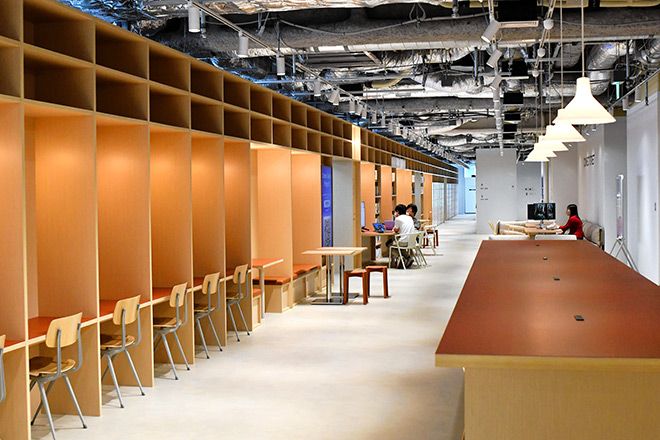
A new office of LY Corp. that opened in Tokyo’s Minato Ward in April. It has an area for meetings and space for individual deep work designed for the company’s return-to-office policy. (Ryuichiro Fukuoka)
A growing number of businesses are shifting from allowing employees to work remotely full time six years after the new work paradigm took root during the COVID-19 pandemic.
While large numbers of employers continue with hybrid work—a combination of remote work and in-person work in the office—the percentage of people working completely remotely has dropped sharply.
A survey by the Japan Productivity Center, a think tank, taken in July found that 14.5 percent of 1,100 employees of companies and other organizations worked remotely.
The figure was more than halved from 31.5 percent in May 2020, when such a survey was first conducted after the onset of the pandemic.
One of the most high-profile efforts to bring workers back to the office is led by GMO Internet Group Inc., a leading player in the information technology industry.
Masatoshi Kumagai, chairman and group CEO, caused a stir by announcing in his X post on July 14 that GMO Internet Group will “completely abolish recommending” remote work for its group companies, which has been allowed since the pandemic.
Kumagai assessed remote work as “a minus overall” when communications among employees and informal learning and mentoring were considered.
His post backfired as he also referenced a decline in remote workers’ keystroke logging, which critics perceived as an attempt to crack down on employees.
A week later, Kumagai explained in a new X post that he “did not mean to deny remote work as a new work style.”
He backtracked in an interview with The Asahi Shimbun, saying the new policy does not prohibit remote work across the board within the group and that individual group companies can decide on what to allow.
LY Corp., an internet and tech firm, has shifted to more in-person work after years of not requiring employees to work in the office during the pandemic.
In April 2025, the company instructed workers to come to the office one day a week or a month, in principle, depending on their department. From May, employees have been ordered to work in the office three times a week.
On the benefits of more in-person work, an LY official cited collaborations among colleagues through small talk in the office and swifter decision-making.
“We are expecting to see improved performance of employees and of the organization as a whole as well as enhanced ability to create new products,” the official said of the hybrid arrangements with an emphasis on in-person work.
But LY employees who have grown accustomed to fully remote working have reacted strongly to the shift.
“There was a fierce resistance to the company’s abrupt policy change,” said one employee. “One of my colleagues decided to quit.”
For now, large numbers of employers take a hybrid-flex approach, rather than letting workers choose either full remote or in-person work five days a week.
NTT Group, a major telecommunications and IT holding company group centered around NTT Inc., stopped requiring employees to work in the office in July 2022.
Of the group’s total workforce of 190,000, 53,000 people who work in areas such as corporate planning and sales are permitted to live in a location of their choice regardless of where their office is located.
When they need to come to the office, their travel expenses, including Shinkansen bullet train fare, are covered as a business trip.
NTT Group said the number of employees who lived apart from their families due to a job transfer was down by about 1,600.
NTT Group’s work style policy does not obligate employees to work from home every day. The company said many work in the office two to three days a week on average. The decision is left to each workplace.
“The satisfaction of employees is high,” an NTT Group official said of the company’s arrangement. “Our approach is contributing to our group’s strength, and we will continue to incorporate upsides of both remote work and in-person work.”
The official added a survey of workers showed higher employee engagement than previously and hybrid work has proved beneficial in attracting talented employees with diverse backgrounds.
Fujitsu Ltd., a leader of IT services, instituted a program in 2020 allowing employees to choose remote work or in-person work.
Today, an average of 20 percent of its employees work in the office.
Letting employees decide their work style boosted productivity, according to the company. As of the end of fiscal 2025, operating profits per employee jumped by 89 percent from fiscal 2022.
Most conferences were held in person previously. But Fujitsu now conducts video conferences as well.
“We are able to use time more efficiently and our decision-making processes have become faster,” said Mitsuya Akamatsu, head of Fujitsu’s Work Style Strategy Office.
He noted that having the option to work from home accommodates the needs of workers who have caregiving responsibilities.
Still, there are challenges to hybrid arrangements, Akamatsu said.
He said it is becoming more difficult to detect small changes emerging within teams consisting of remote and in-person staffers.
In consequence, middle managers have been forced to bear more responsibilities to confirm the status of operations and how subordinates are coping with their tasks at home.
Remote work also risks extending work hours by blurring the boundary between work and nonwork hours.
The Federation of Information and Communication Technology Service Workers of Japan, a group of labor unions in the communications industry, has advocated since the 2024 spring labor offensive “the right not to get connected.”
Working from home is common in the communications industry. The federation calls on employers to fashion clear rules on contacting employees during nonwork hours.
The federation drew up its guidelines for this year’s labor negotiations and urged member unions to start discussions with management.
The Japanese Electrical Electronic & Information Union, which comprises labor unions of electronics manufacturers, also demanded in this year’s negotiations that management and unions should designate hours when video conferences will not be held.
It also called for a dialogue between employees and employers over a work style that does not factor in too many tasks and leaves room for creativity and mental health.
Hiroki Sato, professor emeritus of human resources management at the University of Tokyo, noted that the problems attributed to remote work stem from a lack of clear rules and proper management, even though the new work style has become firmly established over the years.
Sato said a study of around 1,300 managers that he was involved in found that workplaces where managers complained about a decrease in productivity tended to allow workers to turn off their cameras and just use audio during online meetings.
He said nonverbal cues are important for smooth communication.
“Some managers have confused decreased productivity with remote work,” Sato said. “The real issue, however, stems from a lack of defined guidelines.”
The study showed that 45.8 percent of the workplaces had no explicit corporate or department guidelines on how online meetings should be conducted.
Makiko Hagihara, a senior researcher with Recruit Works Institute, a think tank, said her study showed that employers maintaining the remote work system has created a clear standard for assessing the performance of remote workers.
In addition, many remote workers in these companies feel empowered to manage their own assignments.
Hagihara also acknowledged that some companies are trying to optimize productivity with fewer days of in-person work.
In one example, new sales hires dispersed across the country are brought in to accompany experienced salespeople on client visits, an arrangement to mentor the junior workers.
“Whether remote or in-person work is better depends on corporate business strategy and organizational challenges,” Hagihara said. “The best approach is not fixed but evolves over time.”
(This article was Azusa Ushio, Makoto Tsuchiya and Miho Tanaka.)
- Share
- list
