

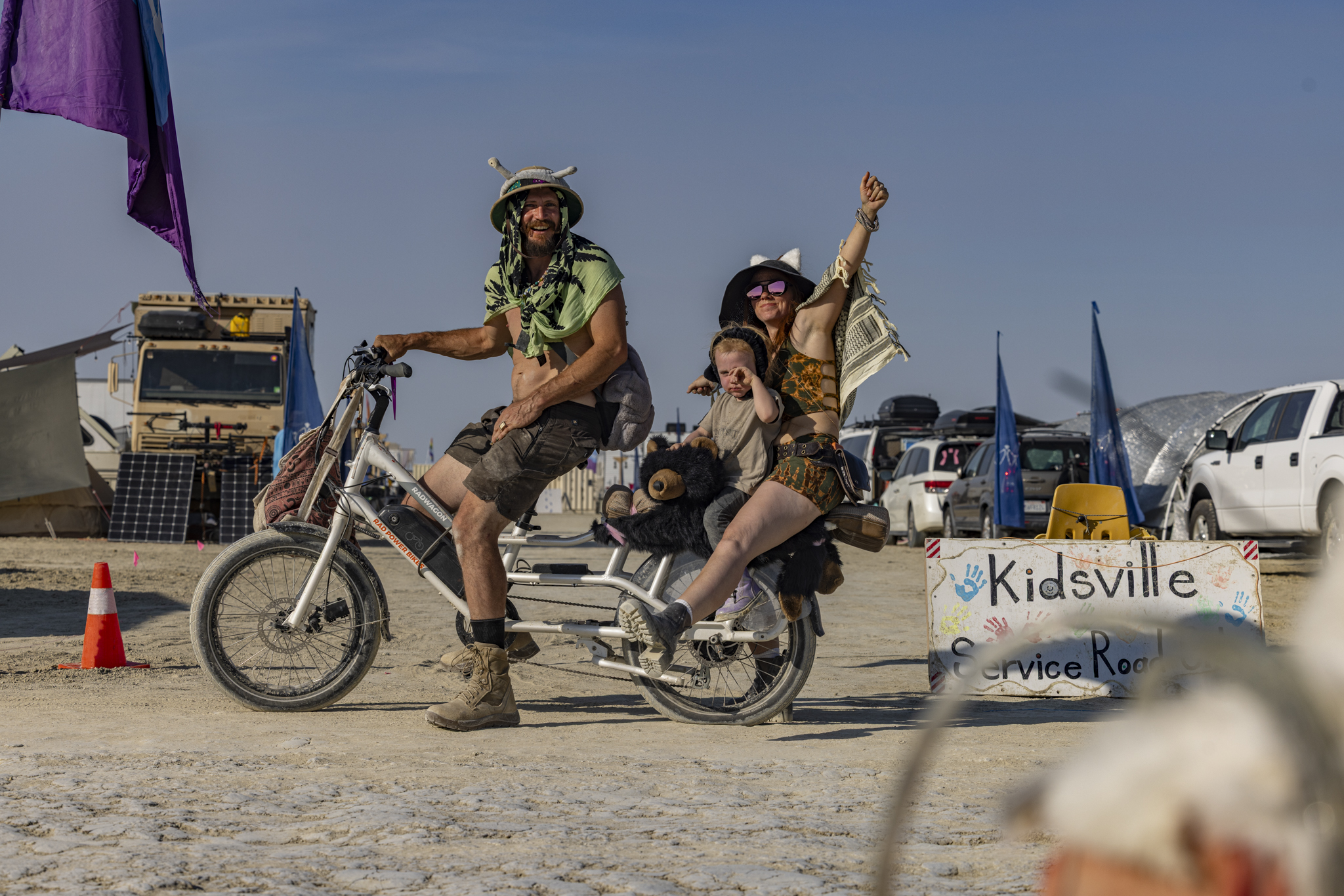
Nev. — Every year, 70,000 people flock to Nevada’s Black Rock Desert to leave behind their worldly troubles and exist in a bubble that is Burning Man
The temporary city in the desert was once an oasis for people to ditch the tech world that was colonizing San Francisco. Forty years later, however, Burning Man has increasingly become home to the same tech folks its original attendees sought to leave behind. It now operates on a budget of over $60 million. This year, the event’s spiritual home was even built by a former tech CEO who quit his job to take on the project.
Burning Man operates on 10 core principles, ranging from radical inclusion to leaving no trace. Though it treats them equally, the principle of decommodification is taken extremely seriously, with the event operating on a gifting economy where the only thing you can purchase with real currency is ice. Even healthcare in its heavily equipped hospital is free.
Article continues below this ad
The Burning Man Project defines decommodification as such: “In order to preserve the spirit of gifting, our community seeks to create social environments that are unmediated by commercial sponsorships, transactions, or advertising. We stand ready to protect our culture from such exploitation. We resist the substitution of consumption for participatory experience.”
The principles may be set in stone, but Burning Man is changing, for better or for worse, and it’s not just the attendees. Though it’s hailed as the largest “leave no trace” festival anywhere in the world, Burning Man has a pollution problem, and it’s not just the trash left in the desert or in nearby towns. Black Rock City has a large carbon footprint. At its daily peak, the city emits as much carbon dioxide per meter as the center of London or Mexico City.

“It’s just like any other MOOP. It’s just invisible,” said George Reed III, Burning Man’s director of regeneration. MOOP, or matter out of place, is Burning Man lingo for trash or litter.
The Burning Man Project, the nonprofit organization that facilitates the Burn, is trying to fight back, launching large sustainability projects to curb reliance on diesel generators. It’s made some strides in that area, reporting that more people are turning to solar energy than ever, but it’s got a ways to go to meet its goal of having net-zero emission by 2030.
Where Burning Man attendees are committed to decommodification, it’s hard to run a $60 million event without a little capitalism involved. To meet its sustainability goals, the organization has begun hiring many of the tech companies of the type that its attendees are taking a vacation away from.
‘Testing ground for the future’
Tech vendors aren’t held to the same gifting economy standards; they receive payment or grants for their services, although Burning Man stated that they’re generally paid below-market rates and donate much of their time. The organization has been selective with who it hires, trying to pick only companies it believes align with its other core principles. At the same time, it’s asking the companies to cover their logos on their tech and hasn’t publicized the names of the startups it’s working with on its website’s sustainability page.
Reed said this is in an effort to maintain the decommodified space for Burning Man participants but that the partnerships are important to keeping the organization on track with its sustainability goals.
“It’s mostly a cultural thing, and we don’t want Black Rock City to become like a trade show,” Reed said. “We want it to be truly a [research and development] testing ground for the future.”
One company head who is happy to follow Burning Man’s decommodification guidelines is Anurag Kamal, CEO and co-founder of fast electric vehicle charging startup ElectricFish. The company makes fast deployable EV charging stations that are also capable of giving energy back to the grid. The Bay Area startup is in its second year of working with Burning Man, with last year being only a testing year and this year providing charging to Burning Man organization vehicles only.
Kamal said he doesn’t mind having to cover his logo. For him, the experience is a great opportunity for the company to test its tech in the harsh conditions of the Black Rock Desert and in turn make its product better.
“If we get to that ubiquity at some point in time, in which we are powering the grid and we have all these chargers out there, at that point in time, we will talk to the org and be like ‘OK, we don’t want to hide the logos,’” Kamal said. “But we want to conform to the ethos. It’s about testing for us and being part of the community.”
For Louis Lalonde, CEO of LOKL Energy, conforming to Burning Man’s culture is easy because it aligns with his own sustainability priorities. The company is a small wind energy startup based in Austin, Texas. Its portable generators use wind turbines in addition to solar panels in order to continuously draw energy, even when there’s no sunlight. At Burning Man, his company’s tech was being used to power air conditioning and refrigeration for greeters at the event’s entrance.
News |
Rare disease haunting the children of an idyllic Calif. suburb
Sports |Ex-Calsoftball player alleges coach coerced her into relationship
Crime |New details uncovered in last year’s shocking Burning Man homicide
News| Ex-child actor claims she was repeatedly raped during Disney filming
Read our stories ad-free on the new SFGATE app.
Lalonde said sustainability is at the core of LOKL Energy and that the Burning Man principle of leaving no trace was integral to the design of its generators. Like Kamal, Lalonde said it’s about the opportunity to test the company’s tech in a unique environment. The dust in the Black Rock Desert is no ordinary nuisance. Its high-alkaline content can act as a conductor when wet. That can be problematic for tech that draws and stores electricity. Lalonde sees the harsh dusty conditions as an exciting opportunity.
“I’d love to see what happens,” he said.
‘A new mission’
Finding companies that can conform to the Burning Man culture has not proved difficult. For some, the organization only had to look in its own back yard.
Overdrive Energy Solutions was essentially created at Burning Man in 2017. Now it’s one of Burning Man’s biggest tech partners.
The company’s mix of software and clean energy hardware allows the organization to operate more efficiently by giving a real-time look at how much energy every battery is consuming, and predicting based on usage when one needs a recharge. While others are dealing with how to introduce cleaner energy to Burning Man, Overdrive deals with a less talked-about issue, which is the overestimation of how much power Burning Man actually needs. It saves the Burning Man organization a sizable amount on its power bills.
Overdrive CEO and founder Neel Vasavada is a “Burner first,” he told SFGATE. He’s been coming to Black Rock City for years, and in 2017, he wanted to stop using a gas generator to power the air conditioning unit in his shift pod. He began building a rudimentary version of Overdrive’s monitoring system, and his tech quickly expanded from his own shelter to a full camp of around 100 Burners and later caught the eye of Burning Man. Now the company works at some of the largest music events, having just deployed at Outside Lands, and is now heading to Portola right after the Burn.
“It speaks a lot to what the org has done in that we’ve been able to cross that boundary from participant to vendor and supplier,” Vasavada said. “That’s what’s really amazing about this organization and why we feel strongly about this.”
Out on the edges of Black Rock City, a similar story is unfolding.
Driving out to the charging station on the very edge of the city, you pass by lots of the larger sound camps, with nearly all running diesel generators. When loud bass isn’t thumping the playa, the incessant hums of the generators stand out. But around the Solarpunks setup, it’s notably silent, apart from lively conversations from people charging their electric bikes.
Christina Chu, Cory Johnson and Karin Campbell have all been coming to Burning Man for years. They don’t have backgrounds in tech like Vasavada, but they are now running the largest solar panel array the event has ever seen.
Solarpunks offers free EV and bike charging through its fast-deployment solar panels as a gift to the playa. The crew started with a 100% solar-powered camp of around 50 people in 2022. Johnson said it was the hardest project they’d ever done at Burning Man.
“We hit bedrock. We couldn’t penetrate. We had no shade structure. We looked like a disaster site. Honestly, it was all tense,” Chu said. “But our power never went down, and we actually were able to gift power also to our neighbors and different artists as well.”
Access our new app with ad-free reading, curated maps and more.
GET IT NOW
This year, Solarpunks has significantly expanded, providing 1.1 megawatts of electricity to an entire city block in Black Rock City, including one of Burning Man’s largest theme camps, Discosmos (from the Burners behind Mayan Warrior). It also is electrifying six art pieces in the deep playa.
The Solarpunks crew has also expanded its tech into the disaster relief space, deploying some of its assets during the LA fires last year. For the crew, Solarpunks’ mission is inspired by Burning Man at its core, and the team sees its future at Burning Man defined by how it can give back.
“We all had our own individual journal with Burning Man in a life we love,” Johnson said. “Solarpunks was us wanting to have a camp and building a community of friends and aligned people, and to have those shared experiences, but in a way that brought in a little bit of purpose or something like a new mission.”
The Burning Man staffer you meet if you’re in an ‘ungodly mess’
Christian missionaries at Burning Man evicted in the middle of the night
New details uncovered in last year’s shocking Burning Man homicide
Inflation comes for Burning Man, leading iconic camps to bow out
After destruction, Burning Man’s Orgy Dome is back in 2026 with a new rule
Burning Man bans new personal item for 2026
The oddest activities at Burning Man 2026
Read all our reporting from Burning Man.
