

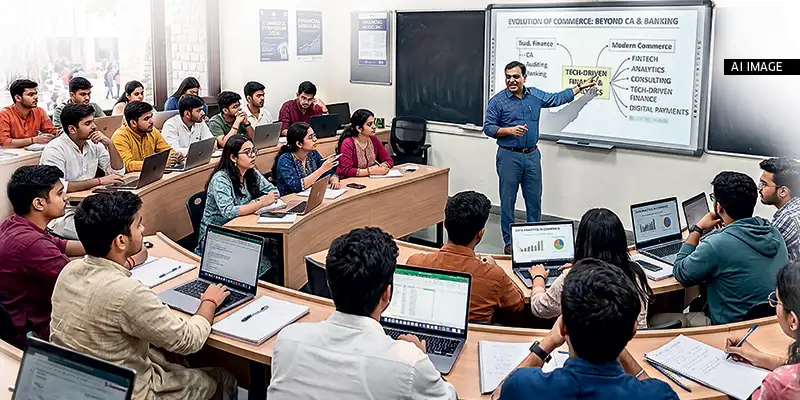
As AI reshapes workplaces, colleges are redesigning commerce education to prepare graduates for consulting, fintech, analytics and technology-driven finance careers
Debasmita Dasgupta| Posted August 13, 2026 09:01 AM
In the 1980s, Commerce was widely recognised as the second-most popular academic stream after science. However, with the rise of business education, popularity has increased manifold after Class XII. Today, Commerce remains one of India’s largest undergraduate disciplines after Arts and Science, accounting for 13.3% of total undergraduate enrolment in 2023–24, according to the latest All India Survey on Higher Education (AISHE). Recent admission trends reflect its enduring popularity. At the University of Delhi, BCom (Hons) was the most sought-after programme in the latest admission cycle, attracting nearly 20 lakh course preferences, followed by BCom with 15.26 lakh. Shri Ram College of Commerce (SRCC), with 626 BCom (Hons) seats, received 38,795 first-preference applications. Similarly, Christ University admits well over 1,000 students annually across its BCom programmes and specialisations spread across campuses. At the University of Mumbai, Commerce recorded the highest seat allotments (65,037) in the first UG merit list.
Despite the rise of AI and automation, Commerce has only grown more relevant. No longer limited to chartered accountancy and banking, BCom programmes today prepare students for careers in consulting, investment banking, fintech, business analytics, sustainability and AI-enabled finance.
One of the biggest reasons behind commerce’s sustained popularity is the flexibility it offers. “Commerce continues to be one of the most popular choices because it does not lock students into a single career path. A BCom graduate can explore opportunities in the Big Four firms, investment banking, consulting, venture capital, startups, finance or even pursue higher education. That flexibility is a big reason why students continue to choose it,” Prof Ashwani Kumar, assistant professor, Department of Economics, SRCC, DU tells Education Times.
The career landscape has expanded significantly over the last decade. “While CA, banking and civil services remain popular, commerce graduates are increasingly pursuing careers in fintech, financial analytics, consulting, investment banking, business analytics, digital marketing, e-commerce, ESG and sustainability, startups and entrepreneurship. The growing adoption of technology and data-driven decision-making has created significant new opportunities across these emerging sectors,” says Prof Aakanksha Sethi, assistant professor, Department of Commerce, Lady Shri Ram College for Women, DU.
Meanwhile Prof Anusha Iyer, associate professor and associate head, Department of Commerce, Christ University, Bangalore, says, India’s economic growth is also driving this demand. “With multinational companies, Global Capability Centres, financial services firms and entrepreneurial ventures growing rapidly, demand for commerce graduates will continue to increase. Students are increasingly pursuing qualifications such as CFA, CMA, and CPA while exploring careers in wealth management, investment operations and corporate finance,” she says.
To keep pace with changing employer expectations, commerce classrooms are also changing. Rather than replacing traditional accounting and finance courses, colleges are supplementing them with subjects focused on digital technologies, analytics, and business intelligence.
At SRCC, students can opt for courses such as Big Data Analytics, Data Analysis, Advanced Spreadsheet Tools and Statistics with R, alongside value-added programmes in Business Analytics and Enterprise Risk Management, reflecting the college’s gradual expansion of industry-oriented offerings since 2018. “Emerging subjects are certainly finding their way into commerce programmes, although the shift has been gradual. It is a practical approach that equips students with in-demand skills without losing the strong foundation that commerce education is known for,” says Prof Kumar.
Following the implementation of the NEP-aligned Undergraduate Curriculum Framework (UGCF) in 2022, LSR has expanded its commerce curriculum with skill-oriented papers such as Financial Literacy while continuing to offer courses including Business Analytics, Digital Marketing and Personal Financial Planning. “These additions are essential to align education with industry needs, enhancing students’ digital and analytical skills, and improving employability in a rapidly evolving business environment,” says Prof Sethi.
Christ University, meanwhile, is integrating AI and digital finance through specialised programmes, curriculum modules and future ready skills initiatives. “Employers are asking for graduates with knowledge of digital finance, fintech, AI in accounting and financial analytics. We are integrating these subjects into the curriculum through specialised programmes, individual course units and value-added courses, and plan to further strengthen AI integration,” says Prof Iyer.
While AI is automating routine accounting and auditing functions, faculty members believe it is simultaneously creating demand for graduates who can interpret information and support business decisions.
“AI is certainly changing the workplace, but it is not reducing the demand for commerce graduates. Instead, it is changing the skills employers expect. Employers are increasingly looking for graduates who can interpret data, solve business problems, and make informed decisions rather than simply perform routine tasks,” says Prof Kumar. SRCC has also seen its recruiter base widen considerably, with companies such as McKinsey, BCG, Bain, Goldman Sachs, J P Morgan, Barclays, D E Shaw and the Big Four regularly recruiting from campus alongside FMCG and technology companies.
Commerce graduates now need a blend of technical and business skills. “AI is automating routine accounting, auditing and financial tasks, shifting the focus from manual processing to analysis, interpretation and strategic decision-making. Commerce graduates are expected to possess digital literacy, data analytics skills, critical thinking and the ability to work with AI-powered tools while applying sound business judgement,” says Sethi. At LSR, over 50 organisations participate in placements, making more than 160 offers across consulting, finance, analytics, marketing and product roles. The highest package touched ₹36.25 lakh per annum, while the average package stood at ₹13.54 lakh.
Prof Iyer adds that AI literacy is becoming indispensable. “Companies now use AI-powered tools to automate bookkeeping, accounting, auditing and report generation. Employers expect commerce graduates to know how to use AI tools, analyse data, solve business problems, and make better decisions rather than just perform manual tasks,” she says. At Christ University’s Department of Commerce, 257 out of 301 registered students secured placements during the 2025-26 season, with an average package of ₹6.5 lakh and the highest package reaching ₹22.5 lakh. Students were recruited for roles such as accounts executive, analyst (assurance/tax/deal advisory), audit associate, business development associate, relationship manager, HR associate, graduate trainee, customer support specialist, operations associate, international sales specialist, and portfolio valuation trainee.
Commerce has remained resilient because it has consistently adapted to the needs of the economy. As businesses continue to embrace digital transformation, commerce education is doing the same, ensuring graduates are not competing against AI but learning to work alongside it.

