


A new kind of private school is coming to Massachusetts with a model that looks very different from the classroom most parents grew up in.
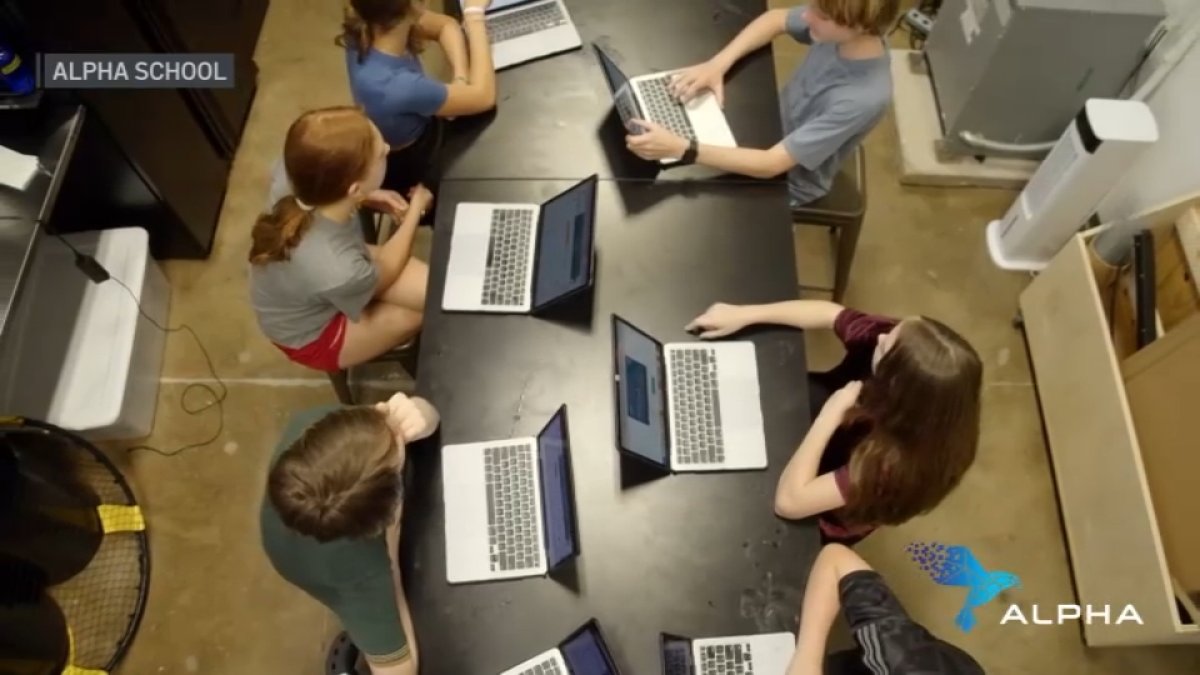
Alpha School is opening three locations in Greater Boston this fall, betting that artificial intelligence and personalized learning can help students complete their core academics in about two hours a day.
Stream NBC10 Boston news for free, 24/7, wherever you are.
For Paul Karger, an incoming Alpha School parent, the idea made sense.
“We live in a world where you can customize your own jeans or your own shoes. Why shouldn’t you be able to customize your own education?”
This fall, Karger is pulling his 8-year-old son, PJ, out of one of Massachusetts’ top private schools to enroll him at Alpha.
“Historically, he’s not somebody that’s loved school. I would say he is creatively gifted,” Karger said. “However, learning, reading, and writing has not been his strong suit.”
New York City’s public schools will temporarily ban students in elementary and middle schools from using artificial intelligence tools in the upcoming school year, Mayor Zohran Mamdani announced Wednesday.
The family got a preview of the Alpha model when PJ spent a shadow day at one of the school’s locations in New York. Karger said his son came home with a reaction he wasn’t expecting.
“He came back and he said, ‘Daddy, I love learning. I love math. I love reading,’” Karger added. “I was like, what did you do with my son?”
Alpha School describes itself as an AI-driven private school that uses personalized learning technology to determine what students know and tailor lessons to their individual level and pace.
“We are using artificial intelligence to raise human intelligence,” co-founder MacKenzie Price said.
Price said the model is not about putting a chatbot on a student’s computer. Instead, the technology assesses where students are academically and allows them to work through material at their own pace, meaning children in the same grade could be working at very different academic levels.
“Let’s say you have a classroom of first grade students. You might have one first grader who’s working on algebra, while the child sitting right next to him is working on his addition and subtraction. That’s really the beauty of personalized academic learning that AI is enabling us to provide,” Price said.
As students head back to school, AI is forcing districts to rethink their rules.
Alpha says students can complete their core academic work in about two hours each day.
The school is opening locations in Lexington, Beacon Hill and Jamaica Plain, where it will take over the former Croft School campus. Tuition is $65,000 per year.
“Part of what makes that tuition this amount, we believe that the adults who work in our classrooms are heroes and they should be paid as such,” Price said. “So all of our teachers, we call them guides, make a minimum of $100,000 a year.”
About half of Alpha’s guides come from traditional education backgrounds, while the rest come from various industries. They largely focus on providing students with motivational and emotional support.
“The amount of human connection is so much greater because of the way that we’ve re-envisioned the role of our teachers and the time that our students have and what they get to focus on,” Price said.
Students spend the remaining six hours of their school day in workshops designed to develop skills including entrepreneurship, financial literacy, and public speaking.
“I’m excited for the time back so PJ can pursue other things he loves to do,” Karger said. “You have to be willing to embrace something different.”
Three new schools with an emphasis on AI-based learning plan to open this fall — with no teachers in the classrooms.
Not everyone is ready to embrace that approach.
Justin Reich, an associate professor of digital media at MIT who studies education technology, said individualized academic instruction comes with potential tradeoffs.
“You can learn lots of things sitting by yourself in front of a computer. You cannot learn how to deliberate with your neighbors sitting alone in front of a computer,” Reich said.
Reich’s concern centers in part on what students may lose when academic learning becomes an individual experience. Traditional classrooms, he said, give students opportunities to work through academic material with classmates who have different backgrounds, abilities, and perspectives.
Still, Reich did not dismiss Alpha’s experiment entirely.
“Maybe there are some bits and pieces that we’ll find that are interesting. I certainly hope so. I’m always hoping that we learn new things that work better in education,” Reich said.
For Karger, the real test begins when PJ starts school this fall.
“I hope he loves going to school and loves learning and I’ve already seen early indications,” Karger said.
Alpha School has capacity for about 500 students across its three Greater Boston locations, serving students in kindergarten through eighth grade. The school says it plans to gradually build enrollment over the next several years.
Artificial Intelligence stories
Artificial Intelligence15 hours ago
Anthropic researcher resigns with a warning: AI ‘could kill us all’
Boston Business Journal23 hours ago
Mass. firm buys another AI chip company in $1.35B deal, its second in four months
Healey announces new regulations on data center development in Mass.
