


If productivity were measured just by how many laws are created, the current U.S. Congress could end up being one of the least productive in at least 45 years.
However, it’s not that simple. According to experts, a lot of lawmaking activity happens behind the scenes that is not easily trackable.
With midterm elections less than a week away, the Get the Facts Data Team gathered and analyzed quantifiable congressional records to see how this Congress — and your lawmakers within it — are stacking up.
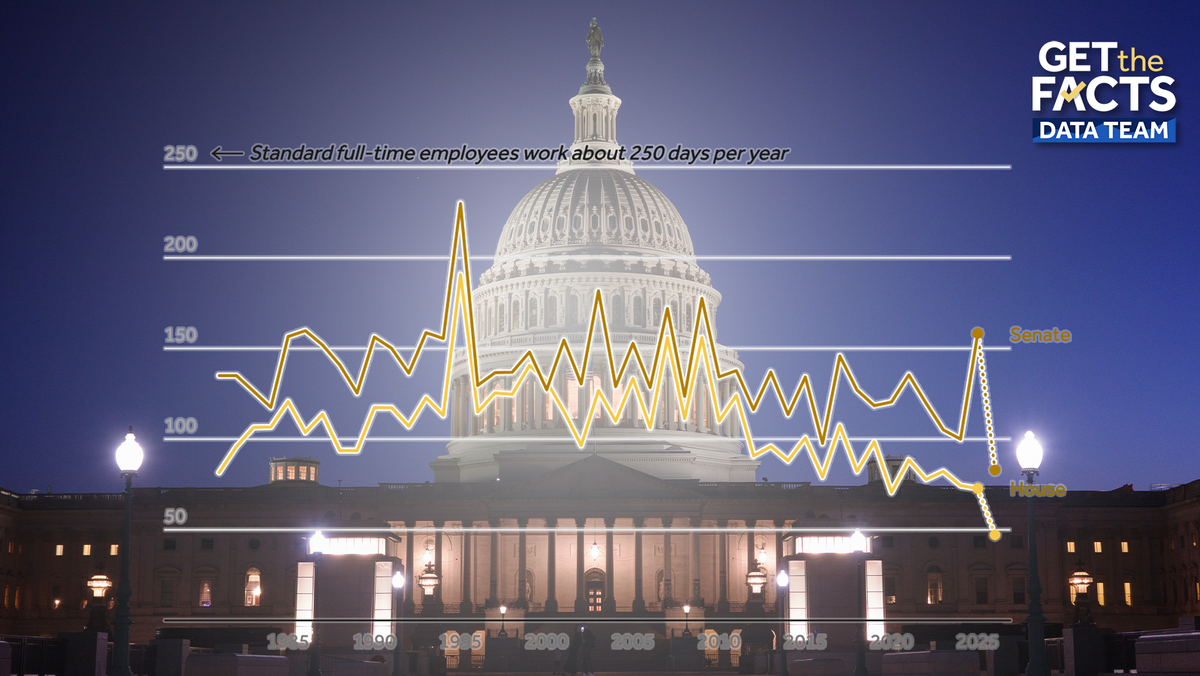
Lawmakers are spending less and less time in D.C.
As of Aug. 31, the House has been in session for 47 full 8-hour workdays this year. The Senate has been in session for about 83.
A typical full-time worker over the same eight-month period would have worked about 167 days. Historically, lawmakers tend to spend less time in D.C. during election years.
Last year, the Senate was in session for an unusually long time, about 158 days over the full year. Majority Leader John Thune expanded the Senate’s work schedule from a four-day week to a five-day week, in part to speed up contentious cabinet confirmations.
When Congress is not in session, lawmakers can draft bills, conduct oversight activities or participate in committee hearings.
There are also several gaps on the legislative calendar to allow members of Congress time to go home and interact with constituents in their districts.
“When people are elected to Congress, there are many different tasks that they can engage with, all of which could be extremely legitimate uses of their offices and different ways to represent their constituents,” said Alan Wiseman, co-director of the Center for Effective Lawmaking.
The lawmaking part
While legislators have upped the number of bills they introduce, the percent that each chamber actually passes has shrunk. The number that become law is even slimmer.
In 2025, 4% of Senate bills and 6% of House bills were passed.
Lawmakers in the current Congress, which began in 2025 and will continue through the end of the year, have introduced more than 15,500 bills. Only 138 have become laws, as of Oct. 24.
For a bill to become a law, it must be passed by both the House and the Senate and then signed by the president. If the bill is vetoed, it must pass a two-thirds majority vote in both chambers.
While both chambers will return after the Nov. 3 elections, the 119th Congress could set a record for getting the fewest laws passed, at least since the Reagan years.
Experts caution that the strict number of laws passed doesn’t represent the totality of legislation that is accomplished.
Laws vary in length. The “One Big Beautiful Bill,” for example, was nearly 900 pages long and covered everything from tax cuts to defense spending increases to stricter health care and food assistance requirements.
Behind-the-scenes lawmaking has also gotten more common, Wiseman said. That’s when parts of a bill that doesn’t advance get added into the final versions of other laws.
“Even in this increasingly at least publicly partisan or contentious era, there’s still opportunities for effective lawmakers to advance their agendas through the legislative process,” Wiseman said.
Congressional records don’t track how many pieces of unpassed bills get tucked into larger laws. That could create transparency issues, experts say.
“There is an argument to be made that if it’s the case that things are happening behind the scenes, it’s not as transparent as what we might think of in some idyllic sense of a bill becoming a law and working through each of the intermediate steps,” Wiseman said.
What has your lawmaker been up to?
All 435 seats in the House and 33 seats in the Senate are up for election on Nov. 3.
To give voters a better understanding of what their incumbent lawmakers have worked on, the Get the Facts Data Team has built the interactive tool below to show you how many bills each has introduced and their top five policy areas.
In the 119th Congress, Republicans have introduced 42 bills per member on average, and Democrats have introduced 56. That’s unusual, experts say, as historically, members of the majority party introduce more bills.
Democratic lawmakers have also led the charge with cosponsoring legislation. They have cosponsored, on average, 63% more bills per lawmaker than Republicans.
The most bills any lawmaker has seen pass into law under this Congress is 10. Sen. Ted Cruz (R-Texas), Sen. Dan Sullivan (R-Alaska) and Rep. Claudia Tenney (R-New York) have each sponsored or cosponsored 10 bills that passed into law.
Senator Michael Bennet (D-Colorado) has sponsored the most legislation, with 359 bills.
Excluding congressional leaders, who traditionally do not sponsor much legislation, Rep. Jim Jordan (R-Ohio) and Rep. Scott DesJarlais (R-Tennessee) have introduced the least legislation. Each has sponsored one bill in the current Congress.
Who’s been absent?
Most legislators who miss votes are either absent due to illness or because they’re campaigning.
In the Senate, Mitch McConnell (R-Kentucky) — who was hospitalized after a fall in June 2026 — has missed the most votes, at 137.
Sens. Ruben Gallego (D-Arizona) and Thom Tillis (R-North Carolina) have missed the second-highest number of votes at 116 and 114, respectively. Gallego was out due to paternity leave. Tillis did not respond to requests for comment on the missed votes by the time of publication.
In the House, Rep. Frederica Wilson (D-Florida), who underwent eye surgery, missed nearly 200 votes. Rep. Raúl Grijalva (D-Arizona) missed 97% of the votes that occurred before his death on March 13, 2025.
New Jersey Governor and former representative Mikie Sherrill missed 56% of eligible votes, largely due to her campaign for governor, her campaign told the New Jersey Globe.
Search for your lawmaker’s voting record here.
