

Business
American AI is expensive. Some startups are turning to cheap Chinese models
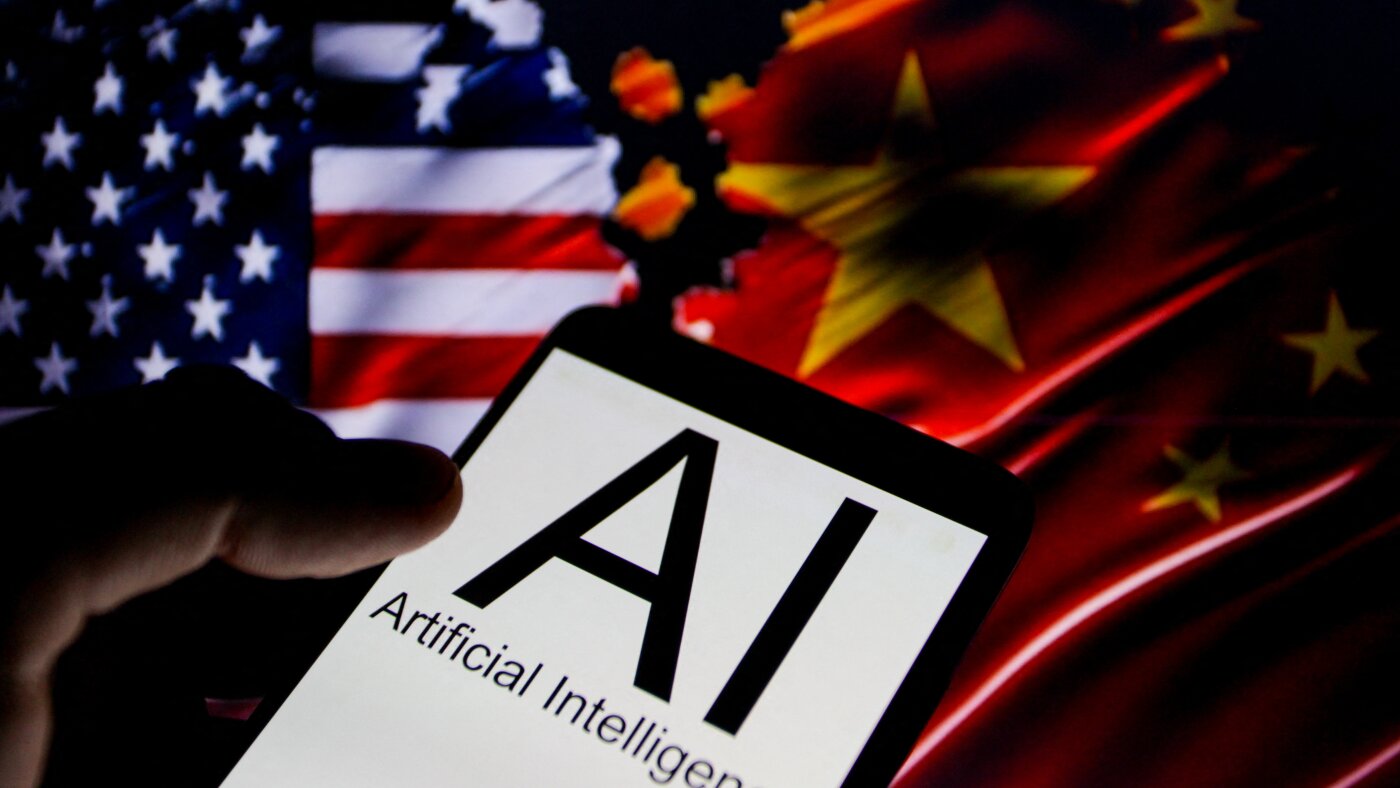
AI is a fast-growing business expense. Some companies are cutting costs by switching to cheaper Chinese AI models.
Imen Ben Youssef/Hans Lucas/AFP via Getty Images
toggle caption
Imen Ben Youssef/Hans Lucas/AFP via Getty Images
Sign up for NPR’sUp Firstmorning newsletter for the stories you need to start your day.
SAN FRANCISCO — Flo Crivello’s San Francisco-based startup, Lindy.ai, creates artificial intelligence “assistants” to manage your email and calendar. At first, the company leaned heavily on Anthropic’s top-of-the-line AI models.
But in meeting after meeting with his finance guy, Crivello said, one thing became clear: “By far, our No. 1 expense was Anthropic,” he said. “Like, more than payroll.”
Business
Is AI ‘one big bubble’? Behind the tech sell-off
More than payroll — for over two dozen employees. More than rent. More than for anything else. So last month, Crivello announced that Lindy had migrated 100% of its traffic to the Chinese AI model DeepSeek-V4.
“It was just 10x cheaper,” he said, adding that it had saved the company millions of dollars. “So it was a very, very simple business decision.”
Artificial intelligence has become one of the — it not the — fastest-growing costs for U.S. businesses. But for many companies, it’s a double-edged sword: necessary but expensive. To survive, a growing number of firms are switching from American models to cheaper Chinese AI.
In the race to create the best AI models, U.S. companies like Anthropic, OpenAI and Google lead the world. Experts say Chinese models are six to 12 months behind in terms of capabilities.
U.S. vs. China: Inside a great power rivalry
China’s AI chatbots are advanced and versatile — and begging for more users
State of the World from NPR
China embraces AI in the classroom
But China has carved out a niche in open-source models, which are free to download and adapt. “The open-source scene right now is absolutely dominated by the Chinese. It’s not even close,” Crivello said.
He said every founder he knows who is working in the AI space either is thinking about switching to Chinese models or has done so already.
And ballooning AI costs are not just a startup issue either. Uber CEO Dara Khosrowshahi spoke about it last month on the Invest Like the Bestpodcast. “We blew through our AI budget in a quarter, you know, for the whole year, essentially. And it is forcing us to adjust,” he said.
(Uber did not respond to NPR’s request for information about whether it uses Chinese models.)
Bloomberg reported Airbnb CEO Brian Chesky as saying that last year the company relied on Alibaba’s Qwen model, which was “good,” “fast and cheap.” Perplexity and Nvidia have also made use of Qwen.
Like a Ferrari or a Honda
Many companies are wary of trumpeting their use of Chinese models due to political sensitivities, but the models are widely available on AI-model hubslike Hugging Face, on the code hosting platform GitHub and via model aggregators and inference providers based outside China.
U.S. vs. China: Inside a great power rivalry
In the shadow of U.S. export controls, China rallies its own chip industry
Technology
Trump administration partially lifts export ban on Anthropic’s most advanced AI model
That includes the San Francisco-based company Featherless, which offers access to some 30,000 AI models. Founder and CEO Eugene Cheah said Chinese models are popular, even if they aren’t “frontier” models, or best in class.
“It’s like the difference between driving a Ferrari and a Honda. You can have the best luxury car, or you can just have a Honda at scale that works,” he said.
“Actually, a lot of open-source AI groups are perfectly fine being N-1, N being where the frontier is,” he continued. “Because as the gap keeps shrinking, at some point the question is: Does it actually matter?”
For many, like Lindy, it doesn’t matter. The Honda of AI is perfectly good.
OpenRouter, another platform where startups can access a range of AI models, reported that use of China’s DeepSeek has gone from around 9% to nearly 20% since January. Use of models from the Chinese companies MiniMax, Xiaomi and Tencent have also risen.
Some users download and self-host open-source Chinese AI models, but many use them via paid AI-hosting companies, like Featherless and OpenRouter, so that user data is kept in the United States.
Business
What do you actually get when you pay for AI?
Elections
Political text messages could get more effective and annoying. Blame AI
Victor Su-Ortiz, who does global product marketing at the Shanghai-based MiniMax, attended a recent AI engineers conference in San Francisco. Companies pay to use AI models by paying for tokens, or units of AI work. Su-Ortiz said it all comes down to the cost per token.
“A lot of repetitive tasks can be done with a model that’s just as performant but has much lower cost per token” when compared with leading AI models, he said. “And this is essentially what has brought these open-weight models into the United States.”
He said companies are shifting from “tokenmaxxing” — using as much AI as possible — to saving costs by limiting usage, switching to cheaper models or routing different types of AI work to different kinds of models.
For research or “deep reasoning,” for instance, the cutting-edge models may perform better, said Su-Ortiz. “But if you’re routing for a coding task that is repetitive, high volume … that’s where one of our models, especially MiniMax M3, will perform exceptionally well at like only one-tenth the cost.”
Saving a few dollars isn’t worth it for everyone
For some companies, Chinese models still aren’t good enough. Jon Gordner is CEO and co-founder of Comment.io, which was founded just weeks ago and is developing a product that he said is like Google Docs for coders and AI agents.
It’s Been a Minute
The human labor that makes AI work
Business
Ask AI or just Google it? Google makes a big change to a little search box
“We need to make as good software as we can as fast as possible. And for us, saving a few dollars on a cheaper model isn’t worth it if we have to spend two or three more weeks fixing its mistakes,” he said.
Gordner said his company is getting value out of Anthropic and OpenAI models in part because both companies are subsidizing users to hook customers. He said monthly subscriptions offer tokens at a huge discount now — but that probably won’t last forever.
“Then for us, it’s going to make a lot more sense to start evaluating Chinese models and open-source models,” he said.
Ara Kharazian is lead economist at Ramp, a company that helps businesses track, control and automate spending. It has insight into AI spending, and Kharazian said he thinks U.S. companies will keep adapting — in other words, they may keep prices in check or introduce high-quality open-source models in a bid to outcompete Chinese rivals.
“The rise of these Chinese models is indicative of the fact that businesses want something that is today not being offered by the American model companies,” he said. “The only reason why I’m bearish about the Chinese models is because I assume that the American model companies will respond competitively.”
Technology
AI giant Anthropic prepares to sell stock to the public, files preliminary IPO paperwork
Gordner, of Comment.io, is less certain. He thinks the major U.S. AI companies may have to start charging morefor AI as pressure to demonstrate profitability rises, possibly as they get closer to going public. Both Anthropic and OpenAI have filed confidential paperwork with the U.S. government to get the ball rolling on eventual initial public offerings.
“At some point,” Gordner said, “the music’s going to stop.”
Anthropic is a financial supporter of NPR.
