

Think about the last time you ordered something you really wanted. You don’t remember the warehouse it came from or the route it took to reach your city. You probably don’t even remember which carrier dropped it off. But you do remember exactly how it felt when it arrived—the relief of seeing it on the porch before the rain started. Or the frustration of finding a “Sorry we missed you” note when you were home the whole time.
That’s the crux of e-commerce delivery. We talk about logistics as a series of nodes, modes, and zones. But your customer experiences it as an emotion. It’s the bridge between “I bought this” and “I have this”. And for many brands, that emotional bridge is still being built by cost logic, not customer logic.
This article explores why parcel delivery has become the most important, yet least controlled, chapter of the customer experience for your brand.
The store has moved.
In the classic era of retail, the ‘moment of truth’ happened in-store. A sales associate greeted you, answered questions, handed you a bag, and thanked you for your purchase. The customer walked out with a product, and a feeling of being taken care of. That was the memory.
The interaction has changed now. It migrated from a physical store to a physical handoff.
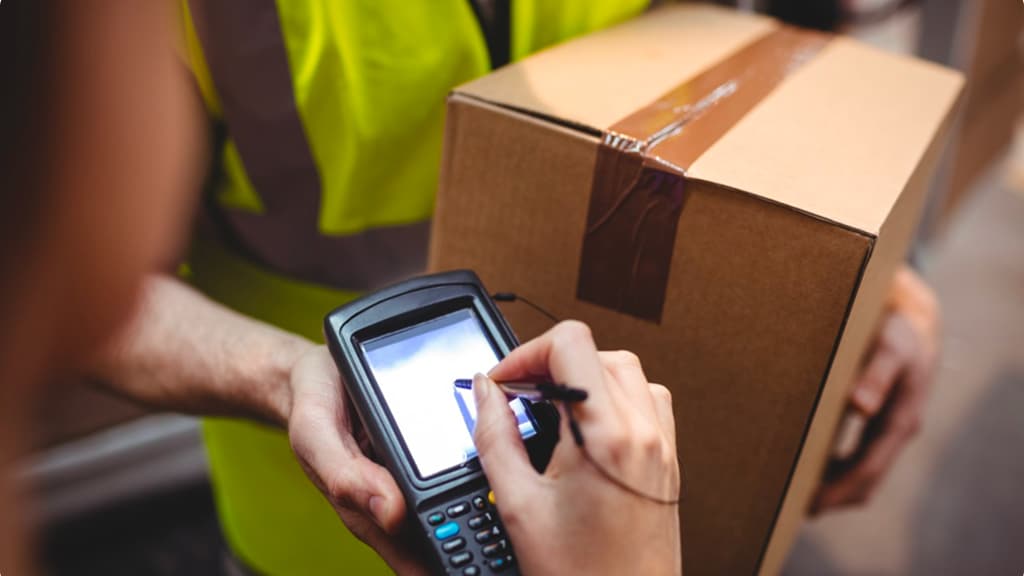
- The ‘associate’ is now a driver in a high-vis vest running up a driveway.
- The ‘counter’ is a front door, a reception desk, or a mailroom.
- The ‘handover’ happens unsupervised, often miles from your headquarters.
- The ‘bag’ has been replaced by a box.
And when that box is late, crushed, wet, or simply unexplained, customers don’t blame the carrier. They blame the brand.
We have moved the most critical moment of the customer journey—the fulfillment of the promise—out of the store and into the chaos of the last mile. In North America, the average household now receives 167 parcels a year—that’s nearly one package delivery every two days. That means your brand shows up more often through delivery than through marketing.
E-commerce parcel delivery, then, is no longer just the end of the logistical journey. It is the beginning of a customer’s relationship with your brand.
Parcel is the only physical touchpoint.
In a digital-first world, parcel delivery is the only recurring, unscripted physical interaction between your brand and your customer. This makes parcel delivery three things:
- Frequent: It happens thousands of times a day.
- Visible: It’s the only part of your supply chain your customer actually sees.
- Emotional: It carries the weight of a promise kept or broken.
That makes it uniquely powerful and uniquely risky.
Unlike most digital touchpoints, delivery cannot be meaningfully A/B tested or course-corrected. Once a package is in motion, the system either holds or folds. Parcel delivery has taken on a role most brands haven’t fully acknowledged and designed yet.
Customers don’t distinguish between ‘carrier’ and ‘retailer’. They don’t care how many partners sit behind the scenes. They experience one brand, one journey, one story unfolding in real time. Yours. So every scan, update, delay, silence, and interaction is a branded moment.
