

Why New York City is Becoming a Hub for Climate Tech Startups
In its most basic form, entrepreneurial success can be a simple equation: the fortunate intersection of new ideas with the opportunities and resources to build them. However, for the business unicorns that launch and grow swiftly to a massive scale, a location in a city that matches entrepreneurs’ ideas with innovative ways of accelerating business growth is essential.
That’s chief technical officer and co-founder of NineDot Energy, a green tech company that went from a small team in 2018 to having raised hundreds of millions of dollars in direct investment by 2024
Cohen believes that this level of rapid scale was possible due to New York City’s standing as a nexus of global venture capital investment, a thriving tech community, and America’s largest consumer base.
A Climate Tech Startup Story: From Zero to $400 Million
“When you use the word innovative, you don’t usually think about energy tariffs and rate design. You don’t think about land use and zoning,“ said Cohen. “But New York has created this framework that you can rethink at the ground floor.”
According to Cohen, New York’s regulatory environment is exceptionally friendly to entrepreneurs in green technology, making it an attractive place to launch a business model that addresses complex sustainability challenges.
”They’ve reexamined these regulations and age-old policies that were set decades ago, and now these lines in a utility tariff book are designed to create innovative distributed solutions that (will also) have a marketplace to participate in.”
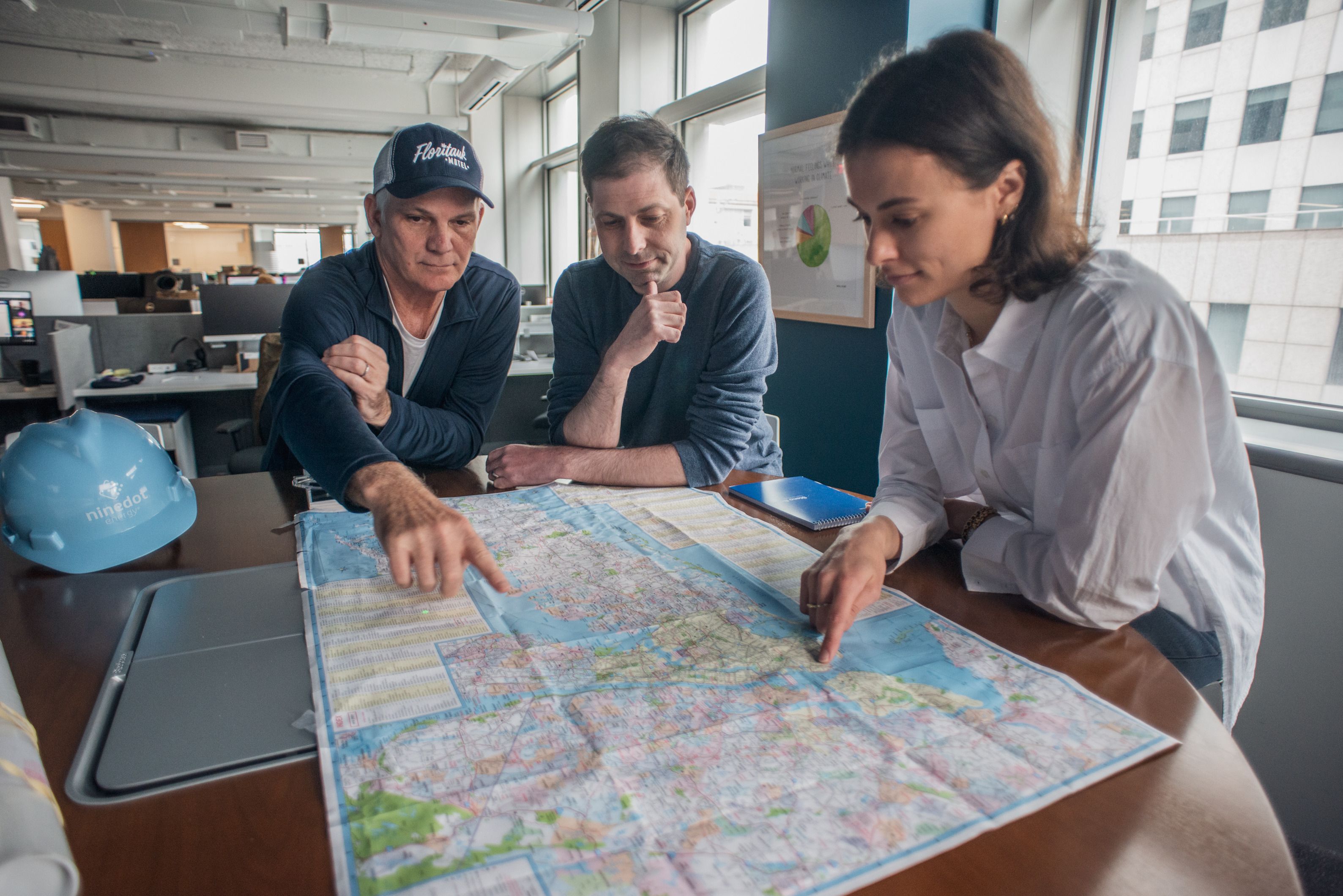
NineDot Energy builds community-wide energy systems to create a more resilient electric grid and reduce CO2 emissions in cities. When Cohen arrived in 2018, he saw New York City as a perfect fit for his nascent company.
The Appeal of New York City for Green Tech Innovators
According to Cohen, because New York City and the state of New York are actively investing in the infrastructure for legally mandated decarbonization efforts, opportunities abound for green tech entrepreneurs. New York’s population—8.3 million—and its sheer number of residential and commercial buildings make it an inspiring landscape for climate innovation entrepreneurs.
Cohen believes that businesses seeking to solve clean-energy challenges for communities will likely find relevant Requests for Proposals (RFPs) abundant in the near future. According to Cohen, housing developments and existing commercial buildings will require significant changes in how they typically generate and manage energy to align with the city’s sustainability benchmarks.
“We didn’t start in New York City; we moved here because of the amazing policy frameworks and the ability to scale a business (here),” stated Cohen. ”We had one desk starting that summer and an idea of how to do things a little bit differently,“ Cohen said. ”Now we have north of 40 employees, and our headquarters are still in Brooklyn, at (New York University’s) Urban Future Lab.”
“We went from bootstrapping entrepreneurs with an idea to now having raised over $400 million for the types of solutions that we dreamed up (in that space) and then could execute,” said Cohen.
Cohen’s vision is to create an energy infrastructure that reflects the city’s future needs. “We’ve built NYC’s first vehicle-to-grid project in Red Hook, Brooklyn, transforming electric vehicles into grid resources. It’s a testament to our innovation and NYC’s supportive environment for pioneering work.”
Cohen believes that the city offers numerous opportunities for him to scale his business even further. “We don’t have to look outside New York City (because) there’s so much activity, so much vibrancy, and so much to do here,” Cohen stated.
New York’s Tech Incubators: Driving the Green Economy Forward
For many entrepreneurs hoping to scale quickly, New York City represents more than the world’s largest global financial center: It’s a catalyst for new ideas—and opportunities—to research, test, and launch business models around sustainability.
That’s Assistant Vice President of the Green Economy Team at the New York Economic Development Corporation (NYCEDC). NYCEDC, a nonprofit organization, works with entrepreneurs, universities, community organizations, and investors to help entrepreneurs ideate, build, and scale innovative businesses
“Our mission is extensive, focusing on strengthening business confidence, nurturing innovation sectors with an emphasis on equity, and enhancing neighborhoods where people live, learn, work, and play,” said Petinos.
How New York’s Policies Are Spurring Climate Innovation
Petinos said landmark policies like Local Law 97 underpin NYCEDC’s efforts. This law is part of New York City’s Climate Mobilization Act, which mandates net-zero emissions for large buildings citywide by 2050.
This act, and others, are propelling demand for green tech innovations, like community battery projects.
According to NineDot Energy, a 5-megawatt (MW) battery project could power 5,000 New York City households for four hours on a hot summer day. Unlocking battery storage capacity at scale is crucial for the city’s transition to a green economy, Petinos stated. Due to sustainability-focused real estate tax incentives for large battery storage projects, an additional 254MW of energy capacity—enough to power tens of thousands of homes—was unlocked for the city
Petinos stated that New York Economic Development Corporation (NYCEDC) has actively participated in the green economy for many years, supporting efforts to make the city a welcoming hub for climate innovation.
Easing the Way for Climate Innovators in New York’s Green Tech Hubs
“NYCEDC is focused on ecosystem development and connecting private and public players to the city,” said Petinos. The corporation helps to catalyze innovation within New York City’s climate technology sector through long-term partnerships, such as the organization’s work with NineDot Energy, Petinos stated.
Support from NYCEDC helps accelerate access to the tools businesses need to launch quickly, Petinos said. At the same time, it helps them forge relationships with investors and community organizations eager to see new and existing businesses thrive.
NYCEDC has consistently invested in or co-founded collaboration-focused business incubators and innovation accelerator programs to create a robust ecosystem for green tech entrepreneurs. For example, Urban Future Lab, home to NineDot Energy, was NYCEDC’s first major investment in clean-tech and renewable energy technology. Such investments provide fertile ground for clean-tech startups to establish their roots in New York City.
Post-Launch: Removing the barriers to startup success
NYCEDC’s support extends well beyond investment to include a bespoke service for larger companies interested in establishing offices in NYC. The corporation works with these companies to help them overcome potential barriers to scale—real estate, talent, and business partnerships—by expediting access to all three.
In addition, NYCEDC helps emergent climate technologies coordinate regulatory wayfinding by connecting them with studio programs, such as the Resilient Energy Studio and Mass Timber Studio, that offer startups the technical assistance they need to accelerate their growth.
Conceptual Rendering – FXCollaborative
Brooklyn: Holding space for innovative startups
In Brooklyn, NYCEDC sees a wealth of opportunities to leverage the built environment in ways that push the city towards its clean energy goals.
NYCEDC’s climate tech pilot program at the Brooklyn Army Terminal (BAT) in the Sunset Park neighborhood is designed to support startups looking to pilot their products. The four-million-square-foot campus offers companies space to test and demonstrate their technologies in live environments before they pitch to investors or go to market.
The BAT campus has become increasingly focused on supporting climate tech innovators. Whether they are testing urban transportation solutions or researching decarbonization strategies, green tech companies will likely find the right combination of tools and workspaces for their manufacturing or development needs on campus. In addition, BAT offers on-site childcare, a Makerspace advanced manufacturing shop, and numerous networking opportunities with more than 100 businesses.
NYCEDC is poised to make another massive investment in the climate tech ecosystem by transforming BAT into a Climate Innovation Hub. Backed by $100M in city funding, this hub will become a linchpin in the city’s climate sector, providing space and resources for companies to research, build, and test cutting-edge clean-tech solutions.
NineDot Energy: Hyper-Focused on NYC
“We’re bringing in the kinds of actors that make an exciting ecosystem for New York,” said NYCEDC’s Petinos. That excitement is palpable for green tech businesses like NineDot Energy, Petinos noted, as the city witnesses the growth of a robust green tech workforce.
That indicates that New York City is the right place for growth-focused green tech companies like NineDot Energy to scale
Petinos added that there’s another reason it’s easy for businesses like NineDot Energy to scale here: New York City can be a great place to live.
NYC: A World-Class Welcome
Businesses with staff relocating to New York will find welcoming, diverse, and multilingual communities. The city’s cultural amenities appeal to international workers asked to relocate. From a legendary food scene to world-class museums to a stunning waterfront, New York’s tech hubs and incubators are surrounded by a vibrant city. That’s a plus for workers who want a short commute from home to a tech hub and a rich cultural life.
NineDot Energy’s Adam Cohen echoed this sentiment, stating that his team’s connection to the city helps the company stay inspired to create new innovations.
“We have a fantastic team of employees and partners who understand New York City, who live and breathe New York City, and want to be a part of this solution.”
That highly motivated workforce is met with numerous opportunities to work on meaningful new projects, Cohen said. NineDot Energy has built battery storage units in several locations across the city since 2018. One of its units, a 3 MW energy storage site that supports thousands of households, was constructed in the Pelham Gardens neighborhood of the Bronx. It was turned on last year—just in time for the hottest summer ever recorded in the city.
“We are hyper-focused on NYC,” Cohen stated, emphasizing that while NineDot Energy’s solutions are localized, their aim is global impact. He believes that because New York’s policies, such as Local Law 97, have helped support companies like his in the green economy, they may inspire the rest of the world to adopt similar approaches to climate innovation.
Got an idea? Make it an industry in NYC.
“It’s about being part of the neighborhood,” Cohen emphasized. “We’re not just taking up space; we’re actually enriching the areas we occupy.” He likened NYC to Thomas Edison’s choice of the city for the first operating power plant: it is a place for demonstration and evolution.
New York is the city to launch ideas that can change the future. Innovation is encouraged, regulatory structures are entrepreneur-friendly, and NYCEDC is dedicated to fueling rapid, sustainable business growth.
A commercial
production by
Paid and
Presented by
Connect with NYCEDC
Discover why NYC is the right place for green tech businesses to thrive and learn more about how NYCEDC can help you scale your enterprise.
