

Agentic AI startups are gaining traction fast in Europe.
Startups in the sector raised a staggering €6bn last year, according to Sifted data, and are already on track to surpass that in 2026, having brought in €4.6bn year to date.
One sector using AI to automate tasks which is really taking off is accounting and finance. Leading companies include Spanish treasury management startup Embat, which raised €30m in May, and Milan-based JetHR, which raised €25m in June.
Visma, which offers software in accounting, payroll and tax to SMBs, also uses AI internally, both in its products and across its own operations. Its internal push extends to the wider group too, especially through a portfolio of accounting software companies it owns across Europe.
Proven customer value is one thing Visma considers when looking to acquire businesses, as well as how well the software is tailored to its local market.
The company now has more than 600 AI initiatives within its portfolio, which it separates into those still in the early experimental phase and those that could be scaled across the wider group.
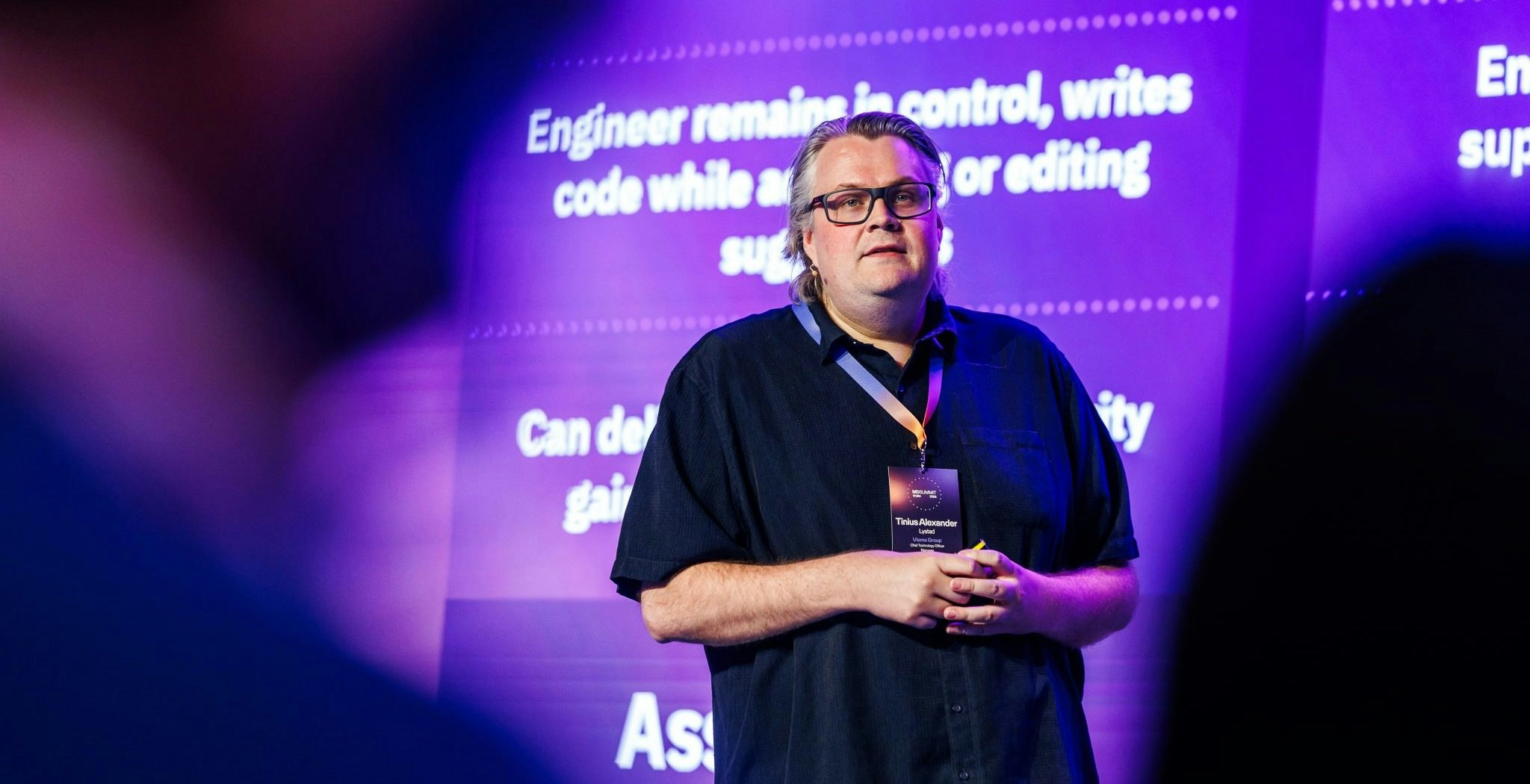
“We want to accelerate and scale the AI initiatives we find the most promising, but also to share knowledge with customers and the wider Visma group,” says T. Alexander Lystad, chief technology officer at Visma.
Sifted sat down with Lystad along with Mikael Gandon, managing director of accounting startup Chaintrust, and Martin Thorborg, managing director of accounting software company Dinero — both part of the Visma group — to unpack Visma’s AI strategy and how AI can transform accounting processes.
Visma’s AI scaling strategy
Companies don’t need to be profitable for Visma to acquire and scale them, but it does look for proof of product engagement such as high adoption rates, frequent usage or direct customer feedback.
Lystad says there are four main categories of AI customer value that Visma usually looks at.
“The first category is automation that saves a user time or effort, such as data extraction, automatic booking and automatic bank reconciliation,” he says.
“The second is assurance. Detecting anomalies within payroll data for example. The third is advisory — surfacing patterns and insights from data and bringing it to the attention of a human or taking action on it automatically.
“And the fourth is agentic. This is about automating entire workflows.”
Visma’s AI portfolio companies are focused on solving specific customer problems and working close to individual local markets.
“The unique thing about Visma is that we combine global scale with local markets. We solve problems locally and close to the customer,” says Lystad.
How Visma’s accounting companies use AI
The traditional accounting lifecycle is slowed down by manual, repetitive tasks, says Gandon, and in highly-regulated fields such as finance, general purpose AI models such as ChatGPT often lack the specific context needed to automate accounting tasks.

This was the case for Chaintrust, which utilises AI to scan, extract, review and post accounting entries such as invoices and receipts into relevant accounts.
“The trigger was watching accountants spend their evenings retyping invoices,” says Gandon.
He saw junior staff spend most of their time on manual entry, reading a supplier invoice, finding the right ledger account and typing it into the production software. “Repetitive, error-prone and work nobody became an accountant to do,” Gandon says
Automating accounting work doesn’t necessarily mean accounting roles disappear, Gandon adds. “A firm can grow its client portfolio without growing headcount linearly, and staff can shift from typing tasks to reviewing and advising.”
A virtual CFO
Small businesses don’t often have the dedicated resources for a finance officer. This is something Dinero is hoping to solve with its virtual CFO, an automated accounting feature linked directly to a bank account using open banking and then used to complete routine bookkeeping and payments. Business leaders can query their data and get advice fed back to them.
Dinero’s virtual CFO is developed to predict whether invoices will be paid on time, audit over-reliance on a single client or a dominant supplier and compare a company’s performance goals with data from similar markets.
“The idea is to give small companies their own virtual CFO to make it easier for them to compete with larger companies. We want to make bookkeeping less painful,” Thorborg says.
“If we can have agents that keep the books up to date, when you get to the time of closing, ideally you shouldn’t have any remaining work to do,” says Lystad.
Trust, accuracy and performance
An incorrect finance entry or calculation can cause compliance and legal issues for businesses.
Dinero ensures there are clear boundaries in place to determine where AI can be used and where it can’t. For advisory features such as its Virtual CFO, generative models are used. For core accounting workflows, it says it uses machine learning and algorithms that can’t hallucinate.
“We have around 20k tests we go through every time we make an update,” Thorborg says.
“Other companies could be more aggressive, but it comes at a price. If the advice you’re getting is wrong because of AI, then it’s hard to win people back.”
Visma and its portfolio companies track the success of AI usage through efficiency and long-term customer usage.
Automation rate is a dominant metric, says Gandon. “Claiming 95% accuracy in a lab is easy but what matters is the amount of entries that go through without a human touching them.”
‘AI will eventually fade from common discourse’: The future of AI and accounting
Lystad predicts AI will eventually fade from common discourse and become a baseline expectation for all companies.
“We will eventually talk less about AI because it will become a natural expectation and a part of the software products we all use,” he says.
Visma and its portfolio companies in accounting and finance are leveraging AI to free up the time of accountants, allowing them to focus on what they came into the job to do, Lystad adds, such as guiding CEOs through data analysis, company restructurings and hiring processes.
“What remains human is judgment,” Gandon says. “Advising a client on restructuring, interpreting a tax position with incomplete information, having difficult conversations when the numbers might be bad.
“The accountant’s value shifts from producing the books to interpreting them.”
