

Newsweek is a Trust Project member
See more of our trusted coverage when you search.to see more of our trusted coverage when you search.
A few years ago, the idea of a billion-dollar Uzbek tech company would have sounded far-fetched. Today, investors are searching for the next Uzum, Uzbekistan’s largest digital ecosystem. It is attracting increasing attention, with hundreds of startups across fintech, e-commerce, logistics, artificial intelligence, and digital services.
This is exactly why Uzbekistan matters. If the U.S. wants Central Asia in its orbit and not locked into Russian surveillance tech, Chinese AI models, and processing of its critical minerals, it needs a success story that is not built on sanctions or pressure, but on commerce.
Uzum’s rise to a $2.3 billion pre-money valuation in March 2026, backed by Omani sovereign entities, is the clearest example. Breakthrough companies tend to reset investor expectations as they search for the next success story. Entrepreneurs gain a local example of what scalable growth can look like.
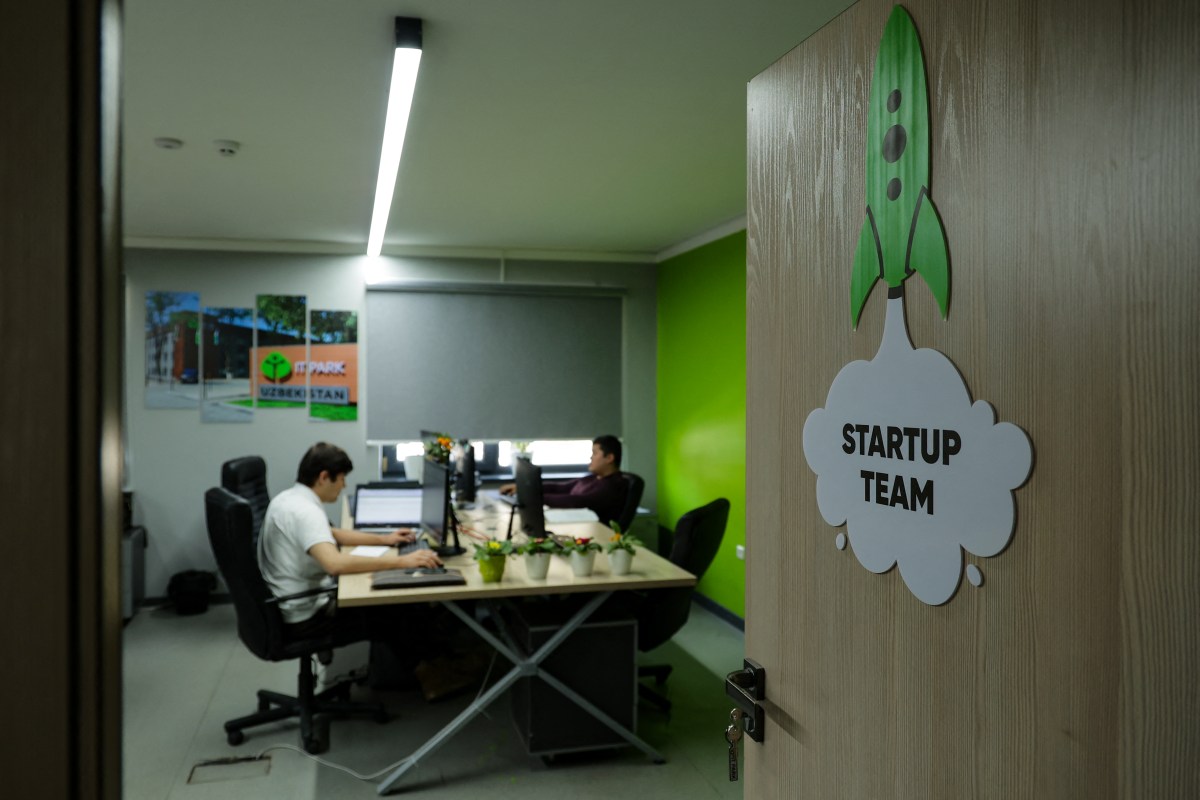
Park Uzbekistan is emerging as a thriving technology hub, with growth spreading across the country’s regions. Export-oriented firms, foreign companies, and technology service providers are establishing operations.
The ecosystem is already showing tangible results. After experiencing one of the fastest growth rates among emerging markets, Uzbekistan joined StartupBlink’s Global Top 100 Startup Ecosystems in 2025, placing 98th worldwide. In 2026, it was named Country of the Year, with a 227.3 percent increase, the fastest globally. Tashkent also became the fastest-growing startup city in Central Asia, with 132 percent growth.
IT Park Uzbekistan has become a major platform for technology exports, attracting companies from the U.S., Japan, Canada, Europe, East Asia, Saudi Arabia, Switzerland, Norway, and the Gulf. It now counts more than 2,800 member companies, including 752 with foreign investment, exporting to 90 countries. In just two months — March and April 2025—IT Park added 132 new export-oriented companies, including 56 with foreign capital, with projected first-year exports exceeding $30 million and more than 1,600 planned jobs — more than two new firms every day.
IT Park already hosts U.S. firms like EPAM, First Line and dozens of Delaware-registered startups exporting to 90 countries. That is U.S. tech diplomacy, which gives a commercial foothold that China cannot easily replace.
The country’s venture market surged from $69.5 million in 2024 to $329 million in 2025, fueled by UzVC, IT Park Ventures, and both new domestic and international funds. Investors are increasingly favoring support for growth-stage companies over focusing solely on pre-seed funding.
Beyond Uzum, other companies have demonstrated that digital financial services can scale effectively. Startups across several sectors are increasingly finding customers. Firms are no longer operating in isolation. In Central Asia, larger venture capital pools, foreign involvement, and a growing number of founders able to build globally competitive businesses are emerging.
For Washington, the stakes go far beyond one unicorn. As Eurasianet recently reported, the U.S. effort to pressure Central Asian states on AI development is falling flat. Washington launched Pax Silica in late 2025 to secure trusted supply chains for AI, semiconductors, and critical minerals. Beijing countered with its own World Artificial Intelligence Cooperation Organization (WAICO). Kazakhstan has already joined both, and the State Department is now drafting a letter warning partners that “to be part of everything is to be part of nothing.”
Investors will keep examining regulatory predictability, corporate governance, and credible exit options. Challenges persist, but these issues are common elsewhere in Central Asia; now Uzbekistan has started delivering enough results to justify these questions.
Uzbekistan is not alone in pursuing this strategy in Central Asia. Kazakhstan’s Astana Hub and other regional initiatives are vying to attract technology companies, founders, and investment.
The significance of Uzum’s rise is not simply that Uzbekistan has produced a unicorn. It is that investors now have a concrete example of a Central Asian technology company reaching scale. Whether others follow remains uncertain. But the conversation has already changed.
If the U.S. doesn’t keep companies like this in its sphere of influence with capital and market access, China and Russia will with cheap loans and surveillance tech. Uzum’s real significance is not that Uzbekistan produced a unicorn. It is that an entire region suddenly looks investable. The next chapter of competition with China and Russia may not be written in military bases or diplomatic communiqués, but in startup incubators, venture funds, and lines of code.
A few years ago, the question was whether Uzbekistan could produce a unicorn. Today, the question is who will finance the next 10?
Bruno S. Sergi is an instructor at Harvard University’s Sustainability and Global Development Practice Graduate Programs and a full professor at the University of Messina, Italy. At Harvard, he is also affiliated with the Harvard Center for International Development, the Davis Center for Russian and Eurasian Studies, and the Harvard University Asia Center.
The views expressed in this article are the writer’s own.
Request Reprint & Licensing
View Editorial & AI Guidelines
