

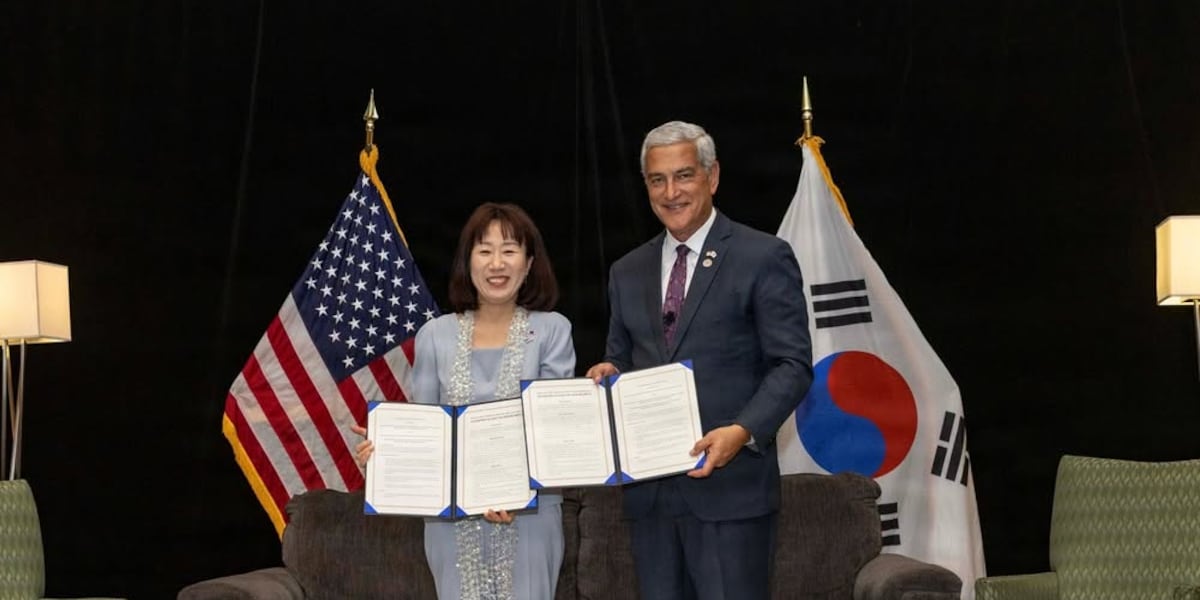
South Korea (KLTV) – A new partnership between the U.S. and South Korea will expand efforts to recover and identify unaccounted-for American service members from the Korean War
The U.S. Defense POW/MIA Accounting Agency (DPAA) and the Republic of Korea Ministry of Patriots and Veterans Affairs (MPVA) signed a memorandum of understanding on August 7 to expand cooperation between the two countries.
In a news release, MPVA Vice Minister Kang Yun-jin pledged the two countries would never forget the sacrifices made during the Korean War.
“We will never stop searching for POWs and MIAs until the very last person is returned to their home.”
The MOU signing coincided with the DPAA’s annual Korean/Cold War Government Briefing in Omaha, Nebraska, where the agency also announced a significant milestone toward these efforts.
The 800th identification from the Korean War was a soldier from Texas.
According to the DPAA, PFC Ricardo Garza of Taft, Texas, died in July 1950 when the U.S. Army’s 21st Infantry Regiment was attacked by North Korean soldiers near the town of Chochiwon, South Korea.
“After the war, his remains could not be identified and for years he was buried as an unknown in the National Memorial Cemetery of the Pacific,” said Anthony J. Tata, Under Secretary of War for Personnel and Readiness.
This 800 milestone is in addition to the 2,000 Americans identified immediately following the end of the war.
Of the more than 36,500 U.S. casualties in the Korean War, the Pentagon still lists more than 7,300 personnel as missing, including 458 from Texas.
According to the DPAA website, 5,300 were lost in North Korea, with most dying in major battles or as prisoners of war.

In an interview Wednesday in Seoul, Vice Minister Kang said many remains have been located near the Demilitarized zone, where many of Korea’s present efforts are centered.
Efforts to return remains began in 1953 with signing of the Korean Armistice Agreement. Thousands of deceased were repatriated after remains were turned over by North Korea, recovered from field searches, or exhumed from temporary battlefield cemeteries. Decades later, in 1990, the North Korean government resumed turning over remains of missing personnel, according to the DPAA. The agency’s website shows 208 boxes of human remains were returned over the next four years. DNA testing began in 1992, according to the U.S. Dept. of War. Starting in 1996, the U.S. military conducted 37 Joint Recovery Operations in North Korea until field recoveries were suspended in 2005. The most recent unilateral turnover of remains came in 2018, when 55 additional boxes of remains were returned following a summit between U.S. President Donald Trump and North Korean leader Kim Jong Un. That same year, the U.S. approved the disinterment of 652 ‘Korea Unknowns’ buried at the National Memorial Cemetery of the Pacific, also known as the Punchbowl. The DPAA also conducts multiple investigations each year in South Korea. A dedicated team, called the Korean War Identification Project (KWIP), is made up of historians, anthropologists, odontologists, and DNA and isotope specialists who work to identify missing Korean War personnel.
Advances in technology have led to more identifications, including several East Texans. In 2011, Army Sgt. Lee D. Henry, Jr., of Tyler, was identified using dental comparisons.
A Wood County service member’s remains were among the estimated 250 individuals represented in the 2018 release of 55 boxes. In late 1950, U.S. Army 1st Lt. George S. Crisp, of Alba, was fatally wounded by Chinese Communist Forces during the Battle of Chosin Reservoir in North Korea. Crisp’s remains were identified through DNA testing in 2019 and was later interred at Arlington National Cemetery.
A Jasper County Korean War soldier was also identified from the ‘unknowns’ disinterred from the so-called Punchbowl in Hawaii. In 1950, U.S. Army Cpl. Orestus Marion Stewart was killed in action as his unit seized control of an airfield near Kyong-ju, South Korea. It wasn’t until 2025 that the military identified his remains using mitochondrial DNA analysis. Stewart was laid to rest in Magnolia Springs in May.
For other East Texas families, the wait to identify loved ones has extended beyond seven decades. A memorial plaque in Nacogdoches lists the names of three service members still listed by the DPAA as unaccounted for: Sgt. Nathul Sewell of Angelina County, Sgt. Custer Mooney of Nacogdoches, and Cpl. Billy Smith of Nacogdoches.
Sewell was captured in November 1950, as his unit defended the west bank of the Chongchon River and was marched to a prisoner of war camp in Pyoktong, North Korea. The U.S. military lists Sewell as having died on or before March 31, 1951.
Mooney was reported missing in action in December 1950 withdrew from the area around the Chosin Reservoir.
Smith was captured in December 1950 and was marched to the Death Valley prisoner of war camp in Hofong, North Korea, where he died in early 1951, according to his DPAA profile.
These East Texans are among the 80-thousand American service members who are missing or unaccounted for from all conflicts, who will be remembered on Friday, September 18 as part of National POW/MIA Recognition Day.
KLTV & KTRE anchor Lane Luckie is traveling to South Korea to explore the ties between East Texas and one of America’s closest allies.Click here for more coverage.
Copyright 2026 KLTV. All rights reserved.
