

In the depths of the pandemic Audrey and Ryan Brown remember feeling the weight of a future that seemed like it was only becoming more uncertain. Like many families, the couple was worried about whether opportunities would be available for their four children years down the road.
They remembered reading Buy Then Build, a popular book promoting the concept of entrepreneurship through acquisition, a way of becoming a business owner and operator by purchasing an existing company rather than starting one from scratch.
Keep up with local business news and trends
We will never send spam or annoying emails. Unsubscribe anytime.
This site is protected by reCAPTCHA and the Google Privacy Policy and Terms of Service apply.
In going down that road, they’ve gotten a crash course in how hard business can be.

They’ve now not only purchased and modernized an existing business, but experienced a roller coaster of emotions amid attempts to establish a new revenue line, only to push through and develop something totally new. The result of their struggle is an app that they hope will have utility for many other businesses and DIY makers alike. They’ve also learned a lot—even if it hasn’t always been fun or easy.
The Browns were attracted to the idea of becoming their own bosses after each stringing successful careers in their own right—Ryan in marketing, brand strategy, and customer experience with high level roles at FleishmanHillard and New Honor Society, and Audrey with experience in operations and finance, with stints at Thomson Reuters and more recently at Ss. Peter & Paul Catholic School and The Journey church in Tower Grove.
“We have these skill sets, they’re complementary,” Audrey explains. Which made them wonder: “Why not take what we have, do something on our own and actually just be working for ourselves? Then we’re in control.”
With that direction set, the two began searching for businesses to purchase. Ryan explains they were “looking literally for a dusty shop” with more than a decade in business, where most of the operations had yet to be digitized, but which had solid revenue growth and an existing client base.
“We were looking for a business that didn’t have a succession plan, so that the owner was the operator, but the operator wanted out,” he says.
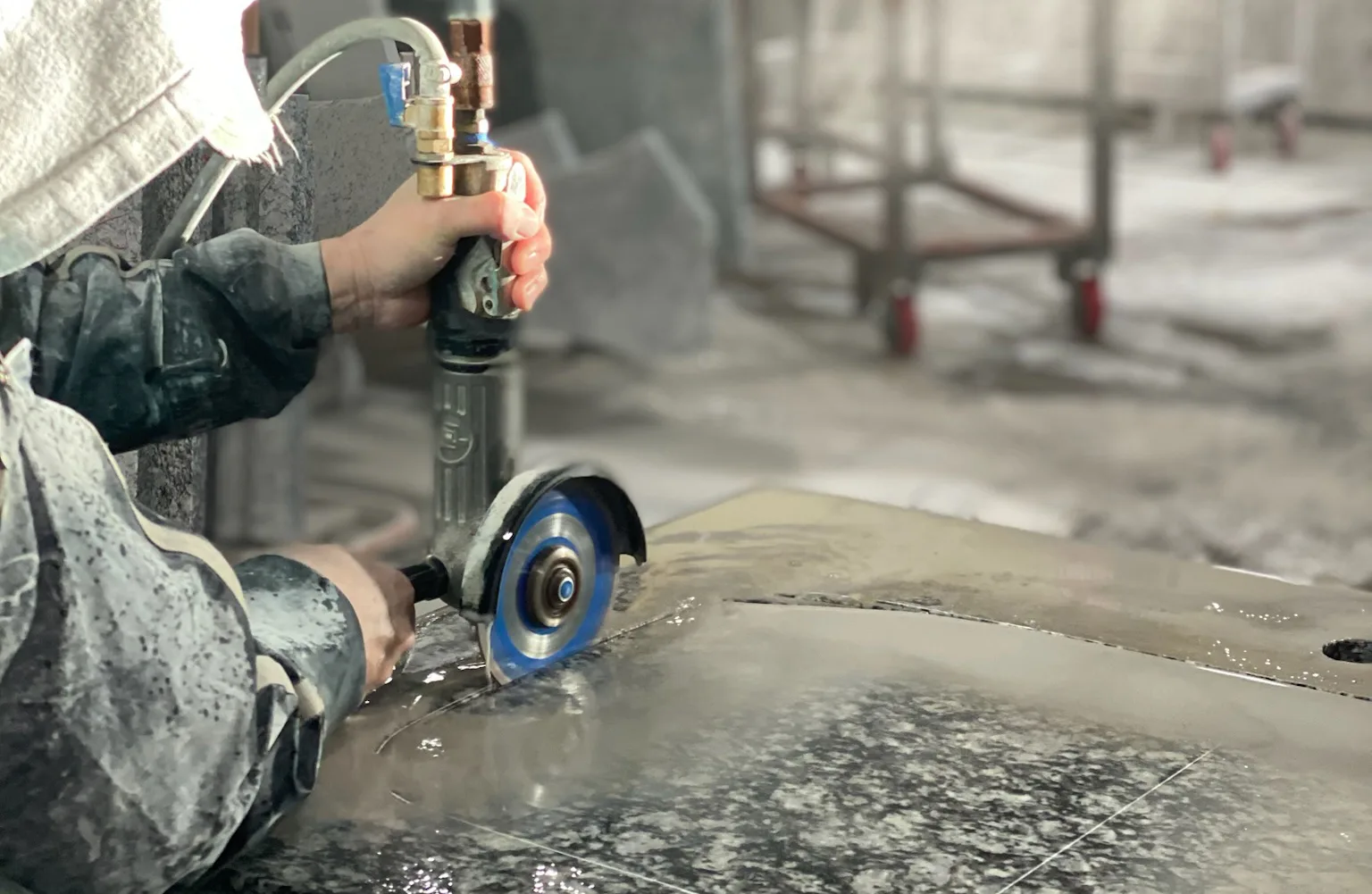
They eventually landed on Rock Creek Granite, a countertop fabricator and installer located in Imperial, and spent close to a year “courting” the business and performing due diligence before officially purchasing it for about $1.5 million in the middle of 2022. They pulled together enough funds and collateral to qualify for a loan from the Small Business Administration.
While the Brown’s story features some of the hallmarks of entrepreneurship through acquisition, such as digitizing operations that had previously only been on paper, their story diverges from more rosy tales of success that often get relayed. Their path, they freely acknowledge, was not easy.
“Ends up we didn’t do enough due diligence,” quips Audrey of the research they performed before acquisition.
Part of what they found intriguing about the business was the prospect of making use of the excess material left over from previous countertop jobs. They had visions of saving the scraps from the landfill, which is where some leftovers from construction projects often go.
And there was a whole lot of it at Rock Creek Granite—some $500,000 worth, according to a report they reviewed before finalizing the purchase. “It talked in detail about how much of that material was of a certain grade, a certain size, and then the estimated total value of it, and how that estimated total value basically went towards the business valuation,” says Ryan.
It was only after they purchased the business that they realized all that excess material was practically worthless, because the leftover shapes weren’t what most countertop projects require.
“To hear that all of that—and to feel it in real time—is worth nothing, it was like, ‘Oh my god, that was snake oil. I just bought a whole bunch of snake oil,’” says Ryan. “I think it’s the first time we felt like the rug was pulled out from us a little bit.”
Rather than accept the leftover countertop material would always be destined to gather dust or wind up in the trash, the two began exploring ways to make use of it, especially after realizing many other fabricators face similar challenges with excess material.
“There’s that saying of ‘it just takes the right buyer,’ but in our case, we sit up on a bluff down on the edge of Arnold and Imperial, in an industrial park, so the right buyer is not driving by us to find these pieces. How do we bring these pieces to the buyer, the DIY-er?” Audrey says.
The Browns figured a LiDAR-based application could gather the dimensions of leftover countertop material and form an inventory they could then manage and sell from. They decided to build an app, and enlisted the help of an outside developer. When that relationship soured, they found a new developer and pulled together enough money to commission a prototype.
“It was irresponsible,” admits Ryan of continuing to pursue an app. “But we were like, ‘We got to do it. This is why we got into this business.’ Like, ‘Go all in, even more.’”
After they received a prototype application for an iPhone that could scan countertop dimensions, they realized they didn’t have enough funds to continue working with that developer. But Ryan says he held onto the projects’ files and, with the help of Claude Code a few years later, eventually found a way to build a consumer-facing app.
Last month, the couple launched Novaclad, which generates an estimated cost for new countertops based on the dimensions it scans.
They don’t see the app generating templates to cut a countertop from, at least not yet, since countertop fabrication requires precision down to 1/16” and LiDAR from a phone isn’t sensitive enough. But Ryan says it offers a solution to a common friction point in the process of getting new countertops, where a consumer may balk at a bid that’s thousands of dollars more expensive than they may have expected.
“Over time, our whole competitive moat is that we are feeding it fabricator-specific information that makes it actually actionable. So that the price tag you see is a price tag that you’ll pay,” he says.
The couple sees this technology helping other fabricators in the country who face similar challenges with excess material get connected to customers looking to price out specific materials from manufacturers they live nearby. And they have visions of expanding it as a platform for other building projects that commonly experience leftover materials.
“We’re at this point now where we’d much rather shift our energy into Novaclad or what we call the fabrication cloud, where it’s grabbing the right material and it’s pricing it out for the customer,” Ryan says. “That has the far bigger potential, and not just in some countertops. In tile, wood, drywall, paint.”
Says Audrey, “Think about all the reclaimed wood that’s out there, or the old wood. [Someone may] try to sell it but a lot of it just gets thrown in the trash.”
Before that lofty vision can be achieved, Ryan says they first have to get Novaclad connected to their specific live inventory at Rock Creek Granite. Both acknowledge balancing the development of Novaclad while running a fabrication business has been taxing on their relationship.
“Rock Creek has always been our test kitchen for the app,” Ryan says. “What Audrey’s exhibiting is a fatigue with keeping the test kitchen running while we figure out this app.”
But, both say, it’s gratifying to reach this point all while macroeconomic shocks, such as high diesel costs, inflation, and tariffs, have thrown a wrench in purchasing decisions, even as they’ve worked to modernize many aspects of their fabrication business.
They’ve managed to keep revenue stable at about $2.5 million a year and retain most of the existing workforce. They’ve also helped develop their employees’ skillsets beyond fabrication to include working with higher tech manufacturing systems and managing the digital e-commerce systems and inventory spreadsheets Rock Creek Granite now uses.
“We just have streamlined the business so much and from day one to now, but we’re still looking at a huge uphill path of things that we can still do,” says Audrey.
Even with the challenges they’ve endured the past four years, both have found the experience to be worthwhile. When asked if it’s something they’d do over again, Ryan looks to Audrey. “Be honest,” he says.
She pauses a moment and answers: “Yeah, probably, to be honest.”
“Really?” Ryan responds. “I wouldn’t.” He then clarifies he would instead pick a different business to acquire. “It’s been that hard,” he says.
Audrey acknowledges the experience has weighed on their nearly two-decade marriage, but “the learning and the growth that we’ve done over the four years is definitely worth it. I think it’s been good for our kids to see us do it.”
They say their four children have watched as they’ve responded to the different challenges in the business and have come away with the resolve to pursue their own ideas. At 10, their youngest has already built a website for custom golf gloves he aims to sell, and their oldest has gotten involved in helping gather donations to save the Compton Hill Water Tower.
Reflects Audrey: “They’re seeing how their ideas can actually come to life with a little bit of creativity, risk, and confidence to put themselves out there.”
