

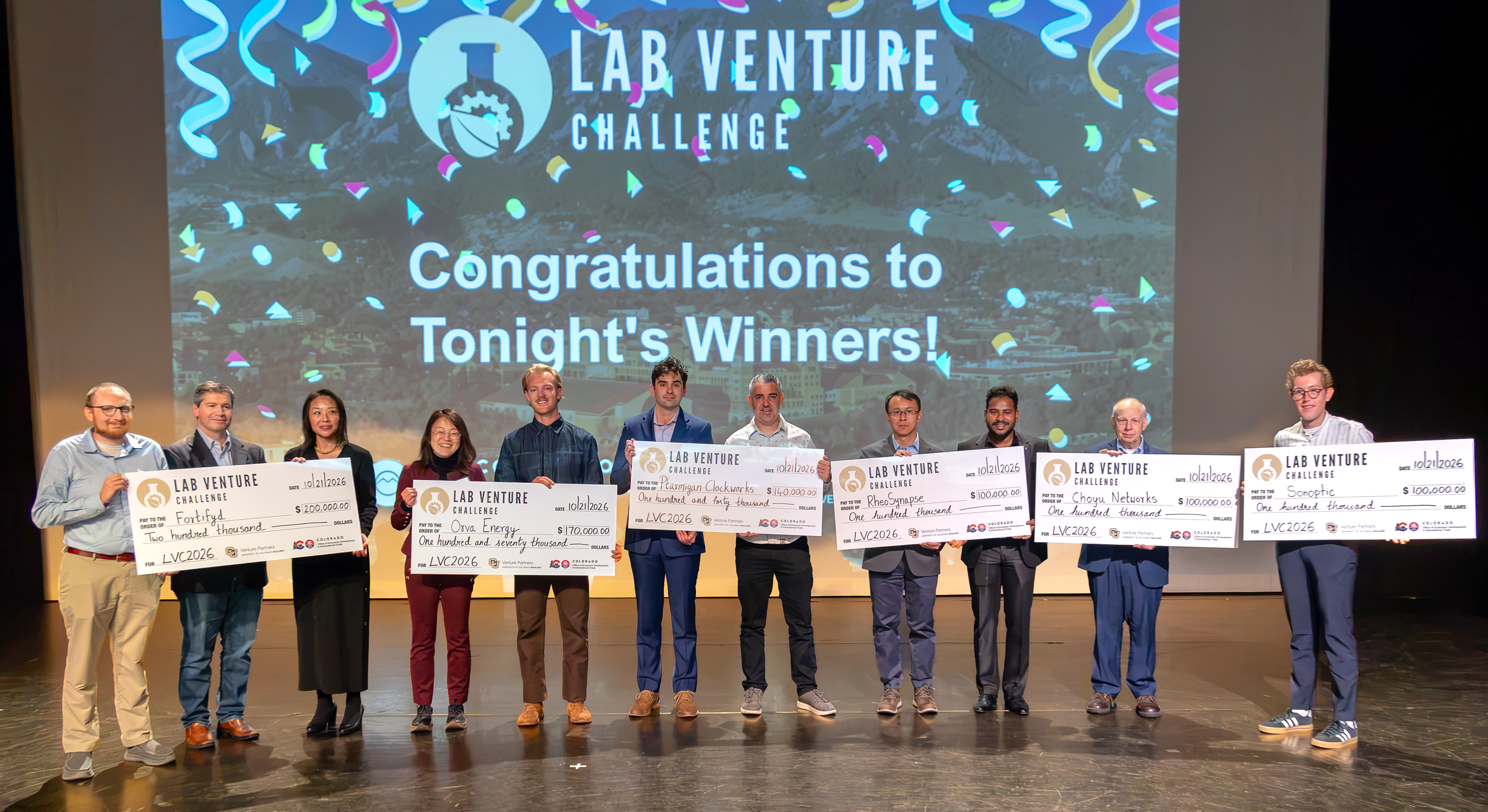

Twelve University of Colorado research teams competed for a combined $1.6 million in startup funding grants in this year’s Lab Venture Challenge (LVC). Judges from CU’s entrepreneurial network heard Shark Tank-style pitches across two nights at the Dairy Arts Center in Boulder, one for innovations in biosciences and another for physical sciences and engineering.
Through LVC, top innovators from CU Boulder, Denver and Colorado Springs can compete for grants to fund projects that address a commercial need, have a clear path to a compelling market and have strong scientific support.
Materials Science and Engineering faculty are part of three different teams to receive funding:
$170,000 — AI-Accelerated Advanced Battery Materials
- To Orva Energy, co-founded by Professor Chunmei Ban.
- Orva Energy is developing a new class of high-energy, beyond-lithium battery active materials made entirely from earth-abundant, domestically sourced elements. By integrating ML/AI with proprietary advanced crystal-structure engineering, their materials enable energy parity with conventional lithium systems at a fraction of the cost. The team has formed a startup,Orva Energy, to bring their innovation to market.
$100,000 — Intelligent Electronic Skin Transforming Prosthetic Diagnostics
- For RheoSynapse Inc, co-founded by Associate Professor Jianliang Xiao.
- Intelligent liquid-metal electronic skin embedded in prosthetic sockets for real-time pressure mapping. AI-driven analytics learn each patient’s pressure patterns to predict socket issues before they cause pain. This affordable, scalable system gives prosthetists data-driven insights to improve socket fit and daily comfort. The team has formed a startup, RheoSynapse Inc., to bring their innovation to market.
$100,000 — AI Designed Biomaterials for Regenerative Medicine
- To Regelife Inc., co-founded by Professor Kristi Anseth.
- Cell therapies are grown in Matrigel, an undefined mouse tumor extract that varies lot to lot; every alternative is one formulation sold for every use. Regelife uses machine learning to design the matrix around the cell, turning 18 months of trial and error into one kit. In ALS, the matrix decides whether transplanted neurons survive. Built on Anseth Lab hydrogel chemistry at CU Boulder. The team has formed a startup,Regelife Inc., to bring their innovation to market.
Find out more about their companies and all the winners…
