

DigitalEdge
Make The Edge Malaysia your preferred
<img src="https://theedgemalaysia.com/_next/image?url=https%3A%2F%2Fassets.theedgemarkets.com%2FDE14-image4-TEM1644_theedgemalaysia.jpg&w=1920&q=75″ alt=”main news image” loading=”lazy”>
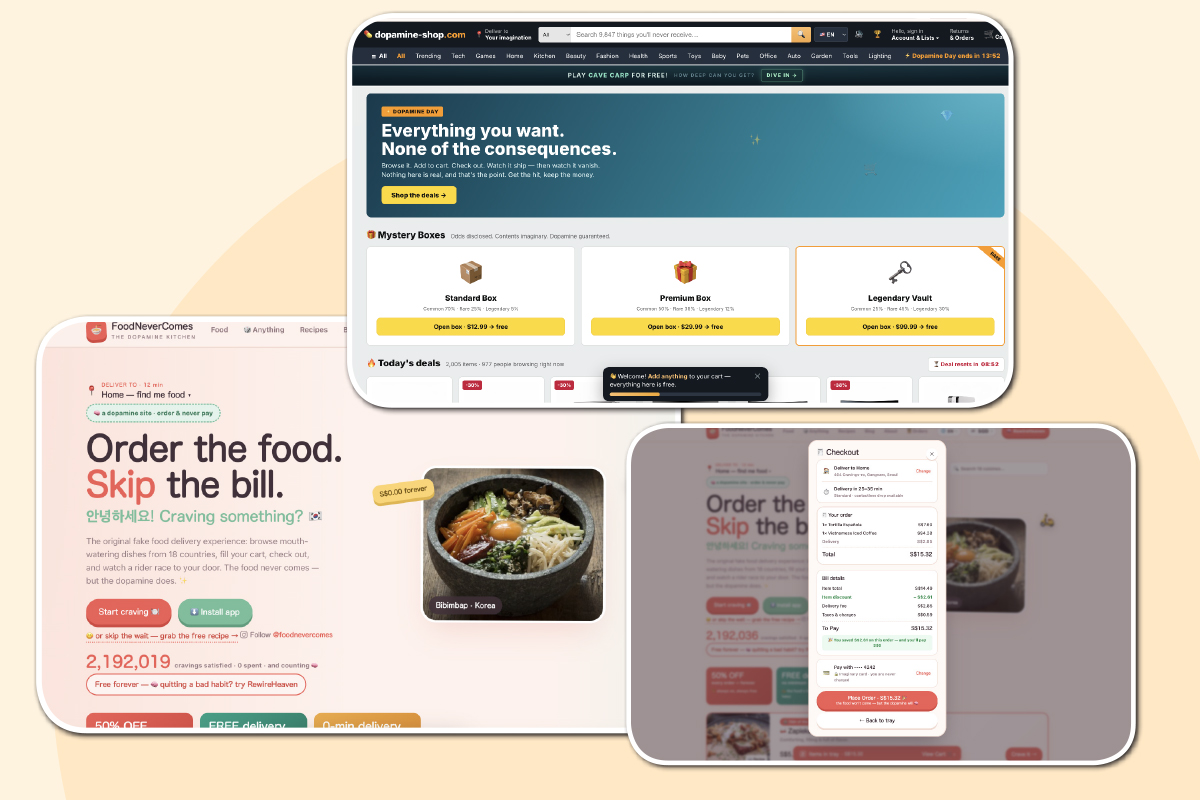
Last week, I learnt about something called a “dopamine site”, which is basically a website that lets you shop without spending any actual money.
One of them, Dopamine Shop (dopamine-shop.com), looks like any other online marketplace, with a search bar, shopping cart, deals, mystery boxes and the promise, “Everything you want. None of the consequences”.
The beauty of Dopamine Shop is that it does not care whether I have RM500,000 lying about or whether Audemars Piguet would actually sell a first-time customer a much-coveted Royal Oak at retail.
I simply add an Audemars Piguet Royal Oak 34 Dial Pink Gold lookalike to my cart, click “buy” and enjoy the closest I am likely to get to owning one, irrespective of the status of my actual bank balance.

The fun is in how familiar it all feels, from the tantalising deals and nail-biting countdowns to the satisfactory reviews and the joy of seeing the little cart icon filling up as you add more things you do not need and cannot afford.
Then there is foodnevercomes.com, which does the same thing with food delivery, letting you browse dishes, customise your order, fill your cart, “pay” and even track a fictional rider heading towards you.
There are deals, recommendations, free delivery and even fictional couriers including a turtle, bee and dragon, although, as the name warns you, the food never comes.
The trend seems to have started in South Korea before spreading elsewhere, and it is not difficult to see the appeal when the cost of actually buying things keeps going up.
There is even one called Virtual Smoke, marketed as a realistic cigarette simulation app that lets you enjoy the sensation of smoking without any nicotine or injurious health consequences.
There is also some logic behind the names: dopamine is a neurotransmitter and neuromodulator involved in reward processing and motivation, while anticipation itself can be part of the pleasure.
In all honesty, perhaps the exciting bit was never owning the watch but imagining, very briefly, that I could.
Perhaps dopamine sites are not an escape from consumerism at all, but proof that online shopping has become so good at selling us the feeling of buying that we no longer need the product.
Now, are these sites problematic? Probably yes.
Could they encourage the same compulsive habits that make real online shopping so easy to overdo? Also probably yes.
We already know that the free-to-play economy is not really free.
There are already serious concerns of addiction in areas such as free-to-play video games that cost nothing to download but are notorious for using hidden costs and manipulative designs to trick players into spending seemingly innocuous amounts of cash (usually between RM5 and RM30), all the while making billions via loot boxes and microtransactions. Countries such as Belgium, Brazil and China have enacted strict regulations against loot boxes, which are mystery items in video games that give players a random selection of rewards.
I also do wonder whether getting used to the thrill of checking out without worrying about the cost, could reduce inhibitions of risky decisions and eventually make things worse when we return to real shopping, where enticing options such as “buy now, pay later” already make it very easy to buy first and worry about paying later.
There is also something slightly sad about pretending to buy things because buying the real thing is increasingly out of reach.
And the fact that dopamine sites emerged from one of the world’s most consumer-driven and digitally connected societies probably says something about how this could manifest into a problem.
On the positive side, perhaps filling an imaginary cart with absurdly expensive watches gives me something to work towards. Moreover, the entire concept is remarkably sustainable, as there is no packaging, no delivery bikes, no returns and no pile of regrettable purchases gathering dust at home — except, of course, for the small matter of my data (or, in the case of the Audemars Piguet, a deep secret) potentially being harvested along the way.
And these sites are certainly useful in dampening my shopaholic tendencies by letting me scratch the itch without spending a sen.
Either way, my Audemars Piguet should be arriving never.
Save by subscribing to us for
your print and/or
digital copy.
P/S: The Edge is also available on
Apple’s App Store and
Android’s Google Play.
