

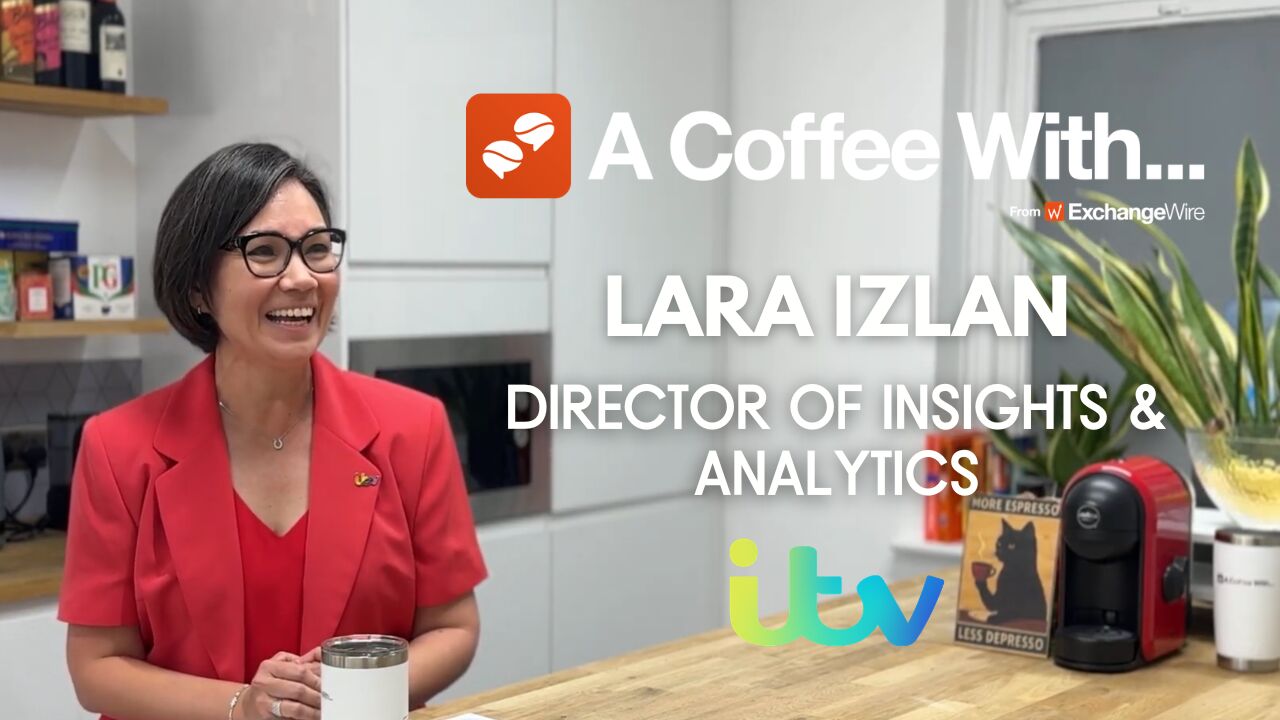
“The Flip Side of Fragmentation is Choice”: A Coffee With Lara Izlan, ITV
In this episode of A Coffee With… Lara Izlan, director of insights & analytics at ITV, joins ExchangeWire’s John Still over a matcha latte to chat experimentation and data strategy in an increasingly fragmented media landscape.
The conversation underscores the shift of data teams from back-office support to central strategic partners in media. With nearly 25 years of experience across media and data, Lara is leading a newly formed group that unifies research, data science, and data analytics. This integrated team leverages blended data and insights to inform business decisions for ITV.
Lara emphasises that experimentation and a proactive test-and-learn approach is essential to navigate fragmentation and intense competition. By integrating data-driven insights across functions, companies can turn consumer choice into growth. AI supercharges this, equipping teams to build more effective, multi-dimensional strategies for the future.
The Evolving Role of Data and Insights Teams
Lara outlines how data analytics has evolved from spreadsheets to big data, cloud platforms, and AI. Data teams have moved from reactive black box operators to proactive partners embedded in strategic planning from the outset. This shift demands that data professionals be influential communicators and storytellers who translate complex analyses into actionable decisions.
Having worked across centralised, decentralised, and hub-and-spoke models, Lara asserts that there is no one-size-fits-all operating model for data teams. The optimal setup depends on a company’s context and maturity. Companies must cultivate a partnership mindset, working alongside stakeholders to inform strategy upfront rather than merely measuring outcomes afterwards.
The Importance of Experimentation
Beyond planning, activation, and measurement, Lara argues the “learning” pillar – experimentation – is often neglected. A test-and-learn and fail fast culture is key to navigating a rapidly changing, competitive media environment; it empowers teams to think more expansively, keeping business models relevant and viable.
“You’ve got an established set of roles, the people and the skills that you need to be able to do planning and activation, etc. You have a set of tools – especially CDPs, DMPs, programmatic stacks – that can do activation. Measurement is a portfolio; we talk a lot about trying to get a unified view across a fragmented space but effectively, I think it’s a portfolio of capabilities. Experimentation uses all of those inputs with a certain culture or mindset to it […] that allows you to be curious and be brave.” — Lara Izlan
Lara cites ITV’s long-term holdout tests for the ITVX streaming service: by withholding new features from a small user cohort, they can quantify cumulative, incremental impact over time. This approach has demonstrated ITVX’s improving value proposition and contributed to it becoming one of the UK’s fastest-growing streaming providers.
Navigating Media Fragmentation
The fragmented media landscape complicates competition for attention. The task is to use data and experimentation to decode viewer behaviour within this complex ecosystem. Lara sees the flip side of fragmentation as consumer choice. She advocates shifting from a single-formula strategy to a multi-dimensional, portfolio-based approach tailored to varying contexts.
AI has arrived at the right moment to address this complexity. By analysing vast datasets and model multiple scenarios simultaneously, AI enables multi-optionality, helping media companies better understand viewer choices to optimise strategies across platforms and content types.
AIAnalyticsDataFragmentationMeasurementStrategyTV
