

An excerpt of this piece appeared in Cog’s weekly newsletter. To become a subscriber, sign up here.
When I think of AI, the first things that come to mind are: billionaire tech bros, the data center wars, our new weirdo data-scraping internet (thanks Google), job loss, kitchen-sink dinner recipes, bloated writing, medical research and sycophantic chatbots that some users think of as friends, medical professionals, even lovers.
What I definitely do notthink about when I think about AI is creativity. To me, AI is the antithesis of creativity. It removes the struggle and the “terror of the blank page;” the process of writing is how I figure out what I think. To quote the patron saint of essays Joan Didion: “I write entirely to find out what I’m thinking, what I’m looking at, what I see and what it means. What I want and what I fear.” (That’s from her essay “Why I Write,” first published in The New York Times in 1976, opposite an interview with Saul Bellow.)
Then, a couple of months ago, I was asked to moderate a panel about AI and creativity at The WBUR Festival. We assembled an interesting collection of people, all women (as I noted in my introduction that day: “No man-els, here!”). My goal was to create the space for a nuanced conversation about AI, not a predictable, knee-jerk “AI-is-awful-and-terrible-for-our-brains” type thing.
This week, I want to introduce you to this brilliant panel, and share a few highlights from our conversation.
Ann Handley, an author and marketing expert, runs the company Marketing Profs, an education and training platform for other marketers. Her book, “Everybody Writes” is a best-seller, and her latest book, “As Slow As Possible,” will be published in early 2027. Many of her clients are under intense pressure to use AI, to be more efficient, to do more faster. But, in her experience, it doesn’t always work out.
We have the ability to do all of these things, to move faster and more efficiently, but I think it’s incumbent on us as people to choose when we want to slow ourselves down intentionally because the world isn’t going do that for you.
We also welcomed Sasha Stiles, a poet and an artist, who’s fascinated by the places where art, science, poetry and technology overlap. She works at the intersection of text and technology, and investigates how generative AI may — with the right inputs, ethical considerations and applications — turbocharge cognition and creativity. Interestingly, what makes Sasha able to do the work she does in the way she does it, is her lifelong study of the classics and literature. Sasha told us:
I think my great joy in life is to work with language in ways that push beyond the limits of language, and take language into a new place, and hack grammar, and hack syntax. In a way, maybe working with these machinic models is kind of a way of doing that. It’s a way of using language to kind of go beyond language itself.
Rounding out our panel wasJane Rosenzweig. Jane publishes two popular newsletters on Substack: the first, “Writing Hacks,” is her own work about the implications of generative AI for writing; the second, “The Important Work,” features reflections from other educators about teaching in the era of generative AI. At the time of the panel, Jane was the director of the Writing Center at Harvard College, a position she’d held for more than two decades. In recent years, she also taught a writing course called “To What Problem Is ChaptGPT the Solution?” and co-designed the curriculum for all incoming Harvard students about AI. But in late July, Janelost her job. As part of “restructuring,” Harvard’s administration laid off 13% of the staff at Harvard College, and closed the Writing Center. After the news broke, more than 100 current and former Writing Center tutors wrote an open letter condemning its dissolution. At the panel, Jane said:
My students write research papers at the end of the semester, and this was the first semester of the six times that I’ve taught this course where a number of them came to me with their concerns about generative AI. One of them was working on cognitive offloading, and he was sitting in my office, and he said, ‘I just can’t get around the idea that this is going to make everyone in my generation really stupid.’
I don’t use AI very much. I tap it when I’m making travel plans or trying to come up with a good full-body dumbbell workout I can do at home. But AI, as a topic, is now impossible to avoid.
I worry about what it will do to my job, and to independent journalism. I worry about the effect it will have on our social contract. I worry about what it will do to my children’s brains and to creativity. As the designer Debbie Millman wrote recently, “Before a person lets a machine imitate her voice, she should have endured the long, uneven, often humiliating process of acquiring one.” There are benefits to productive friction.
You can listen to the conversation here, or read the transcript below, which has been edited for length and clarity.
Cloe Axelson:Your course, Jane, is designed to be completed with zero AI. Can you tell me why?
Jane Rosenzweig: I teach a course called “To What Problem Is ChatGPT the Solution?”, and we don’t actually use AI to do the writing. It’s part of the first-year writing curriculum at Harvard College, so I’m teaching in a program where every first-year student is taking a writing course.
Only about 15 of them are taking mine. But we have so far, as a program, had the policy that this is a place where we want students to learn how to think and write on their own so that whatever they’re doing in their other courses and in the future, they will have that background already. I always say to my students you’re going to be doing a lot of different things in other courses.
Sometimes you’ll use artificial intelligence, sometimes not. But what I want is for you to know how to do the thing yourself so that the decisions that you’re making in the future will be be informed by that kind of deep understanding of critical thinking and writing.
CA:So, Ann. People in your world — the marketing world — are getting a lot of pressure to use AI. To do more, be faster, be more productive. And I’m wondering, how are they using it? Is it working? And then can you tell us a little bit about how you, use AI and when you decide not to?
Ann Handley: I run a company called MarketingProfs, which is a training and education company for marketers. And, as Cloe says, I’m sure some of you here who work in business know this, but, especially in the marketing world — in the content world — there’s a lot of pressure to use AI to make your production more efficient.
Not necessarily more effective, but to be more efficient. And so the goal is how much faster can we go? But how effective is that, right?
I think that’s the big question. I think it varies. It depends on, how people are choosing to implement AI, because right now, even in marketing — and I don’t know if this is true in, in either of your worlds too — but it’s a little bit of the Wild West.
If you talk to the AI companies, they’re saying: “Yeah, you can use it to more efficiently to do all of these tasks, and it’s a productivity turbocharger, it’s 10X-ing everything.” And if you talk to the leaders of these companies, they’re so- saying “Yes, that’s absolutely what we want.”
But then it’s also up to individual people and their managers at those companies To figure out what that means. I think it’s very uneven how it’s playing out. In terms of how I use it I just finished a, a book that’’ll be published next year by Penguin Random House, and it’s called “ASAP: As Slow As Possible,” as Cloe said, and it’s about choosing or when to take the long road in a shortcut world.
We have the ability to do all of these things, to move faster and more efficiently, but I think it’s incumbent on us as people to choose when we want to slow ourselves down intentionally, because the world isn’t going do that for you. I think that same tension that’s playing out in business is also playing out in what I feel in myself as a writer and as a creative person.
I guess to answer your question, I don’t think anybody really knows how it’s going. It’s like you have your AI enthusiasts, you have a, AI haters and I think, there’s a lot of people that are just trying to still figure it out at this point.
CA:We’ll get to that question, Ann. But first I want to turn to Sasha. I think lots of people, maybe even some folks in this room, have a knee-jerk reaction to AI. They think that using it is a lazy approach to writing. But Sasha, I learned you have an AI sort of alter ego a transhuman, in your word, named Technelegy.
And in very simple terms, and forgive me if I butcher this, but my understanding is it’s an AI system that you trained and coded to emulate and augment your own writing voice. I’ve heard you say it’s like a prosthetic imagination, in a sense. We’re going be open-minded here on this panel. And I want you to help us understand what are people misunderstanding when they have that knee-jerk immediate reaction?
Sasha Stiles: I started working with large language models in 2018. And I got interested because I’d always been a tech nerd. I’ve always been a sci-fi nerd. I’ve always been really interested in speculative futures and, avid reader of Wired and things like that.
So when I was reading about these early transformer architectures, I instantly felt myself freeze. As a lifelong writer, some chill went down my spine. What does this mean? I’m a lifelong poet. I studied language and literature as a Harvard undergrad, in a time before there were any, AI courses or curricula to speak of.
That’s my background. I’m coming from a humanities-based language arts background. And I got interested in AI because I wanted to know more about how large language models really relate to communication and what they have to do with our, human speech, our human language and the way that we write, the way that we think, the way that we communicate with one another.
And, so it came out of being unsure of what to expect and being skeptical, and then on the other hand, feeling absolutely exhilarated by the possibilities. And just thinking, Okay as a poet, I think my, my great joy in life is to work with language in ways that sort of push beyond the limits of language, and take language into a new place, and hack grammar, and hack syntax.
And in a way, maybe working with these machinic models is a way of doing that. It’s a way of using language to go beyond language itself. And so that really enthralled me and pulled me into it. And I think because I have come to it from this very strange trajectory — I’m not comp sci, I didn’t study AI in a formal way — I think I’ve been a little bit of an outlier in the AI realm for a while. I’ve been able to bring together these different viewpoints and be able to have a little bit of a balance.
When I set about creating this alter ego that you mentioned, it actually was a process of taking my poetry that I’d been writing and publishing in traditional lit magazines and turning that into a training data set, and teaching myself, how do I take my writing and turn it into something that I can use to train a language model on?
And it was an exercise. I never had any intention of using it for anything in particular. I just wondered, how do I translate from human poetry into something that’s legible to a machine? And that kind of led me into a place of experimentation where a lot of the skepticism, a lot of the uncertainty was replaced just by the feeling of just unalloyed excitement at where that was taking me.
As a writer, as an artist, as a creative person, a whole new realm opened up, and that was the beginning of a lot of really exciting things. I think the idea of bringing poetry and technology together to a lot of people is sort of anathema.
Eight years ago putting the two things into the same conversation I think was very strange. And so a lot of my work has really been to look at poetry as not just an art form, but to think about how it actually is technological, how it is a form that is reliant on structure, and pattern, and algorithm, and to look at what it has to teach us about the way that we’re structuring these language models.
CA:I’m going to stay with you for one minute, Sasha, because I know that you’ve said that poetry is like data storage, and this feels like a good moment for you to try to explain that to our audience.
SS: In a very real way, poetry’s not just decorative language. It’s a beautiful art form, but it’s not just a beautiful art form. Poetry arose before the advent of written language because we needed a way of remembering really important human information. We needed a way to encode our memories and our stories and our legal records and all of that, so we invented poetic devices like meter and rhythm and rhyme and alliteration and assonance because they make ideas easier for us to remember.
And so when I say poetry is data storage, that’s what I mean. I’m saying that slightly tongue in cheek, of course. I’m not trying to say it’s a form of engineering per se, but I want to blur the boundary between poetry and technology. They’re not all that different in some ways.
CA: Jane, I’m gonna come to you next, and I’m wondering how the wide adoption of AI has changed the way you teach. I’m wondering if you can give me an example of something would’ve done previously but have now had to change how you interact with your students because AI exists.
JR: Before I get into that, I just want to say — because I think this is a really interesting point from where I sit — that what Sasha is able to do with AI, and thinking about it with language, seems something that she’s able to do because she also learned how to write and read and think on her own, pre the cognitive offloading concerns that we all have.
And that’s something that I think in the classroom now is on our minds all the time. How do we make sure — when there is this possibility that didn’t exist 10 years ago, five years ago — to preserve what we value in the classroom. I think that’s mostly what’s been on my mind.
I jumped into teaching about AI almost as a way of dealing with my feelings about what was happening. I wanted to just face it head on. I wanted to talk about it with my students, and it’s been an amazing experience because I do get to hear their thoughts about it all the time. But I think one of the things that’s been really challenging is a sense that the social contract between teacher and student right now. There is a feeling that maybe things have been AI generated- even when they haven’t. It’s a feeling that’s there with us in the classroom.
I think a lot of us are doing some version of what I’ve been trying to do. I haven’t moved the writing in the classroom. That’s not really feasible when you’re trying to teach people how to slowly work through a problem or a question and read deeply and those sorts of things.
I’ve tried to move pieces of that process into the classroom. We are also fortunate in our program that we have a lot of one-on-one conversations with our students built in, and those are the things that help you maintain that feeling that you and the student are in a conversation, and they’re in a conversation with their ideas.
I think one of the biggest challenges we’re facing is that nobody has solved that problem. A lot people have solved it by saying, “We’ll have blue book exams instead of writing a paper.” But if you actually teach writing, that’s not really a feasible solution, and so a lot of us are trying a lot of small things.
CA: You strike me, Jane, as a person who probably ascribes to the old Didion quote “I write to know what I think,” or something to that effect. We need young people to be able to think critically.
I was talking to a woman, a friend the other night who’s on the executive team of a company. She does strategy, and she has a very intimate relationship with Claude, as it turns out. She uses Claude like her intern. But she also said, “The only reason I can do that is because I’m, have been working for 20 years, and I know what I’m doing.”
And Ann, this brings me to you because she made the point to me that is, I think, something will resonate with you. There’s a big difference between output and the thinking that creates the output. Can you talk about that?
AH: It’s funny to me just listening to you talk about the experience you have in classrooms, Jane. It’s not unlike what I see all the time in my world. When you talk about the fact that there is a foundation that you’re trying to put down, I feel that, that tension, too, with younger colleagues.
It’s really anybody who communicates in business, which is literally all of us. I almost feel it’s like an urgency that I’m trying to convey to them. This really matters. It’s really important that you just don’t cognitively offload all of this stuff.
At my company, I’ll literally say “Take out your notebook and write a first draft by hand,” and they look at me like, “You’re nuts.” And I’m like, “I don’t actually think that I am, ’cause it’s a, a very useful way of helping you think through problems and think about what you want to say before you think about what the output looks like.”
I think it’s very much being expressed across almost every industry, and in all that we’re doing.
CA: Sasha, so you started experimenting with one of the OG ChatGPT, right? Sorta? 2018-ish? Yep. GPT-2 back then. GP- oh, GP- Very early very early. And I’m wondering if you can share with us how your collaboration has evolved over time.
SS: Sure. I also want to say — sorry, but this is one of those conversations where our minds are all going a mile a minute and before I forget, I do want to respond to what Jane and Ann were just saying.
CA: Oh, yes please. By all means.
SS:Every time there is a pivotal transformation like this in the history of human communication, and there haven’t been very many, but every time there has been this, enormous resistance in anxiety and skepticism.
I studied classics when I was younger, and I think about Phaedrus, and I think about Plato and Socrates, and this dialogue about what would happen with the advent of writing. They’re philosophers thinking in the age of oral tradition, thinking there’s nothing worse that could happen than for us to write our thoughts down.
Because writing things down calcifies an idea and freezes it and means that it’s going to make us stupid. And externalizing thought in, in the form of literacy, is going to be to the detriment of humanity. And look where we’ve come as a result of literacy. And I don’t say this blithely, but I try to also situate this transitional moment that we’re in within that context, and this longer trajectory from orality to literacy, and now to generativity.
And to understand that on the one hand, yes, it’s very important to think through, how students are using these tools? How do we make sure that these are being utilized in thoughtful ways? But also, this is opening up a door to something that we don’t really know yet, and it could be really incredible.
The point of my work is not to use AI to write my kind of poetry. It’s to open the door to experimentation to see what happens when a new form of language begins to emerge, something that allows us to think ideas and perceive things in ourselves and in the world around us that we’re not currently able to.
I think in a way, that’s also been the journey with my alter ego Technelegy, is to go from, this very rudimentary understanding of how do I train a chatbot that can understand my writing and mirror it back to me, to a deepening into this understanding of this actually isn’t about creating a chatbot.
I want to open up the door to a playground where I can begin to look at how language in this generative age is different from language in the age of literacy, and is different from the 20th century idea of broadcast culture and authoritative voice and fixed meaning.
What is AI doing not just to language, but what is it doing to meaning and to perception and to all these other things? That’s been the larger, foundation for a lot of this journey.
CA: I want to pick up on something you said, Sasha, which is that we don’t know.
There’s a whole lot of not knowing here, and I’m a child of the ’80s and ’90s. We had an Apple IIGS. I couldn’t imagine Google. I remember going off to college in 1996 and thinking, “I guess we’ll figure out this email thing” with my high shcool friends, and now we can’t imagine life without it.
And it reminds me of Wendy Mogel, who writes about parenting. Her basic thing is since we can’t predict the future, we have to really raise resilient kids who are critical thinkers. And I wonder, Jane, what you think about that. It must be so interesting to sit here and have a potential former student doing the work that she’s doing with integrity, but you’re in the trenches.
He’s worried about this. Another student was was trying to figure out whether an education is will have any value. He was looking at what a college education has signaled in the past. And he was in my office, he was bereft. He said, “I don’t know what we’re doing here anymore.”
I don’t think they need to be bereft. But I find it interesting that my students are actually very worried about this. They wantto be Sasha. They don’t want to be someone who can’t think and write for themselves.
CA:But, how do you build resilient, critical thinkers?
JR: I think we have to keep giving young people opportunities where we say we care what you think; we care what you have to say, and we have to scaffold experiences where what they think actually matters. What my students want is to be a person who has something to say. But they want to figure out what will that mean or look if nobody’s cares what they think, because a chatbot can generate something faster? I think that’s actually the challenge.
I’m much more interested in that challenge than how we stop people from cheating (although someone has to worry about that). How do we figure out how you – student — can matter, and your ideas can matter, in a world that’s just so crowded with so much output.
CA:Ann, I’m want ask you the same question about the not knowing. You had a piece then went wildly viral on LinkedIn, I think, that was in response to a piece by Matt …
AH: Matt Schumer.
CA:Matt, yes. He basically says: THIS IS THE END. Within one to five years, 50% of white collar jobs will be gone. And Anne jumps in and says, “Pump the brakes, fella.”
AH: Listen, babe. Yeah. So that piece. Matt Schumer is a tech entrepreneur. Essentially, he has invested in an AI company, and he wrote this incredibly viral piece. I forget the name of it.
CA:I can’t come up with it either.
AH: It was like basically: You will be homeless with no job. I’m paraphrasing, It’s All Over.
CA:It’s All Over.
AH: It was pretty dark. He painted a rough picture to the point where he was saying shore up your finances and hoard food. He was a step away from saying that. But it wasn’t pretty. And lot of people freaked out about it. It had enormous play. So, I wrote a counter piece to that, because it just disturbed me at such a fundamental level.
First of all, the inevitability like this is happening, get on board or be left behind. That’s something that we hear all the time. And I don’t subscribe to it because I don’t believe that’s fundamentally helpful or useful for any of us. This technology is here, and I’m not saying that we just need to, embrace it wholesale. I think we need to be very smart and, and very careful about it.
But at the same time, seeing it as an inevitability that going to destroy all these white collar jobs just seems irresponsible to me. So I wrote this viral piece about it as a way to understand why this upset me so much.
CA:The line that I pulled out, I’ll read it back to you, is: “When speed becomes cheap, judgment carries a premium.”
AH: In my world everyone’s all into how do we learn how to write a good prompt? How do we learn how to use these tools? But no one’s really ta- talking about how we insert judgment into that moment, so it’s not prompt literacy, I think it’s judgment literacy. How do we figure out those moments maybe we can build something special like Sasha’s talking about?
How do we figure out how to shore up our own skills and voices and insert meaning into what we’re doing. I think that’s what’s missing in a lot of the conversations, at least in, in the business world.
CA:OK this is an audience question, for anyone who wants to take it. Maybe Sasha, I’ll turn to you. What role do writers have to play in training models?
SS: I think writers and artists more broadly have a big role not just in training the models, but in sort of training all of us humans in how we might rethink the way we’re approaching some of this.
I get so frustrated by the talking points that sort of reiterate the dystopian tropes and this idea that that, techno-feudalist AI is completely inevitable. I’m really tired of the dominant narrative around technology being what it is, and being driven by the same people.
And I think that’s why I do the work that I do as an artist and why so many of my peers in the arts who are using technology do it too: We want to imagine alternative narratives, different possibilities and envision different futures.
I think opportunity is to think about how we can push past the very mundane, banal use cases for AI that we see everywhere and to use our creativity and our imagination as writers, as creative human beings, to think about the other applications of these really astonishing technologies that we’ve only begun to scratch the surface of.
We can’t just use these technologies to write better work emails or look through resumes. That is such a fundamental waste of what this is all about.
AI is a force that is really changing life for all of us, no matter whether we’re actively using it or not. I think it’s up to all of us to figure out do we want to just abdigate our responsibility and let it continue on the course that it’s on? Or do we want more thoughtful people? Do we want more creative writing students and artists and philosophers and musicians and people who maybe have a different perspective on what technology could be? Don’t we want them in the mix as well?
AH: Yes. I think my perspective on that is very much that in this world, writing matters. Good writing matters more now, not less.
And so even though the market may be undervaluing it, I think there’s also a counterbalance movement starting to bubble up. Where we’re asking, when do we use these tools, and when do we not use these tools? And how do we do more interesting things?
It’s an opportunity, I think, for writers to even bring more to the game. That’s the way that I’ve been thinking about it and talking about it.
CA:That’s hopeful.
AH: But I think that’s why we need to have these conversations, because they’re not happening. You can’t rely on the AI companies to say, “You know what we should do? We should get some writers to start thinking about things differently.”
That’s just not going happen. I think that’s one of the things that we’re all doing here, is just collectively trying to push a different narrative and try to support a different narrative.
CA:I’ve been trying to think about how human creativity and AI-generated creativity can coexist, somewhat happily. And a friend had an analogy for me. She said, sometimes you buy a textile from Italy, a scarf, and sometimes you buy a scarf on Amazon. Do you think that as we go forward, there will be more of a premium placed on human-generated content?
AH: Yeah, for sure. I absolutely do think so. It’s almost like artisanal content or something like that — artisanal writing, if that’s a thing. The thing that scares me, because I’ve had a long career of going through the pain of learning how to write and how to create.
The thing that scares me is that, I realize I’m now veering into an area that you expressly said, “Don’t go into this area.” But what happens when people don’t have that same sort of experience, but anyway …
CA:Go ahead, Jane. Go ahead.
JR: I think the thing that worries me the most about the “artisanal” versus… “Amazon” model is in education. We have a lot of underfunded public schools in this country, and the idea that those will be the people who will get an AI tutor, and my students will still get taught in a class of 15 where they have peer review and me and all sorts of resources, is the kind of the dystopian version of this. What value is what we spend money on. That’s what worries me about this.
I mean, we can decide if we want to consume some kind of AI generated TV show. But that seems very different. I personally don’t do that at the moment. But it seems very different from deciding — for a whole generation of kids — that we’re going to have this bigger gap in the education system.
SS: I agree with you totally. And also, when people talk about generative AI, we just assume that generative AI is all about generating content or generating text or generating music or code. But it’s not just about generating something new.
It can also be used for a lot of other things, including activating an archive or organizing material or, being able to look back at your own writing in a way that helps you understand your style or your craft.
There’s so many ways we can use it that are not about just creating more synthetic content, and that’s something that I think is also very lacking in a lot of the products that are out there and a lot of the, the discourse in general.
It’s not just about production. I think that’s why I’m very committed to bringing poetry into the conversation and looking at how we could be more poetic about AI in the sense of, how can we make it less about just churning out stuff? How can we make it more about using AI as a lens to go deeper into something and to really excavate material and understand the underlying connections or the fundamental illusions that are within a piece of writing, for example.
And I think there’s so much potential for that’s really exciting and that also allows the human and the machine to coexist in really meaningful ways.
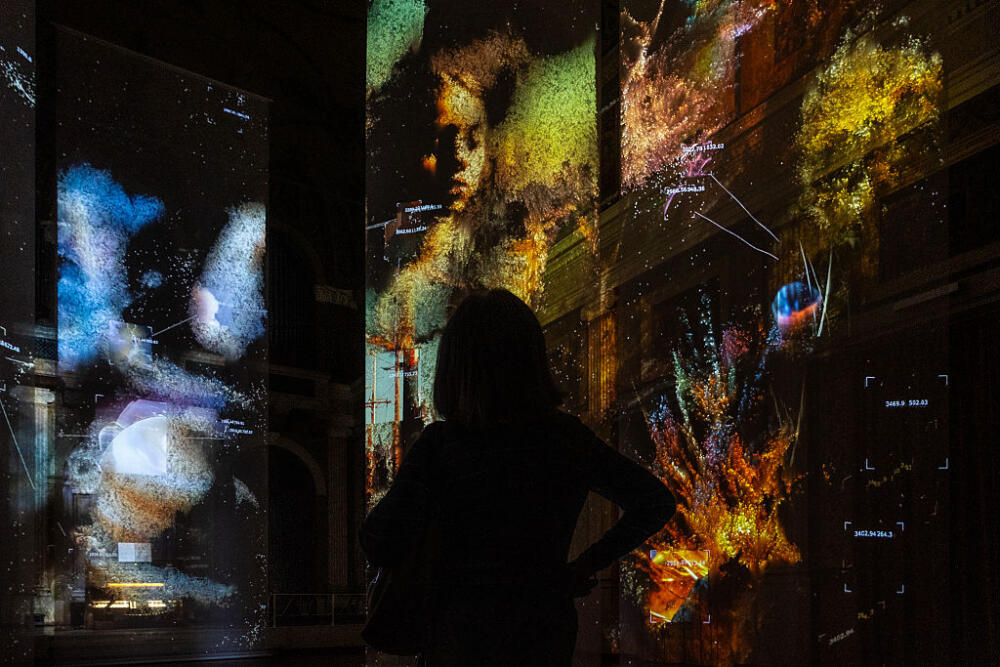
CA:We don’t have time to go into this in depth right now, but Sasha had a piece at MoMA called A Living Poem, and that was created by you and Technelegy.
It was on a big screen in the lobby at MoMA. My understanding is that it was you and Technelegy using inputs from text-based material in the museum with a very cool soundscape. If you Google Sasha, you can find it on MoMA’s website, and it’s amazing.
SS: So essentially, I created this generative poem as a vessel for my own interest in text-based art and language art, and the history of text-based art, and where generative art and AI falls on that trajectory. It was this very complex code-based schema that took my research into the text-based art collection and the computational art collection of the Museum of Modern Art — not to take those pieces verbatim — but to allow me to create this this research lab, like this code-based research environment where I could bring my own poetry and my own thoughts about writing and language and AI, and put them into conversation with Jenny Holzer and Barbara Kruger and Baldessari and all these amazing artists who formed me and to let them all bounce around off each other and then see what emerged.
But it wasn’t necessarily generating variations. And I think that goes to the heart of what I think one of the fundamental misunderstandings, too, of AI is, which is that there is no originality.
I often look at AI as really pointing to the larger notion that all creativity is collaborative and that no artist is doing anything on their own. None of us is working in a vacuum. We are all of us assemblages of formative influences and things that have happened to us in our lives and all of our memories and all of that.
And I think there is something, again, which we don’t have enough time to unpack here, but there’s something there that’s also really important to think about when it comes to this knee-jerk assumption that AI is producing something that is plagiarism or that is not original. All human creativity is about bouncing ideas around in our head, taking something that T.S. Eliot wrote or that Sappho wrote or Enheduanna wrote, thousands of years ago, and letting that bounce around in my own body and head and see what emerges. And that is what I think essentially you can do with generative systems.
CA:We have three minutes left. Jane and Ann, I want to give you a chance to jump in here on guardrails. On our prep call for this event, we talked a lot about productive friction. I get the sense from both of you that perhaps we don’t think the federal government will be weighing in any time soon with guidelines or guardrails around AI, and that it’s going to be up to us to figure that out how to protect the benefits of productive friction.
AH: I think that’s a conversation that that we all need to have with ourselves. I have a personal AI policy: Ways AI is helpful for me as a writer and a creative person and ways that it’s just not.
For example, I never write a first draft using AI. Because for me, I want to get my own thoughts out first. To me, when I open up AI first and think about using generative AI as a tool to create a first draft, it feels like the difference between walking the sidewalks in a planned community, where you walk in a very specific way on a very specific path, as opposed to what I need, what my creativity needs.
I need that sweaty feeling of hacking my way through a jungle. Little critters are biting at my ankles, and I’m sweating and crying, and it’s really hard. I want that. I love that feeling because I know when I’m there, when I’m mired in it, then I’m going to get to something that’s ultimately really productive and useful for me.
Now, that doesn’t mean that I don’t use AI as part of the process. After I’ve created something that I like, I will ask generative AI to help me … to cosplay the role of a reader or an audience person that I’m thinking about that I want to affect, that I want to touch.
I’ll ask AI to cosplay that role and feed it back to me. That to me is a really helpful tool in terms of extending my own brain, because I don’t know what I don’t know. It’s just a way to get a different perspective and understand how my work might hit differently. It doesn’t mean that I always have to accept it. One of my favorite things is to tell AI that, “No, you’re wrong.” I find some personal joy in that.
CA:Jane, do you want to add anything?
JR: Sure. From where I sit in the classroom, the thing I’m focused on to make sure that we don’t lose productive friction, is making sure that students don’t stop feeling like they have something to say, because there’s this shortcut that they can take, and they don’t necessarily know yet what the value of that productive friction would be.
We have to find ways for them to value this process. Part of it is that we need to make sure that they don’t think there’s no point when AI can just do things. Right? AI can play chess, but we still play chess. AI could write something, but then you are not having the experience of doing it yourself.
CA:Thanks, everybody.
