

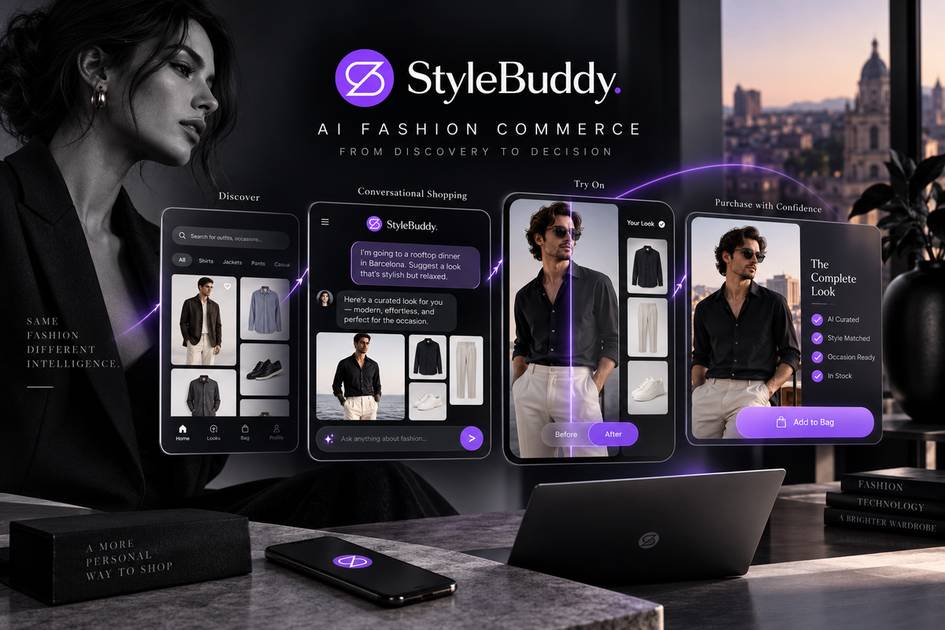
StyleBuddy is making a bigger bet than simply adding AI features to a fashion website. Under
Founder and CEO Siddharth Pandit, the company is building an AI-powered commerce layer
designed specifically for fashion – one that helps brands move shoppers from discovery to styling,
visualisation and purchase within a more intelligent journey.
Pandit’s starting point is straightforward: online fashion still asks shoppers to do too much
imagining. A product grid can show what is available, but it cannot easily answer whether a look
suits the shopper, works for a particular occasion, pairs with other pieces, or feels right before
checkout. StyleBuddy is being built around that decision gap.
The company has already built a community of more than 100,000 users and engaged with 100+
fashion brands. It is now expanding that foundation into a broader StyleBuddy AI fashion
commerce platform for brands, with three connected growth paths: Sell With StyleBuddy, Agentic
Storefront and Virtual Try-On. All three are powered by the same AI styling engine and product
catalogue layer.
Sell With StyleBuddy gives fashion brands access to StyleBuddy’s shopper ecosystem, where
products can be discovered through styling-led recommendations rather than being buried in a
conventional feed. The ambition is to make discovery more contextual: shoppers arrive with an
occasion, a mood, a budget or a style intent, and AI helps connect that intent to relevant products
and complete looks.
The Agentic Storefront takes the same intelligence into a brand’s own e-commerce site.
StyleBuddy’s AI stylist sits on top of the existing storefront and allows shoppers to describe what
they are looking for in natural language. The system can recommend coordinated outfits from the
brand’s own catalogue, remember shopper preferences and keep the customer inside the brand’s
checkout journey. The goal is to make the storefront behave less like a database and more like an
always-on digital stylist.
Virtual Try-On addresses another major point of hesitation: visual confidence. StyleBuddy’s
technology lets shoppers see how garments may look before purchase, while also giving brands a
faster way to create visual fashion content. The company is extending this capability with AI
content tools for product imagery, styling and background generation, making the proposition
relevant to merchandising and marketing teams as well as to shoppers.
What makes the platform distinctive is the way these pieces are being connected. StyleBuddy is
not positioning virtual try-on as an isolated widget, or conversational AI as a chatbot attached to a
product page. Its vision is one intelligence layer across the fashion journey – discovery, styling,
visualisation, content and commerce – with brands able to adopt one capability or combine them.
That ambition is closely tied to Pandit’s own view of what fashion commerce should become.
Digital shopping removed much of the emotional confidence of trying something on in a store and
replaced it with flat images, filters and guesswork. StyleBuddy’s aim is to put more intelligence and
confidence back into that journey, while still keeping the brand in control of the customer
relationship.
The company is also designing for scale. Its current brand proposition is built for fashion
businesses across markets and digital channels, and StyleBuddy has stated an ambition to grow
its ecosystem to more than 2 million users and 500+ participating fashion brands over the next 12
months. Its platform already references activity across 40+ markets, while the company continues
to invest in consumer adoption, brand partnerships and AI-powered fashion experiences.
For Pandit, however, the longer-term goal is larger than user and brand counts. StyleBuddy wants
to become part of the infrastructure through which fashion brands sell online: an AI layer that
understands shopper intent, turns products into styled looks, helps customers visualise themselves
in those looks, and creates a stronger bridge between inspiration and purchase.
Fashion e-commerce will continue to use search, filters and product grids. StyleBuddy’s bet is that
those interfaces will increasingly sit behind something more intelligent – a storefront that can listen,
interpret, style, visualise and sell.
If that transition happens at scale, StyleBuddy wants to be one of the platforms defining it.
Read more about StyleBuddy on their company page
AI
E-commerce
StyleBuddy
Technology
