

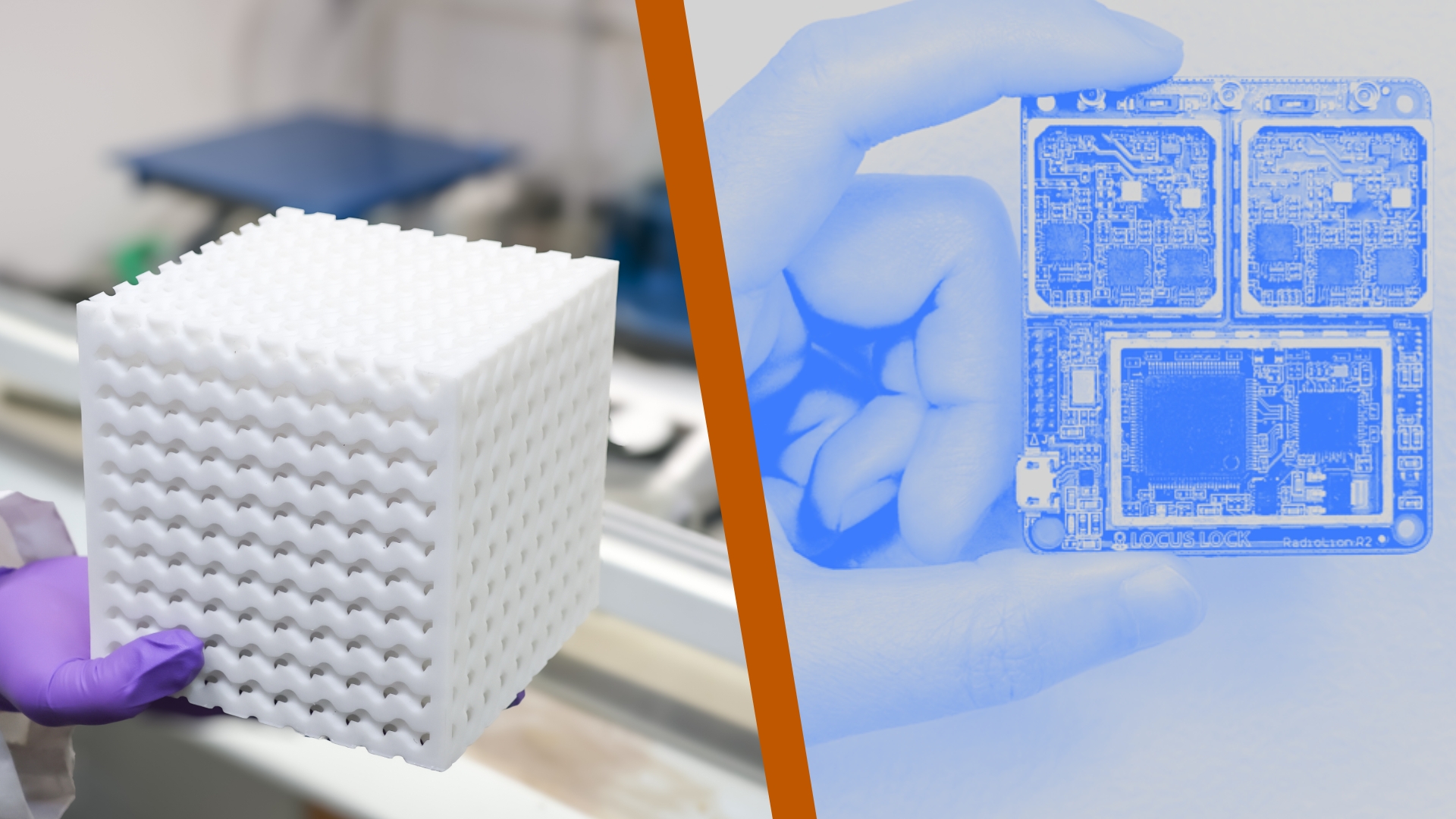
Tucked away in the bustling center of The University of Texas at Austin campus inside the Norman Hackerman Building is a laboratory where UT researchers are developing technology that is diminishing U.S. dependence on foreign critical mineral mines. What was once an experiment has developed into a successful startup business, Supra Elemental Recovery. Supra is one of dozens of emerging technology companies UT has shepherded from lab to commercialization through funding, resources and business expertise.
“We aim to systematically transform UT innovations into market-ready companies,” said Mark Arnold, associate vice president for Discovery to Impact and managing director of the UT Seed Fund. “We’re bringing ideas out of our schools and colleges and into companies that are improving the nation’s advanced manufacturing, defense capabilities and supply chain resilience. Innovations cultivated through Discovery to Impact’s programs are exactly what people expect from public higher education.”
Discovery to Impact is the team that helps University startups advance their technologies and get their products to market faster through business development, market analysis, access to funding and other resources. This team of experts has become a mainstay for a university that ranks No. 2 in startup creation among public universities nationally and No. 8 globally by PitchBook.
Throughout UT’s campus, you’ll find interdisciplinary research fields coming together to uncover solutions that benefit society. It’s a place where mechanical engineers meet medical teams, and natural scientists meet bright entrepreneurs. The resulting discoveries are turned into impactful ventures, creating high-tech jobs and fueling local workforce development.
“Our research community is built on collaboration,” said Fernanda Leite, vice president for research. “By bringing together expertise and ideas from across disciplines, UT creates an environment where promising discoveries can grow into startups with the potential to tackle some of our nation’s most complex problems.”
UT has fostered a vibrant startup pipeline, spinning out 48 ventures during the past three years, 12 of which are backed by the UT Seed Fund. Discovery to Impact created the fund in 2022 to address a gap in venture capital needed to get promising technologies to market faster. The future of American industry and manufacturing can be seen within these companies advancing breakthroughs happening at UT Austin.
Here is a look at four innovative companies built on UT technologies that are strengthening American industrial independence and securing domestic supply chains.
Reshoring U.S. Supply of Critical Minerals
Critical minerals are essential for today’s energy, defense and advanced manufacturing technologies and for the broader economy — however, capturing critical minerals can be expensive and largely depends on offshore mining. Using a feat of scientific alchemy, Supra Elemental Recovery Inc. has developed a 3-D chemical sponge here at UT to recover these elements from industrial byproducts and electronic waste at high purity so that they can be used across American industries.
Revolutionizing Domestic Battery Production
UT’s technologies are improving U.S. manufacturing by finding new chemistries and cost-effective solutions to support domestic battery production. These innovations are helping to meet the growing demand for batteries that power everyday consumer electronics, electric vehicles, and large-scale energy storage systems such as data centers.
Nascent Materials Inc. is using UT-patented advanced manufacturing technologies to produce safer, cheaper and higher-performing cathode materials for lithium batteries. In a lithium battery, the cathode is the positive electrode made up of various materials that with its negative electrode, or anode, enable the flow of an electric charge. Today, most lithium-ion batteries are produced in China, and the materials that go into them are scattered across the globe. Nascent Materials’ solution helps strengthen the U.S. battery supply chain and solves major production challenges including flammability risks and intense energy consumption.
Modernizing Industrial Automation with AI-powered Robots
Contoro Robotics is building robots to tackle the most physically demanding task in the supply chain industry: unloading non-palletized boxes in trucks and shipping containers. The company’s innovative human-in-the-loop (HITL) platform seamlessly combines artificial intelligence and human intelligence, enhancing robot capabilities and paving the way for broader automation in logistics and beyond.
Launching Next-Generation Navigation Systems
Improved mobility in commercial and defense sectors relies on high-quality navigation systems often in complex and challenging environments. Using technology discovered in UT’s Radionavigation Lab, Locus Lock is developing next-generation Global Navigation Satellite Systems (GNSS) — powered by advanced software positioning technology that is more accurate and reliable than modern GPS systems. The result is secure, high-precision location data designed to operate in GPS-contested and denied environments, actively detecting and mitigating radio frequency spoofing and jamming.
“America’s leading universities should be engines of discovery and innovation that strengthen our nation,” said William Inboden, Executive Vice President and Provost. “By turning groundbreaking research into new technologies and companies, UT is strengthening America’s industrial base, advancing our global competitiveness, and helping restore public trust in higher education by demonstrating its value to our country.”
As the No. 1 recipient of National Science Foundation funding, UT has a proven track record of cutting-edge research with the potential to change the world. Discovery to Impact unlocks that potential by facilitating the transition from research to market-ready ventures that support America’s future in manufacturing and domestic production. Learn more on the Discovery to Impact website.
