

Welcome to HackerNoon’s Writing Prompts! Would you like to take a stab at answering some of these questions? <a href="https://app.hackernoon.com/new?template=ten-questions-for-startup-founders&ref=hackernoon.com” rel=”nofollow noopener” target=”_blank”>The link for the template is HERE.
1. What is your company in 2–5 words?
AI that writes like you.
2. Why is now the time for your company to exist?
Because everyone is using AI to write, and everything is starting to sound the same. ChatGPT and Claude are remarkable, but they flatten every voice into one smooth, agreeable register — and no prompt fixes that, because prompts describe your style without changing what the model is. Writers keep telling me the same thing in the same words: the output doesn’t feel authentic. We’ve passed the inflection point where people know they’ll be using AI whether they like it or not. The question now is whether they get to sound like themselves while doing it.
3. What do you love about your team, and why are you the ones to solve this problem?
The team is me — I built the whole thing, from the model training to the UI. What qualifies me is nearly forty years in AI and cognitive science. I was working with neural networks in the 1990s, back when nobody cared, and I was lucky enough to train under two pioneers of the field, Elizabeth Bates and Jeff Elman, who did foundational work on how humans and machines process language. Voice — what makes your language yours — has been my research question my entire career. This product is that question turned into software.
4. If you weren’t building your startup, what would you be doing?
Writing about AI. I publish Inside the Black Box, a Substack about what’s actually going on inside large language models — separating what these systems really do from what the hype says they do. Honestly, I’d probably also still be building something; I get as much joy from tuning the engine and iterating on the interface as I do from the research. The startup is just the version where all my favorite problems live in one place.
5. At the moment, how do you measure success? What are your metrics?
Right now success is measured in honest feedback and activation: how many invited testers sign up, upload their corpus, and get their voice trained — and what breaks or confuses them along the way. My favorite recent metric: a beta tester signed up and uploaded 13,000+ words within a day of getting his invite. That “I immediately fed it everything I’ve written” reaction is the signal I’m optimizing for.
6. In a few sentences, what do you offer to whom?
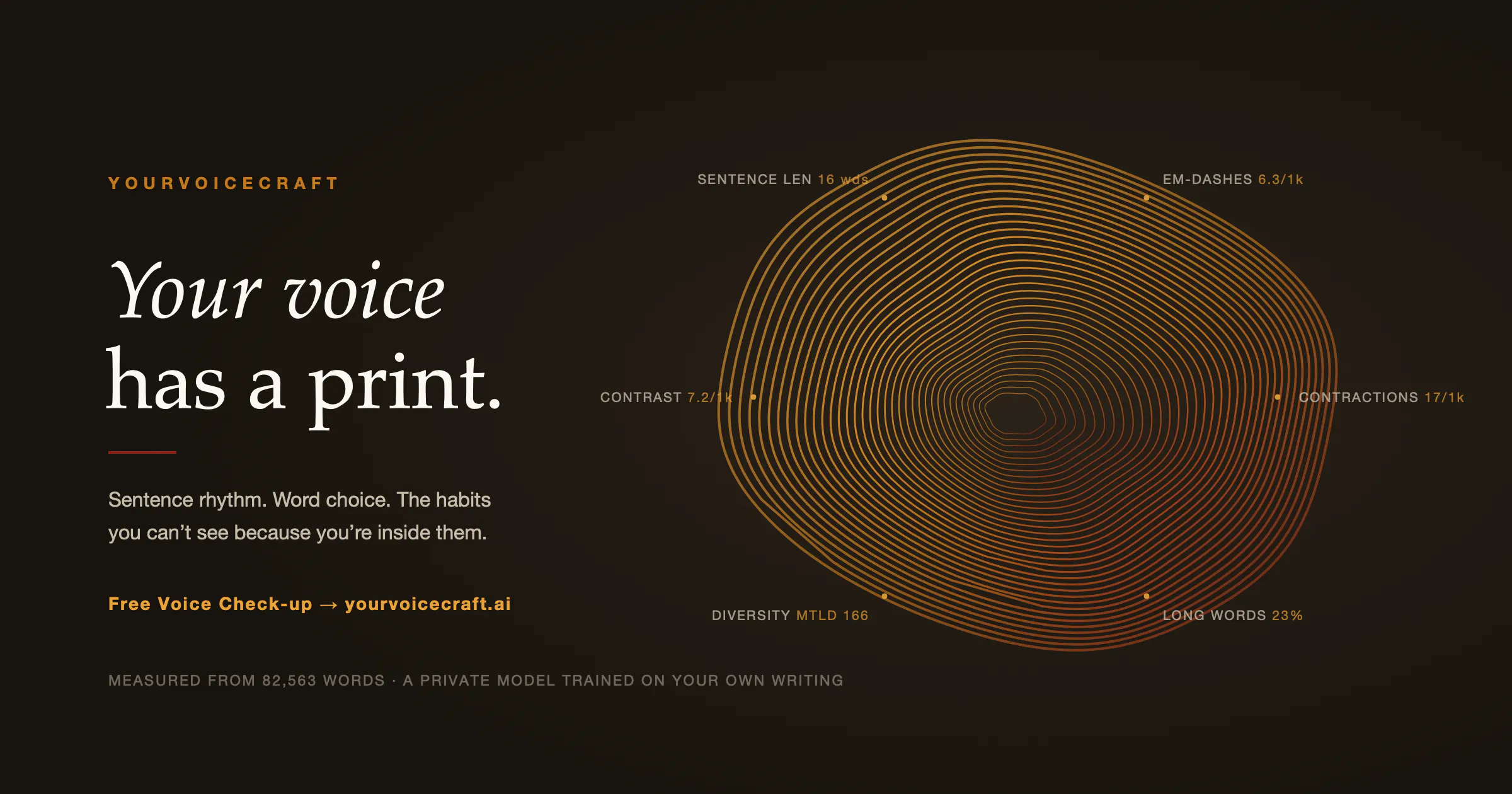
YourVoiceCraft is a web app for anyone who writes online — Substackers, bloggers, marketers, coaches, consultants. We train a private model on your own writing — actual weight retraining, not prompting — so you get a ChatGPT-style experience that writes in your voice. Because it has read all of you, it can also show you your stylometric fingerprint, score any draft against your voice paragraph by paragraph, flag when a new piece contradicts something you wrote six months ago, map the gaps in your topic coverage, and warn you when your style is drifting. Everything runs on our own hardware: your words never touch OpenAI, Anthropic, or any third party, and it’s one flat membership with no per-word meter.
7. What’s most exciting about your traction to date?
The quality of the people leaning in. In a few weeks of quiet, invitation-only outreach, we’ve gone from zero to active beta users training voices — including one who uploaded a large body of work the day he got access. I’m also getting substantive engagement from professional writers and editors who are exactly the skeptical audience this has to win over. When someone whose whole career is voice says “I’m fascinated,” that matters more to me than a vanity signup number.
8. Where do you think your growth will be next year?
Substack-first. It’s a built-in audience of serious writers having an active debate about whether and how to use AI — and the product ships with a Substack reader: paste your archive link, and a few minutes later it has crawled your work and acquired your voice. From there, marketing teams are the natural second market, because brand-voice consistency is the same problem wearing a suit. And for organizations whose words can’t leave the building, we build fully private, air-gapped deployments on infrastructure they control.
9. Tell us about your first paying customer and revenue expectations over the next year.
No first paying customer yet — we’re pre-revenue. The model is a flat monthly membership, with higher tiers for more trained voices and the deeper analysis tools. No tokens, no per-word meter: I want people to rewrite a paragraph forty times without watching a taxi meter tick, because the freedom to experiment is where the good writing happens.
Over the next year I expect revenue to come from writers who publish often enough that voice consistency is a working problem rather than a curiosity — Substackers first, then marketing teams. I’d rather have a small number of people who’d genuinely miss it than a large number who signed up once.
10. What’s your biggest threat?
The obvious answer is the frontier labs deciding to care about this niche. But the honest answer is the flattening itself becoming normal — a generation of writers deciding that sounding like everyone else is an acceptable price for speed. If people stop valuing their own voice, there’s no market for protecting it. Everything I’m building is a bet that they won’t stop — that the more AI-generated sameness floods the internet, the more a distinct, verifiable human voice becomes the scarcest asset a writer has.
This startup founder interview template is based on HackerNoon Founder & CEO David Smooke’s ten questions for startup founders.
Would you like to take a stab at answering some of these questions? The link for the template is HERE.
