

- Sacramento-area restaurants are using artificial intelligence to generate marketing images, from a Freeport barbecue spot to a Land Park burger joint.
- Proponents point to expanded reach at minimal cost, with some restaurants reportedly tripling their traffic.
- Opponents say it makes all advertisements look identical, and they’re less likely to buy from those restaurants than others not using generative AI.
Fair Oaks resident Keith Lew dines out a couple times a week and shares takeout from area restaurants with his 12- and 18-year-old daughters on top of that. They might try Sichuan dishes off Highway 50, street tacos in Orangevale or phở in La Riviera.
Lew spends his working days selling technology to school districts and frequently uses artificial intelligence platforms such as <a href="https://www.sybill.ai/" rel="nofollow noopener" target=”_blank”>Sybill, Gemini and SmartRidge. Yet he is unlikely to order from any restaurant that relies on AI-produced images of dishes on their menus or social media pages.
“It’s definitely a turnoff,” Lew said.
Restaurants across the Sacramento region are increasingly using generative AI to market themselves to diners. It is cheap, quick and easy, with a high potential return on investment — but repels some consumers rather than drawing them in.
Posts online, people in line
The list of local restaurants deploying AI posters encompasses time-tested Sacramento favorites (Fox & Goose Public House) and Gen Z hot spots (Jet’s Midtown). It includes the casual Onigiri Burger across from William Land Park, riverside barbecue spot Brody’s Restaurant in Freeport, Hà Nội Phở in Elk Grove and Birdie’s Social Club across from Sutter Health Park, plus breweries such as Fort RockBrewing in Rancho Cordova and Jackrabbit Brewing in West Sacramento.
No person is more associated with Sacramento-area restaurants’ AI marketing than Rajkumar Karthikeyan. A Punjabi native who’s lived in the region since 2009, he ran a social media marketing company before AI came along.
Working with Mehfil Indian Restaurant and Bombay Indian Cuisine & Sweets in Roseville, Desi Market & Grill in North Natomas and Halal Shop in Oak Park, he said the new technology was “a natural progression.”
“AI is basically like social media on steroids,” Karthikeyan said. “It helps restaurant owners create amazing content at a fraction of the effort that it used to be five years ago.”

Karthikeyan uses AI to identify what audiences restaurants should target and what dishes the brand should focus on in addition to generative components. He prefers to show off his restaurant clients in videos made through Google’s Gemini Omni, though they often request flyers. With a prolific Facebook presence centered around his 80,000-follower group “Things to do in Sacramento CA!“, he’s been able to flood online platforms and search results with his content.
Traffic has tripled at some of the restaurants Karthikeyan has partnered with, he said. In two months, Mehfil went from an empty dining room to lines out the door for its lunch buffet, he said.
Most graphic designers will not work for the $20 a month Google AI Pro charges, and Karthikeyan acknowledged that AI eliminates some existing jobs (and guzzles municipal water, another frequent criticism). But that rough period will eventually lead to a boom in self-employment and financial success, he predicted.
“You’re going to see more millionaires created at the end of this thing than any other transformative technology that we have seen in the past,” Karthikeyan said. “When people criticize this whole thing, again, I’m not saying they’re wrong, because there are challenges. But it’s a matter of whether you want to see a glass that’s half full or half empty.”
Backlash at a yet-to-open Midtown café
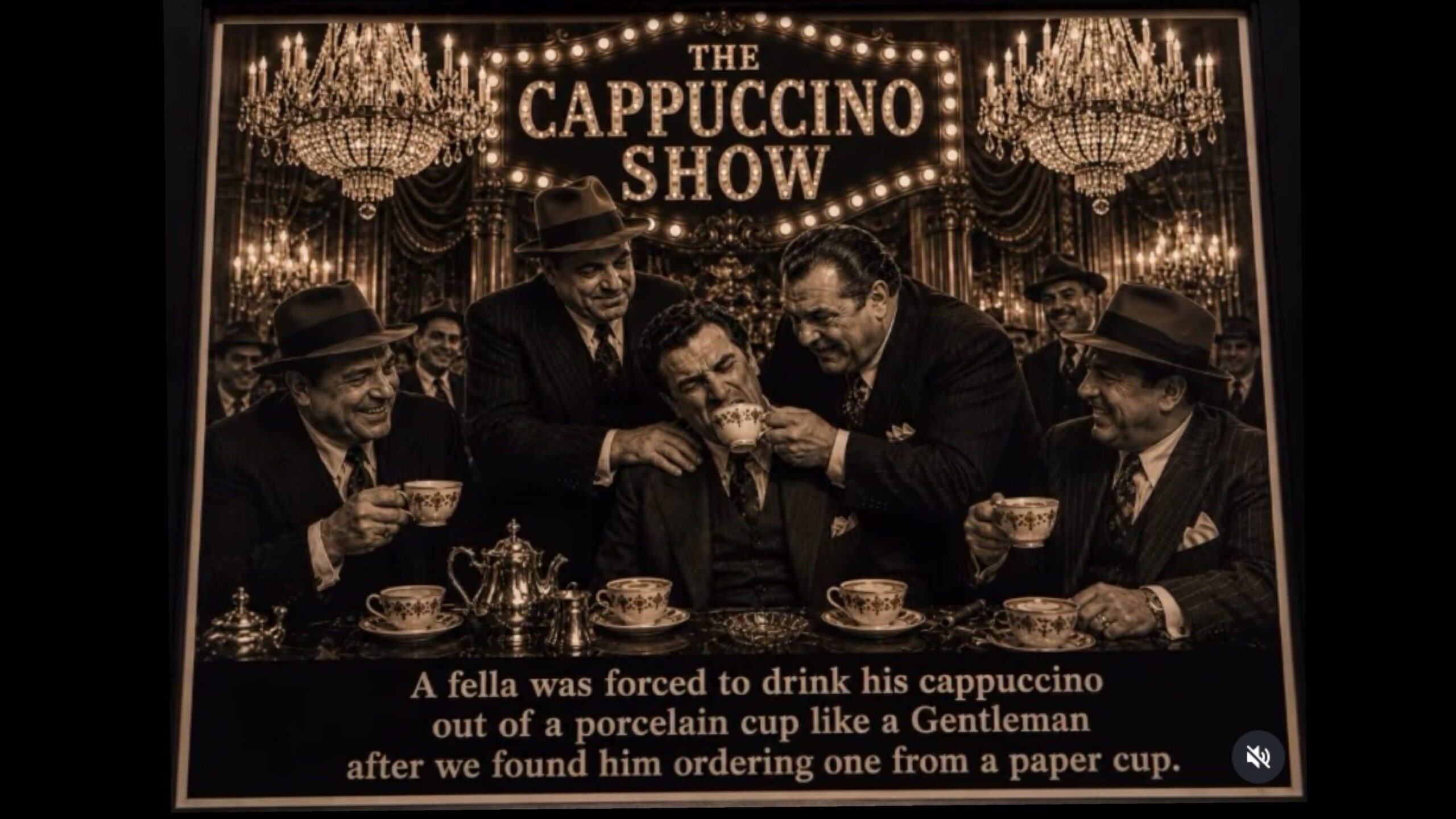
Perhaps no Sacramento business’s use of generative AI has drawn more ire than one that has not yet opened: The Cappuccino Show. A photo of the New York-inspired deli and café’s banner outside its future Midtown home, replete with a computer-generated cigar, coffee cup and vintage microphone, drew more than 350 comments on Reddit, few of them positive.
It was Sacramento’s version of the controversy surrounding Grind & Unwind, a San Francisco café that recently became the city’s focal point for generative AI backlash. The mom-and-pop shop took down the AI-generated food pictures previously in its window after someone graffitied the word “seriously?” across the display in early July, two days after a viral post in the San Francisco subreddit.
The Cappuccino Show co-owner Juanes Ramazzini said he is “the food guy” and his business partner, Freddy Cohan, makes the marketing decisions. They had just signed the lease at 22nd and K streets, wanted to celebrate by raising the banner and had no real panini or latte images to share yet, Ramazzini said.
After “really negative feedback,” Ramazzini said, Cohan removed some of The Cappuccino Show’s AI-generated social media images, though he continues to sprinkle others in among construction snapshots. The café, which is slated to open around early October, hired renowned local artist JM Knudsen to paint its new logo on an exterior wall last September.
At Ramazzini’s other Midtown restaurant, Bambina’s Pizza & Pasta, his wife Maria Arriola handles the marketing. While it is neither of their preferences, generative AI has made promoting Bambina easier during a physically difficult period, Ramazzini said.
Arriola gave birth to the couple’s son five months ago, Ramazzini said, and was too limited immediately before and after giving birth to take photos of newly introduced specials or promotions at the restaurant. So Ramazzini took photos with an admittedly clumsier touch, sent them to Arriola at home, and she used tools such as ChatGPT Pro to turn them into World Cup flyers.
Neither Ramazzini nor Arriola speak English as their first language, and they have relied on AI to refine their public writing, too. But Ramazzini, a veteran Sacramento pizzaiolo who studied in Italy, is not keen on artificial image creation. He does not want it lumping in his pizza with lesser ones, he said.
“I’m not a big fan. I think that if everybody’s using it, everything looks the same,” Ramazzini said. “There’s no unique touch. There’s no uniqueness. You cannot differentiate from the other businesses. … AI creates it, and yeah, it’s cool, it helps, but it’s not really creating a unique product. So you’re losing the art of marketing through AI, in my opinion.”
New California law will identify AI creations
Not sure if your favorite restaurant has been advertising with AI? It may soon be easier to pinpoint.
The California Artificial Intelligence Transparency Act, billed by State Sen. Josh Becker, D-Menlo Park, as “the nation’s first comprehensive AI transparency framework,” began its first phase at the start of August. It requires generative AI producers to clearly label their work as such, provide free AI detection tools and list the date when the image, sound or video was created or altered.
The law, known as CAITA, applies to generative AI companies publicly operating in California with more than 1 million monthly visitors or users. CAITA will also require more disclosure from generative AI system hosting platforms, large online platforms and device manufacturers in 2027 and 2028, though pending legislation could further tweak elements of the law.
Even if using AI, show your own food, some say
Lew recalled a Threads post of an AI-generated surf-and-turf dinner where the shrimp were presented as unnatural circles with no start or end in sight. It’s that kind of content, he said, that really turns him away.
Lew will cut a restaurant some slack if they used real photos of their food in an AI-generated ad, he said. Still, AI-generated promotional materials do not look great to him no matter what, he said.
“The AI menus and AI graphics, you can just spot it a mile away, right?” Lew said. “I mean, they all look alike, which is weird to me. And the fact that these business owners do not seem to think that matters. … You can’t tell the businesses apart if you just look at their ads, they’re very busy and of course, the AI generated images are the worst part.”
Bambina generally adheres to that rooted-in-reality philosophy when using AI, Ramazzini said. In an industry with notoriously thin margins, it is certainly cheaper than the marketing companies that quote him from $2,000 to $4,000 for a couple of videos per month. Still, the artist in him blanches.
“Some people are using it because you pay, I don’t know, $200 a month, and you’re able to create this stuff, and you don’t have to have the skill or any studies or even a nice camera or anything to do it,” Ramazzini said. “So that’s the advantage of it, but the problem is that there’s no uniqueness to it. Some people don’t care. Personally, I do care. Like how crafty I am with my pizzas and my pastas, I want everything to be the same way.”
