

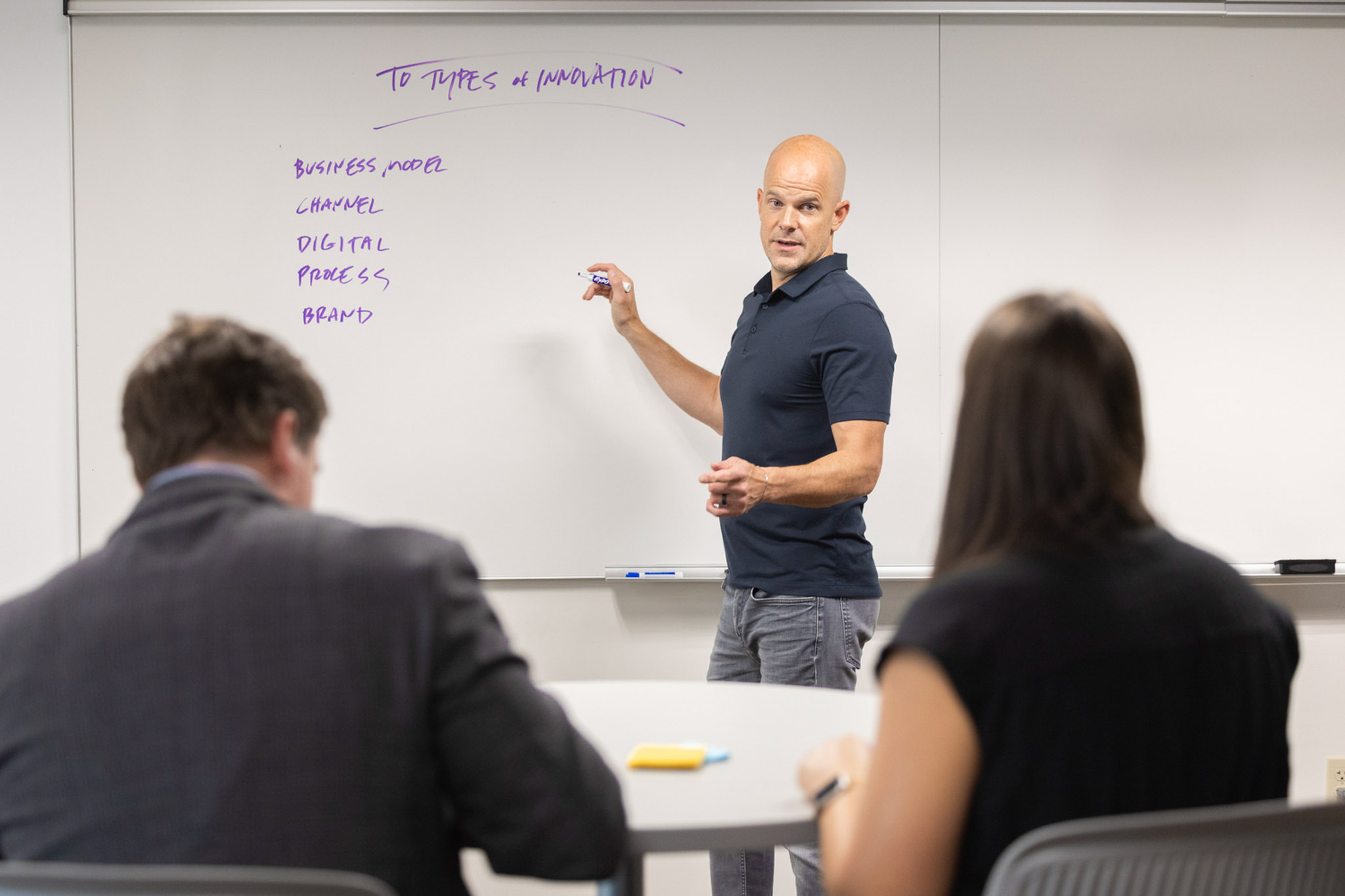
Sam Larson ’27 MBA didn’t have to wait until he finished his Master of Business Administration to put what he learned into practice. During a four-week January course at the University of St. Thomas Opus College of Business, he developed an artificial intelligence application his employer is now actively exploring.
“Instead of putting in these academic hours outside of my 9-to-5, it really blended the two together,” said Larson, who works in innovation for ARCO/Murray, a commercial construction and real estate firm.

His experience illustrates exactly what faculty members envisioned when they designed ENTR 707: Innovation and Corporate Entrepreneurship, which focuses on “intrapreneurship,” the practice of innovating and finding creative solutions within an established company. The course reflects the broader philosophy of the Part-time Flex MBA, where working professionals apply what they learn to real challenges within their own organizations. Rather than solving hypothetical business cases, students bring real opportunities into the classroom, test ideas with faculty and peers and return to work with practical solutions they can implement immediately.
The class brought together professionals from health care, manufacturing, construction, insurance and other industries, giving students the opportunity to learn from a wide range of experiences and approaches to innovation.
On the first day of this course, Danielle Campeau, associate dean of the Schulze School of Entrepreneurship and co-instructor for the course, asked the students “Do you consider yourself an innovator?”
Roughly 40% of the students described themselves as somewhat innovative. Many saw themselves simply as professionals doing their jobs, not as people leading change inside their organizations.
“One of our main goals by the end of the class is for students to see themselves as innovators,” said Campeau, who before joining academia, spent years in the biotechnology and medical device industries helping organizations bring new products to market. She has never viewed innovation as something reserved for startup founders or research laboratories.
“It can be very big innovations all the way down to something really small that might just be innovative for the department or the process that they’re working on,” she said.
To build a bridge between research and the daily realities of corporate innovation, Campeau co-teaches the class with Ryan Backer ’99 under the business school’s Prof+Prof (professor and professional) teaching method. Backer, an innovation consultant and St. Thomas alum, spent more than two decades championing innovation at Fortune 500 companies, including General Mills, Nestle and Medica.
As co-instructors, Campeau and Backer combine academic theory with decades of corporate innovation experience, giving students both the strategic frameworks and the practical perspective to apply what they learn immediately in their own organizations.
“We’re equipping the MBA candidates to create something they can take to their bosses,” Backer said. “It’s in the language of corporate America.”
That corporate baseline means students quickly learn that innovation is rarely a straight line.
“You form a hypothesis, you test something, usually it doesn’t work – that’s not failure, that’s learning,” Backer said.
Larson experienced that firsthand. Working in innovation for his firm, he initially proposed an ambitious AI project to automate portions of construction design and pricing. But as he gathered feedback from his classmates and colleagues, he realized the concept wasn’t the strongest opportunity. Midway through the course, he changed direction entirely.
“I don’t want to push and have to do a final project that I don’t use,” Larson said.
His final project focused on a completely different AI application that could analyze data across multiple construction systems and prompt project managers with timely reminders throughout a project’s life cycle, from scheduling final photography to preparing for closeout.
“It’s something we’re actually working on at work right now,” Larson said about the positive reception from his employer.
The course lessons resonated just as deeply with Samantha Harris ’27 MBA, who works in sales and marketing at Solventum, a spinoff of 3M’s healthcare business.
“I definitely went into the class thinking innovation is product development,” she said. “A huge takeaway from the class for me was that it can be much broader than this. Innovation is any type of solution.”
Harris applied that broader lens to customer experience, communication and operational improvements in her daily job. Because the course work tied directly into her daily corporate responsibilities, it never felt like isolated academic tracking.
“There was theory in the class, but it was heavily application,” Harris said. “To relate every single concept back to work that I’m doing every single day, I found to be just really helpful. It kept me engaged and excited with the things that I was learning.”
A major component of that real-time application involved learning how to use emerging artificial intelligence tools thoughtfully.
“I can’t teach a corporate innovation and entrepreneurship course and not talk about the impact that AI has on corporate innovation,” Campeau said. “So, we did a lot of work last fall to redesign and rethink how we’re talking about and including AI in the conversation around corporate innovation. A lot of it was about career progression, too. How can we help them understand ways to leverage AI to think innovatively, but also to help their own careers?”
Campeau and Backer fully integrated generative AI into the coursework, treating it as an active sounding board to pressure-test concepts and surface blind spots. Students practiced writing detailed prompts and critically evaluating the outputs rather than simply accepting the technology’s first answer.
“You have to be able to put a good prompt into AI to get good support from the tool,” Harris observed. “You’re applying critical thinking to that response.”
Beyond the technology, the course forced students to recognize that a creative idea means very little without the business data and narrative structure required to survive an executive review.
“A lot of my job is influencing others,” Harris said. “You can have this creative idea and do all of the research, but it kind of means nothing if you’re not very specifically asking for what you need.”
Instead of turning in a traditional final exam, students built their final presentation deck module by module, continuously adjusting their ideas based on real feedback from their professors, peers and coworkers. By the end of the January term, Harris left with a functional presentation template she continues to use in her professional career.
“Outside of just the learnings, it’s nice to have an actual tool that I left with,” Harris said.
