

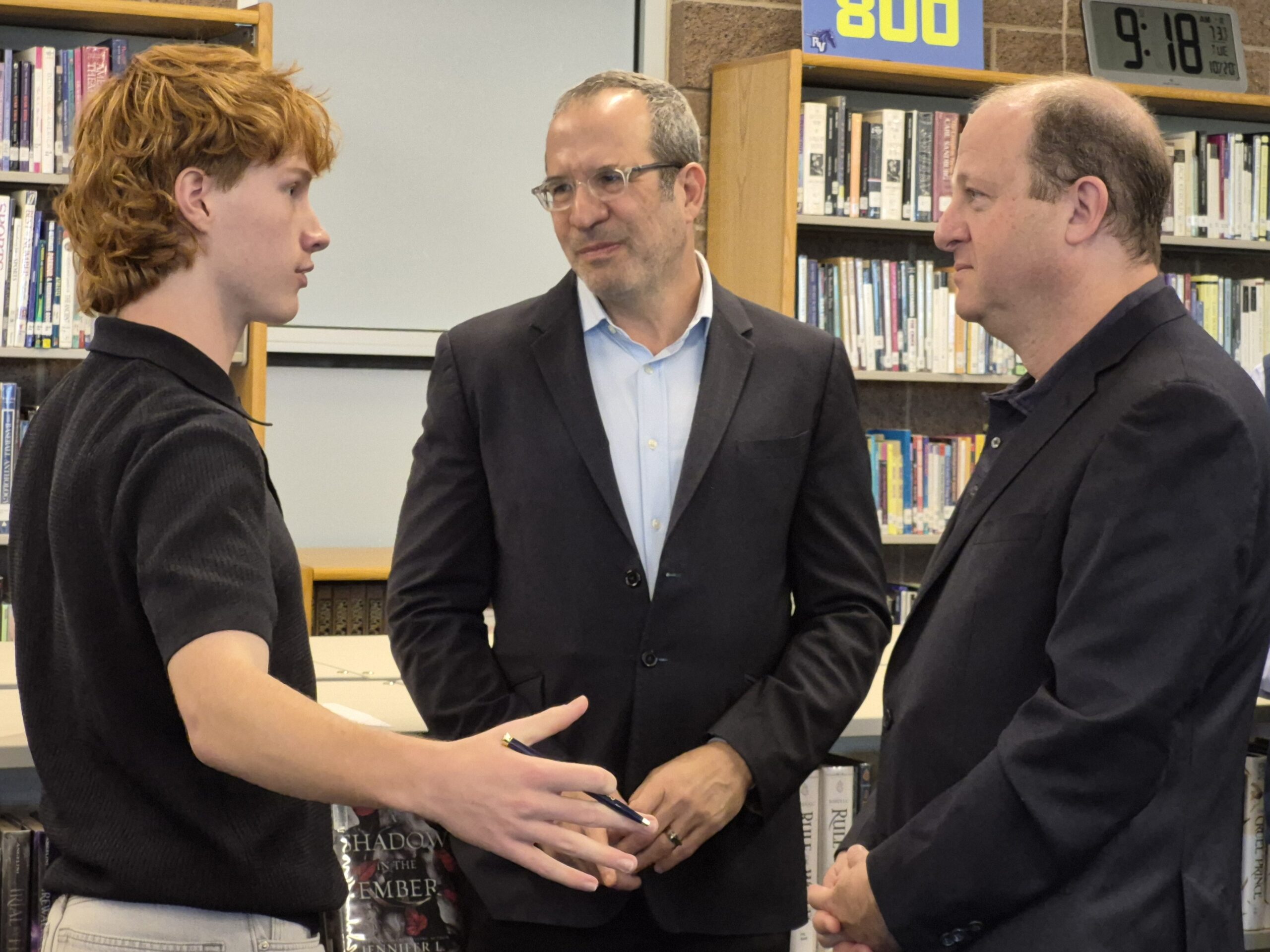
Gov. Jared Pols (right) and College Board CEO David Coleman (center) talk Tuesday with Ralston Valley High School senior Emmett Garland, who is laying the groundwork to launch his own company after taking the AP Kickstart Cybersecurity course.
Calling it a step to benefit both the public and private sectors, Gov. Jared Polis on Tuesday ordered state agencies and higher-education institutions and the Colorado National Guard to boost the benefits they offer to students who pass the AP Kickstart Cybersecurity exam.
The cybersecurity track is a new set of courses being offered currently in about 20 Colorado high schools by the College Board, the organization best known for its Advanced Placement classes that give college credit to students who complete them successfully. The new AP Kickstart courses offer not just college credit but industry-approved credentials for students who go directly into the profession, creating new pathways into careers for learners who may not want a four-year degree right away.
Cybersecurity is a growing field in Colorado and across the country, and professionals can work in everything from law enforcement to national defense to financial or other private-sector fields where it is vital that information be protected from hackers. The state has leaned into the sector since the passage of a 2016 law established the National Cyber Intelligence Center on the campus of the University of Colorado Colorado Springs, and the latest effort is intended to boost the pipeline of workers into the industry.
It does so first by creating a career pathway in six state departments in which students who complete the course successfully will have the opportunity to secure internships and other work-based learning opportunities with the agencies. It also mandates the Colorado Department of Higher Education to ensure the credits earned through the course are transferable to all state colleges and universities.
“An all-government approach”
Finally, the executive order directs the Colorado National Guard to consider qualifying scores from the AP Cybersecurity exam when assessing someone who has applied to serve in the Guard. This can let students get further education in the field as part of the force of part-time citizen soldiers while allowing the Guard to benefit from their existing abilities.
“We call this an all-government approach to meeting Colorado’s needs,” the Democratic governor said, doubling down on his eight-year efforts to boost pipelines into in-demand industries, particularly by expanding paths beyond traditional four-year degrees. “A high school diploma should give you a running start. It should be more than just a diploma.”
Gov. Jared Polis signs an executive order on cybersecurity career pathways in front of supporters of the policy Tuesday at Ralston Valley High School in Arvada.
AP Kickstart Cybersecurity courses teach students to secure spaces, networks, devices, applications and data, and they do so with an interactive curriculum that lets students assess vulnerability of systems and deal with threats in real-world scenarios. Ralston Valley High School in Aurora, where Polis signed his executive order on Tuesday, is one of the Colorado schools offering the official course this year after it has been in pilot mode throughout the state over the past few years.
College Board has partnered with business organizations, including the Colorado Chamber of Commerce, to expand the number of schools offering the course, and it is available now from the Denver metro area through more rural communities like the San Luis Valley. The same partnerships have been working to expand another AP tract for students that may not go directly to four-year universities — Business with Personal Finance, a series of courses teaching students how to own and operate their own company.
How the cybersecurity courses are boosting student academic interest
David Coleman, CEO of College Board, said at the Tuesday event that his organization is striving to reach out more to students in ways that go beyond the rote learning of the past and connect their educational experience to potential careers. Colorado is just the second state to promote the cybersecurity course as it has, and Coleman predicted the effort not only could boost the sector in the state but could boost high-school graduation percentage by keeping a range of students more interested in their studies.
“The young people in this country — the high-school students here and everywhere — have so much to give if we can challenge them in the right way that brings out their talents,” Coleman told a room of students as well as state and education officials. “It’s like a sleeping giant.”
College Board CEO David Coleman speaks Tuesday at an event at Ralston Valley High School.
As an example, Ralston Valley senior Emmett Garland, who has taken the class and has begun work to launch a company that protects other firms from artificial-intelligence-enable hacking threats, spoke to what the course means to him. It taught him to think more critically about cybersecurity, he said, and getting to try to ferret out and disable threats as part of the class drove home the career possibilities in the field, he said.
“I believe that students are in critical need of obtaining these skills before we enter the workforce,” Garland told the crowd. “I hope other students will see this as a chance to build on their skills.”
Polis’ efforts on economic and educational issues
Polis administration officials hinted that the next step they could take would be to put together a working group to ensure that businesses know of the value of the classes and are able to reward successful graduates in the same way state agencies now will do.
Though the term-limited Polis will leave office in mid-January, he is taking steps to boost a lagging economy and business atmosphere in several ways, saying that he wants to help the state be more competitive for job expansions and relocations.
Last week, for example, he received a report recommending 49 actions from a Competitiveness Council that he put together in July, and he announced that he’ll look through the suggestions to see what he can do before he steps down. Similarly, he is expected to get a report later this month from an Environmental & Sustainability Working Group that has been examining ways to streamline often-laborious permitting processes for transmission lines and for industrial projects that seek to reduce emissions.
