

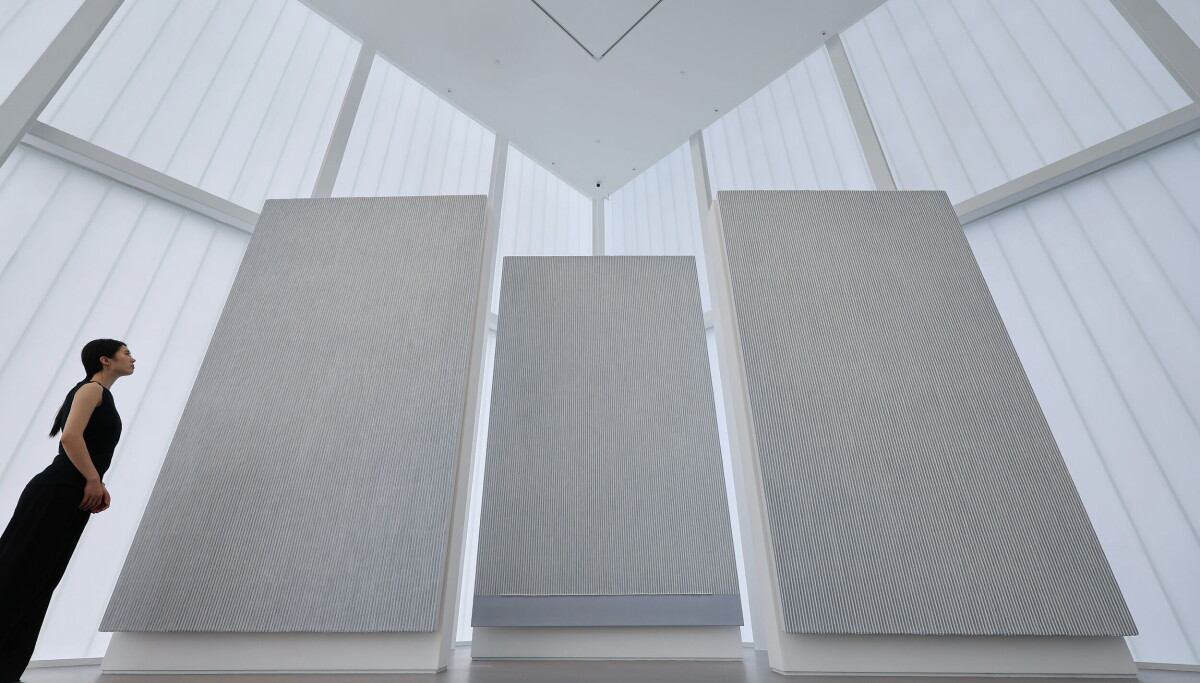
In the summer of 2023, a 92-year-old Korean master painter and a Vietnamese French artist in her 70s sat facing each other for three hours in a home in Yeonhui-dong in Seodaemun District, western Seoul.
Huong Dodinh, the Vietnamese French artist, had asked for the meeting. She was in Seoul for an exhibition of her own and had known the painter’s work for years — though he, until the request arrived, had not known hers. Since one spoke Korean and the other French, an interpreter sat between them, but they soon had little to do. Both artists had dedicated some 50 years to the same craft, and they recognized a kinship with the other within minutes.
“We did not speak the same language, but we shared something far deeper: the same inner search, the same spirituality and the same conviction that creation is a path of silence, patience and light,” Dodinh told the Korea JoongAng Daily.
The painter, Park Seo-bo, one of the greatest Korean artists of the postwar generation, had already been diagnosed with lung cancer at the time and would die three months after Dodinh’s visit. She was the last foreign artist that he ever met.
“When I held Park’s hand, all the tension that I’d felt melted away,” Dodinh explained. “Even though his body was already causing him pain, his eyes would light up whenever we talked about painting.”
Three years after that fateful meeting, right next to that house where they met, the Park Seobo Museum, spanning five floors, opened its doors last week. But the museum’s first exhibition is not a retrospective of Park himself. Instead, it pairs the master’s works with Dodinh’s, inspired by their three-hour conversation.
Park Seung-ho, the museum chairman and Park Seo-bo’s son, referred to the museum as “the Park Seobo Museum without Park Seo-bo.”
“Every exhibition [at the museum] doesn’t necessarily have to include my father’s work,” Park Seung-ho said during the press conference for the opening on Aug. 18. He added that his father’s legacy was not confined to his art; Park Seo-bo had also actively worked as an art educator, facilitator and curator during his half-century career.
“One might ask, ‘How can a museum without Park Seo-bo be called the Park Seobo Museum?’ But that is precisely why I wanted to name it after my father.”
It is rare for a private art museum bearing a single artist’s name to be established on this scale and in the heart of Seoul. To find a similar precedent, one must go about three decades back to the opening of the Whanki Museum, named after Kim Whan-ki, in the early 1990s. So the question naturally arises: Why Park Seo-bo, and why now?
Related Article
Unmatched in importance
The most obvious answer — that it is because Park Seo-bo is a master of dansaekhwa, or Korean monochrome paintings — is only half correct.
While he is undoubtedly one of the most well-known dansaekhwa artists, the art style that broke auction sale records for Korean paintings and is now known as a representative movement of modern Korean art, Park Seo-bo’s body of work and career is much more than that, according to experts.
“Because dansaekhwa is so strongly recognized internationally, we tend to focus solely on that aspect, but [he] played a much larger and important role across the entire spectrum of postwar abstract art,” said Chung Yeon-shim, a professor of art history and theory at Hongik University.
Park Seo-bo’s artistic trajectory runs parallel to the changes in Korean society and the art world. The dark, thick canvases of Art Informel — a French-origin art movement in the late 1950s that rejected geometric structures in favor of gestural and spontaneous expression — became noticeably brighter in Korea from 1965.
“As Seoul became more urbanized and industrialized, artists stopped practicing Art Informel; colors became brighter, and geometric motifs and forms began to appear more frequently, and you can see this in [his] works,” said Chung.
Although the style of Park Seo-bo’s famous “Écriture” (1967-81) series first appeared in the late 1960s, the style that we know today as his unique artistic language was established around 1973.
Critic Yoon Jin-sup, who has worked with dansaekhwa artists and as a curator in one of the first dedicated exhibitions to dansaekhwa in the early 2010s, summarizes Park Seo-bo’s position in monochrome painting as “unparalleled from its formation through its development.” What makes his style distinct, in Yoon’s opinion, is the mark the brush leaves behind — the stroke itself.
“With Park [Seo-bo], it’s about the brush, the stroke,” the critic said. “That’s why the title of the series is ‘Écriture,’ which means ‘handstrokes’ in French, and it runs from his earliest work right through to the last.”
Prof. Chung pointed out that Park Seo-bo’s career is more than a personal history, as he led much of the artistic movements in the period after the 1950-53 Korean War, when artists were free to experiment because of a lack of established practices and administrative restrictions in the art world.
“The artists back then had less money and support than those now have, yet I think that there were many things that they could do as a result,” she said, speaking of a paradox. Because there were no established systems, no art criticism and no market, people could create anything, especially by joining forces.
“When you study Park, you find the entire history of postwar Korean art encapsulated within it,” Chung emphasized.
Paintings drawn with the body
Discussions of Park Seo-bo’s work, while often described with keywords such as “meditation” and “emptiness,” cannot be limited to those concepts alone; a closer look at his stylistic techniques renders a deeper understanding.
Critic Yoon focuses on the evolution of the brushstroke. In the uniform strokes of Park Seo-bo’s early period, then his free-flowing lines — once he encountered hanji (traditional Korean paper) in the early to mid-1980s — texture is at the forefront.
“Just as soil is pushed to both sides when plowing to form furrows, and I see [individual brushstrokes] as the essence of the [artwork’s] body,” said Yoon.
Chung’s explanation of Park Seo-bo’s technique ultimately arrives at the same conclusion. Western abstract painters generally stand in front of the canvas to paint. Park Seo-bo, however, spread a large canvas on the floor, stood on it and used his entire body in the process of making his art.
“[His] methods were ascetic, and when I say that, I don’t mean ‘like a monk.’ I mean ‘using one’s own body to paint,’” she said.
She also emphasized that Park continuously changed the physical properties of his materials by using pencil on oil painting grounds — and, later, hanji — or experimenting with color techniques inspired by nature.
In other words, for Park Seo-bo, repetition was not stagnation; he actually constantly reinvented repetition itself.
Ma Dong-eun, the deputy director of the Park Seobo Museum, curated the underground space of the museum’s opening exhibition exclusively with Park Seo-bo’s works to highlight this “stagnant evolution.”
“What is important is that this transformation goes beyond a mere formal shift from black to bright colors,” Ma said.
She also cautioned against grouping either Park Seo-bo or Dodinh solely under the terms “emptiness” and “ascetic practice.”
“While much has been stripped away in [his] finished works, reaching that [seemingly empty] state actually requires an immense amount of time and effort. From a distance, they appear empty, but up close, one actually sees a great deal,” she said.
In this regard, a separate retrospective exhibition on Park Seo-bo, titled “Changing, Unchanging,” which opened at the Kukje Gallery on Monday, traces the artist’s entire career, with some 40 works spanning from 1967 to 2023, just before his passing. The title is derived from Park Seo-bo’s own statement: “If you don’t change, you fall; but if you do change, you also fall.”
The organizer and his legacy
Park Seo-bo beyond the canvas is less known to laymen, but his role as an educator and facilitator is just as large a part of his legacy. He taught at Hongik University for over three decades and served as chairman of the Korean Fine Arts Association from 1977 to 1980, selecting the artists sent to international events such as the Paris and São Paulo biennales.
“Selecting artists and dispatching them through the association — that, in a sense, was a power,” critic Yoon said. The association now has roughly 45,000 members, but at the time, the membership list was not even as thick as a college notebook. Through that role, Yoon assesses, Park Seo-bo made a significant contribution to establishing “bridgeheads” for contemporary art in Korea and abroad.
Institutional frameworks for fine art barely existed in Korea then, and Park Seo-bo helped build the first ones. As Prof. Chung puts it, “there were no curators back then,” and artists took on the role themselves. The department of art history and theory at Hongik University, founded during Park Seo-bo’s tenure as dean, came out of the same awareness.
On the other hand, the same organizational drive that Park Seo-bo had also operated by excluding certain art styles. Yoon noted that because Park Seo-bo was someone who, after the Art Informel movement, devoted his entire life to championing abstraction, there was “a certain degree of disparagement toward figurative art.”
“Figurative styles that lack self-development or self-innovation are bound to be weeded out, and [he] did not shy away from his own aversions,” said Yoon. “[His] influence helped establish a new form of art, but we must also ask what that same influence placed at the center and what it pushed to the periphery. Historicizing Park [Seo-bo] does not mean glorifying him; whether the new museum can grapple with that question will, in fact, determine its character.”
That is where the work of the Park Seobo Museum begins. Chung pointed at the vast archive kept by Park Seo-bo and now stored at the museum. The artist kept everything dating back to the 1950s — admission tickets, brochures, letters he received, newspaper clippings, even notes on the backs of canvases — for 70 years.
“His archival fever was an incredibly unique element you won’t find in other artists, and the amount of material the museum has, not only on Park [Seo-bo] but on the art scene of his period, will be substantial,” she said. It is not just Park Seo-bo’s personal record but a trove for researching Korean art history from the 1950s.
The museum has chosen to focus on the era following Park Seo-bo, which is why Park Seung-ho invited a foreign woman artist to open it. Among his father’s lesser-known endeavors in the late 1970s and early 1980s were discovering and nurturing young artists and recognizing the potential of women artists.

“I want to focus on elevating women — those who have not received significant attention from the art world or who, despite receiving attention, have struggled to rise above a certain ceiling — to their rightful place,” Park Seung-ho said.
Opening the museum is the easy part. It remains to be seen whether it will become an institution that merely repeats an already established name, or a museum that uses that name and its resources to spark dialogue with the next generation of artists.
Park Seung-ho relayed that if his father were still here today, he probably wouldn’t have said a word about the opening.
“I believe that what my father left behind — and what is most important to both his surviving family and the foundation’s staff — is the attitude toward life and the artistic philosophy that he exemplified,” he said. “We must reconstruct [Park Seo-bo’s legacy] from a contemporary perspective using today’s language and integrate it into the operations of the foundation and the museum.”
