

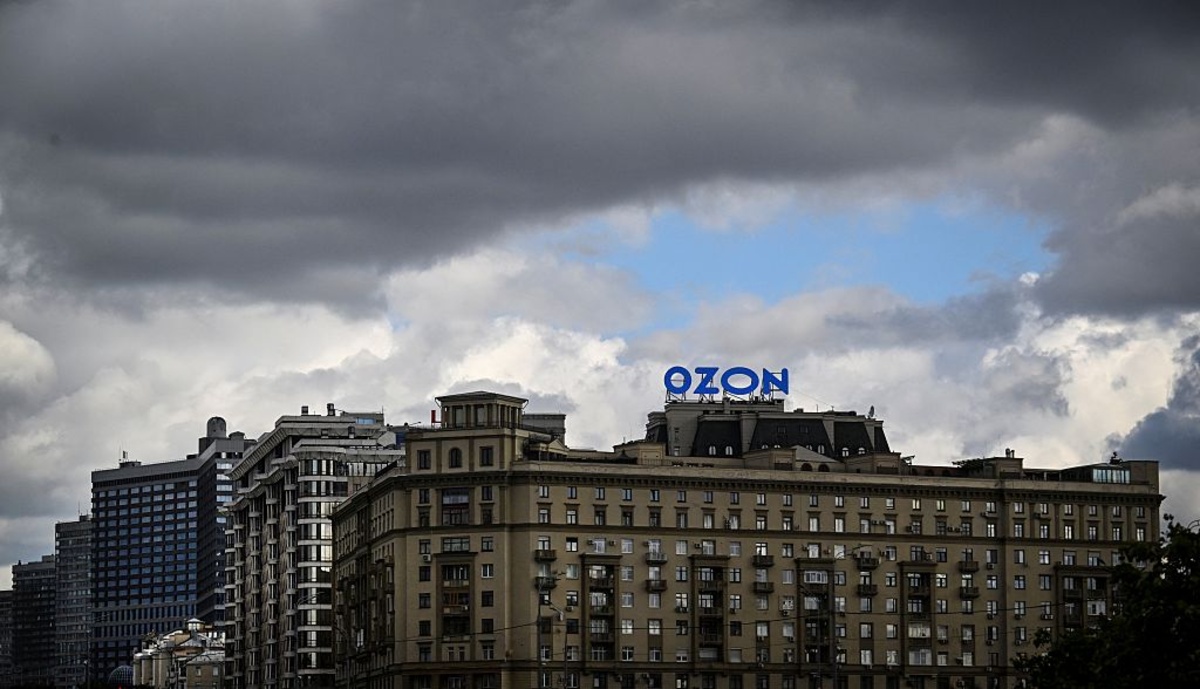
Ukraine’s Independence Day barrage against Russia’s second-largest online retailer struck four more Ozon logistics hubs across southern Russia overnight on August 24, bringing the total number of facilities hit in just 72 hours to six, collapsing the company’s share price by as much as 29% on the Moscow Exchange, and creating something that weeks of attacks on rival Wildberries never produced: a real-time, publicly priced indicator of how much Ukraine’s economic warfare campaign is costing Russia’s commercial sector. Four Ozon hubs were hit across southern Russia on August 24, bringing six facilities offline in 72 hours, while Ozon shares sank on the exchange.
Where Wildberries — Russia’s largest online retailer — is privately held, invisible to markets, and able to absorb physical destruction without producing a financial signal the world can observe, Ozon is listed on the Moscow Stock Exchange under ticker OZON. In a single trading session, six strikes turned an e-commerce campaign into a financial event. The Moscow Exchange responded by <a href="https://meduza.io/en/news/2026/08/24/shares-of-russian-online-marketplace-ozon-drop-more-than-28-on-moscow-exchange-after-ukrainian-drone-strikes-on-its-warehouses” rel=”nofollow noopener” target=”_blank”>switching Ozon to 30-minute auction to contain the volatility — a structural admission that markets could not price the damage in real time.
Robert “Madyar” Brovdi, commander of Ukraine’s Unmanned Systems Forces, confirmed that overnight strikes hit 66 Russian targets — including a MiG-29 fighter jet, four radar stations, energy facilities, naval vessels, the Kombinat Kamenskiy defense-industrial facility, and Ozon logistics hubs across four southern regions.
What Burned and Where
In the early hours of August 24, Ukrainian drones struck Ozon facilities in four Russian regions simultaneously. A fire erupted at the company’s Makhachkala logistics center — the largest Ozon warehouse in the North Caucasus, covering approximately 130,000 square meters (1.4 million square feet) in Dagestan’s Tyube industrial park — at approximately 05:00 local time (22:00 ET August 23). The Dagestan center handles North Caucasus logistics and serves as a hub for shipments to Azerbaijan and Iran. Ozon confirmed that employees were injured in Makhachkala, though the company said their lives were not in danger.
A large fire also broke out at Ozon’s logistics center in Enem, on the outskirts of Krasnodar. Workers were evacuated from warehouses in Adygeysk and Nevinnomyssk as a precaution; both facilities escaped structural damage. Kumpilov confirmed the Adygeysk hub fire, Murat Kumpilov, head of Russia’s Adygea Republic, said.
Dagestan’s acting governor, Fyodor Shchukin, confirmed that “drone fragments” caused fires in the Kumtorkalinsky district, while Krasnodar Krai’s governor Kondratyev reported children killed by drone debris — falling debris struck a private children’s center in Krasnodar, killing at least two children and injuring seven others, including two adults. The debris casualties, attributed to Ukrainian drones by Russian officials, represent the most severe known civilian harm from the Ozon campaign to date; independent verification is not possible from current reporting.
Three Days That Built the Campaign
The August 24 strikes were the third consecutive night of attacks on Ozon infrastructure.
On August 22, Ukrainian FP-1 drones manufactured by Ukrainian defense company Fire Point struck Ozon’s logistics hub in Chapayevsk, Samara Oblast, in the company’s first confirmed strike on Ozon. The Chapayevsk complex covers approximately 135,000 square meters (1.45 million square feet) — one of the company’s largest facilities in the Volga region. Built at roughly 5 billion rubles (approximately $60 million), the facility processes more than 215,000 delivery orders per day. Ozon confirmed injuries and evacuated more than 500 workers; operations were suspended indefinitely.
On August 23, an Ozon hub in Orenburg caught fire after a drone strike, forcing evacuation of more than 300 workers.
When War Damage Becomes Market Data
Wildberries accounts for approximately 45% of Russia’s online orders and, together with Ozon’s roughly 32% share, the two retailers hold three-quarters of Russia’s total e-commerce volume. Because Wildberries is privately held, the financial consequences of Ukraine striking 15 of its largest hubs since July 18 had no immediate market expression — no share price moved, no stock exchange halted trading, no publicly-listed shareholders faced a margin call. Ozon’s public listing changed that arithmetic.
When its Makhachkala hub ignited, a financial signal propagated across Russia’s capital markets within hours. Ozon shares fell from Friday’s closing price of 2,979 rubles (approximately $36 per share) to a session low of 2,112.50 rubles (approximately $25 per share) — a 29% decline — before partially recovering to trade around 2,405 rubles (approximately $29 per share) by mid-session. AFK Sistema fell more than 17%, as Ozon’s major shareholder holding a 31.8% stake. The MOEX index fell 2-3% on the day.
That spread — Ozon down 29%, the broader index down 2-3% — is the market’s notation of company-specific war risk. It is not a general panic; it is a priced assessment of what happens when Ukraine decides to focus on a specific publicly-listed company. For Russia’s investment community, the implication is legible: any company large enough to matter to Ukraine’s economic warfare doctrine, and public enough to carry a stock price, is now a different category of asset.
Ozon rose nearly 300% from the market turbulence that followed Russia’s full-scale invasion in February 2022, making it one of the best-performing listed equities on the Moscow Exchange before this week.
How Does Ukraine Justify Targeting an E-Commerce Company?
Ukraine’s Ministry of Defence made its rationale explicit when it announced the Ozon campaign on August 22: “Systematic strikes on storage centers holding dual-use goods are disrupting the enemy’s logistics and negatively impacting Russia’s economy as a whole. After Ukrainian units hit the 15 largest logistics hubs of Wildberries, it is now Ozon’s turn.”
The dual-use goods argument draws on Ukraine’s established targeting rationale for Wildberries — which was documented to carry drone parts and armor, navigation equipment, fiber-optic cable, and military-linked goods through its network. The Chapayevsk facility sits adjacent to the Chapayev Mechanical Plant, which manufactures industrial explosives, and the Promsintez enterprise.
The legal question remains genuinely contested. Under Article 52(2) of Additional Protocol I to the 1949 Geneva Conventions, a lawful target must make “an effective contribution to military action” and offer “a definite military advantage” when struck. International humanitarian law analysts have noted that marketplace dual-use availability is insufficient to satisfy that threshold without evidence of knowing, specific military supply.
What is documented is the physical proximity: in the case of Chapayevsk, Ukraine struck an Ozon facility sharing an industrial park with known explosives manufacturers. Whether proximity and dual-use goods together cross the IHL threshold is a question no tribunal has yet been asked to resolve.
How Does Ukraine’s Campaign Reach Southern Russia?
The weapons delivering these strikes are Ukrainian FP-1 drones, built by Fire Point and confirmed in use at Chapayevsk. The FP-1 carries a modular warhead and uses a three-layer navigation architecture — satellite guidance as primary, an inertial navigation unit as fallback, and terrain-matching via downward-looking camera as a corrective layer — designed for Russia’s jamming environment. The drone costs approximately $55,000 per unit and has an operational range of up to 1,600 kilometers (994 miles).
Makhachkala in Dagestan lies roughly 800-900 kilometers (497-559 miles) from Ukrainian territory — well within the FP-1’s range. The August 24 multi-region strike pattern across Dagestan, Krasnodar, Stavropol, and Adygea within a single overnight operation demonstrates that the USF is now running coordinated campaigns across geographically dispersed areas simultaneously.
Russia’s structural defense problem has not changed from the Wildberries phase: the surface-to-air missile systems Russia deploys — S-300 and S-400 batteries designed to intercept aircraft and ballistic missiles — are not cost-effective against low-altitude drone swarms. Each interceptor costs far more per shot than an incoming FP-1. Deploying that coverage to shield hundreds of commercial logistics facilities distributed across Russia’s geography would cost more than the commercial value of the warehouses being protected. Russia’s Defence Ministry claimed its air defenses intercepted and destroyed 351 Ukrainian drones in overnight operations on August 24 — while Ozon warehouses burned in four regions.
Why Was Ukraine’s Independence Day Chosen?
The choice of August 24 — Ukraine’s 35th Independence Day — to escalate against Ozon was not coincidental. Western leaders gathered in Kyiv for the occasion, including UK Prime Minister Andy Burnham, Burnham’s first overseas trip since taking office, to co-chair a meeting of the Coalition of the Willing alongside other international partners. Burnham announced that the UK agreed to allow MBDA to release classified data on British components used in the SCALP long-range missile, enabling local assembly lines in Ukraine.
Brovdi’s doctrine has consistently included a psychological dimension alongside the operational one. The Unmanned Systems Forces commander has publicly stated that strikes on Russian commercial and industrial infrastructure are designed to erode “the illusion of a comfortable peacetime existence for the obedient population of the aggressor state” — a framing that explains the selection of Independence Day as a deliberate signal, not merely a scheduling coincidence. That doctrine and its economic consequences were examined in TechTimes’ 822-drone war coverage.
Russia Struck Back Overnight
While Ukraine’s drones were reaching Ozon’s logistics network, Russian forces launched their own overnight campaign. Russia fired two Oniks missiles and 143 drones — six Kh-31P and Kh-59 guided air-launched missiles and drones including Shahed, Gerbera, S8000 Banderol, and Parodiya decoy variants, approximately one-third of them jet-powered — at Ukrainian targets. Ukraine downed 109 of 143 drones plus one Oniks missile and two guided missiles.
Russian strikes killed at least eight people and injured 43 across Ukraine over the previous day, Ukrainian authorities reported. The strikes destroyed a railway infrastructure target in Kharkiv Oblast, killing two women. Russia struck two Epicentr hypermarkets in Odesa, sparking large fires at both stores — a retail chain with roughly analogous commercial significance to Ozon, now hit in a parallel pattern.
The symmetry is operationally deliberate on both sides: both Ukraine and Russia are now running parallel campaigns of economic attrition, targeting each other’s commercial and logistics infrastructure with unmanned systems, while independence-day gatherings of Western leaders in Kyiv and Russian presidential pledges to rebuild hit logistics networks provide the competing political frames for the same strategic logic.
What Comes Next for Russia’s E-Commerce Sector
Ozon’s gross merchandise value reached 2.8 trillion rubles (approximately $33.6 billion) in 2024, with 1.4 billion orders delivered to 56.5 million customers across Russia and Commonwealth of Independent States markets. More than 600,000 sellers use the platform.
Wildberries — now with 15 or more major facilities hit — moved to protect future inventory by seeking warehouse space in Kazakhstan and began dispersing goods from centralized hubs to pickup points and distributed seller locations. Russia’s government accelerated the launch of Roy.Market, a military marketplace for drone parts and tactical equipment, to rebuild the supply channel that Ukraine’s campaign disrupted.
Ozon, whose shares had climbed nearly 300% since February 2022, has so far not announced an equivalent dispersal strategy. Whether Russia’s state pledges to reconstruct logistics infrastructure — Vladimir Putin publicly pledged support for Wildberries after those strikes — will extend to Ozon, and on what timeline, remains an open question as Ozon strikes continue.
Russia’s Central Bank previously revised its 2026 inflation forecast upward to 6–7% and cut its GDP growth forecast, with analysts citing logistics strikes among factors driving the revision. Adding six Ozon facilities in three days to that economic pressure would compound the disruption further — though the full macroeconomic effect depends on how quickly Ozon can reroute operations.
For defense analysts and investors watching Russia’s listed equities, Ozon’s 29% session drop on August 24 is something that no Wildberries strike could produce: a market price for the question of whether Russia can protect its commercial infrastructure from a campaign its air defenses cannot economically stop.
(Exchange rate as of August 24, 2026; conversions are approximate.)
Frequently Asked Questions
Why is Ukraine targeting Ozon after weeks of attacking Wildberries?
Ukraine’s Ministry of Defence announced the shift explicitly: after striking 15 of Wildberries’ largest logistics hubs, Kyiv declared it was now targeting Ozon, framing both companies as stores and distributors of dual-use goods — including drone components and electronics — that support Russia’s military supply chain. Six Ozon hubs were hit in 72 hours beginning August 22, following a confirmed pattern of FP-1 strikes that expanded the warehouse campaign from Russia’s largest online retailer to its second-largest. Ukraine has not produced specific documented evidence for Ozon equivalent to the “SVO” category deletion and 1,000-listing Foreign Policy investigation that supported the Wildberries targeting rationale; its claim rests on the dual-use goods argument and the Chapayevsk facility’s proximity to defense-related manufacturers.
What does Ozon’s stock crash reveal that the Wildberries campaign didn’t?
Wildberries is privately held — no publicly observable financial signal exists when it loses warehouse capacity. Ozon’s Moscow Exchange listing means that six drone strikes in three days produced a real-time market price: a 29% session decline that told investors and the world simultaneously how much Ukraine’s campaign cost one company in a single morning. The Moscow Exchange’s decision to shift Ozon’s trading to a 30-minute auction format — a mechanism used to contain extreme volatility — was itself a structural acknowledgment that the drone campaign had crossed into territory markets couldn’t price in a normal session. AFK Sistema lost more than 17%, as Ozon’s major shareholder holding a 31.8% stake, in the same session.
How does Ukraine fly drones to southern Russia’s Dagestan region?
The FP-1 long-range attack drone, built by Ukrainian firm Fire Point, has an operational range of up to 1,600 kilometers (994 miles) — far enough to reach Makhachkala in Dagestan from Ukrainian territory. It uses a layered navigation system combining satellite guidance, inertial navigation, and terrain-matching via downward-looking camera, built to defeat Russian jamming. The drone costs approximately $55,000 per unit, costs Russia far more per intercept, and can be coordinated in multi-target operations as demonstrated by the simultaneous strikes across Dagestan, Krasnodar, Stavropol, and Adygea on August 24.
What is the legal status of attacking commercial warehouses in wartime?
International humanitarian law under Article 52(2) of Additional Protocol I permits targeting objects that make “an effective contribution to military action” and offer “a definite military advantage” when destroyed. Ukraine’s warehouse campaign legality is contested: international law analysts have argued that a marketplace’s commercial availability of dual-use goods is likely insufficient to meet this threshold, while Ukraine argues its targets function as active nodes in Russia’s military logistics network rather than incidental civilian commercial platforms. The question has not been resolved by any international tribunal, and Russia’s simultaneous strikes on Ukrainian commercial infrastructure — including the Epicentr hypermarkets in Odesa — follow the same contested logic in reverse.
ⓒ 2026 TECHTIMES.com All rights reserved. Do not reproduce without permission.
