

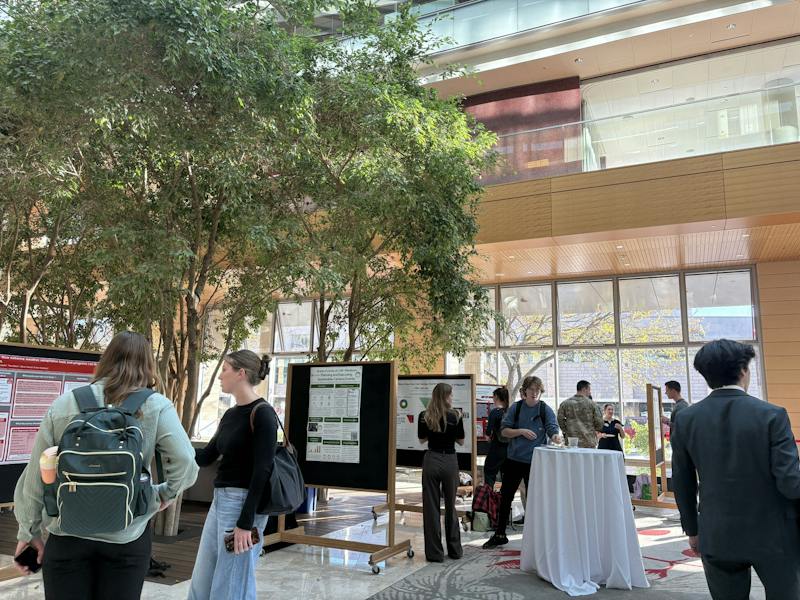
University of Wisconsin-Madison’s annual Sustainability Symposium on Oct 28 gave students, faculty and alumni the chance to discuss how entrepreneurship impacts sustainability.
University of Wisconsin-Madison’s Office of Sustainability hosted their fifth annual Sustainability Symposium at the Discovery Building Oct. 28.
The Sustainability Symposium opened up an opportunity for students and faculty to give quick, five minute presentations on their sustainability research, ranging from advancing a circular agriculture bioeconomy in Wisconsin to eliminating CO2 emissions in UW hospitals, and dedicated time to poster presentations at the end of the event for researchers and students to discuss their work.
The Office of Sustainability offers a variety of research and involvement opportunities focused on improving campus and city sustainability. UW-Madison’s work on achieving their sustainability goals earned a STARS Gold Rating last year.
“This year’s theme is sustainability and entrepreneurship. What does it take to turn promising ideas into real-world solutions?” Dr. Andrea Hicks, director of Sustainability Education and Research, said.
She emphasized how the event highlights the idea that “sustainability is for everyone. Not just engineers…and not just folks from the School of Business, our partner this year, but everyone.”
For his opening speech, Dean of the Nelson Institute of Environmental Studies, Paul Robbins, encouraged attendees to think about good ideas.
“They require a plan of what it’s going to cost, and what it’s going to benefit… ideas that can innovatively hit the road in new ways, I hate to say it, they require entrepreneurship,” he said.
Dr. Erica Plambeck, UW-Madison alum was the main speaker at the event. During her talk, she presented the idea of a deadly circular economy, and gave an overview of five different papers she and her colleagues are currently working on regarding lead exposure in Bangladesh.
Plambeck discussed the issue from an entrepreneurial standpoint, stating, “If we’re going to improve something…we need business to come in and figure out why people are getting lead poisoning, and what to do about it.”
“You engage in policy action, but it’s going to take forever to get anything actually happening. So you need market-based solutions today while we’re waiting for the government,” she added.
Bangladesh is among one of the leading countries with the highest risk of lead poisoning. The impact of lead poisoning in children is severe and can result in lifelong neurological and physical impairment with links to cardiovascular and kidney disease.
Plambeck discussed how informal battery recycling, used for electric vehicles, is one of the main drivers of lead poisoning in Bangladesh.
Enjoy what you’re reading? Get content from The Daily Cardinal delivered to your inbox
“Bangladesh had been importing electric vehicles and batteries for the electric vehicles from China,” she said.
In 2015, there was a rise in the domestic manufacturing of these batteries and manufacturers “are making the lead acid batteries for those vehicles…in the country, and recycling it in Bangladesh.”
Due to the short battery life of the lead acid batteries (LAB), Plambeck and her team saw an opportunity for business to make a change by attempting to beat the LAB industry.
Plambeck and her team “managed to sell lithium batteries with seven-year durability,” she said. She claimed customers were more likely to buy these batteries when offered a three year loan with full-term warranty over LAB’s.
“Globally, we need to stop digging up the lead and moving it into the biosphere, and that means figuring out how to improve things from an entrepreneurship perspective.”
Support your local paper
Donate Today
The Daily Cardinal has been covering the University and Madison community since 1892. Please consider giving today.

Under the sun, The People’s Farm commemorates the end of harvest season
Democrats Berman, Cooke elected in contentious 1st, 3rd Congressional District races
