

Kazakhstan’s transition to a unicameral parliament and the implementation of its new constitutional framework were among the key issues raised by foreign observers during the parliamentary vote taking place on Aug. 23. The country’s prospects for attracting international investment were also a major focus of their discussions
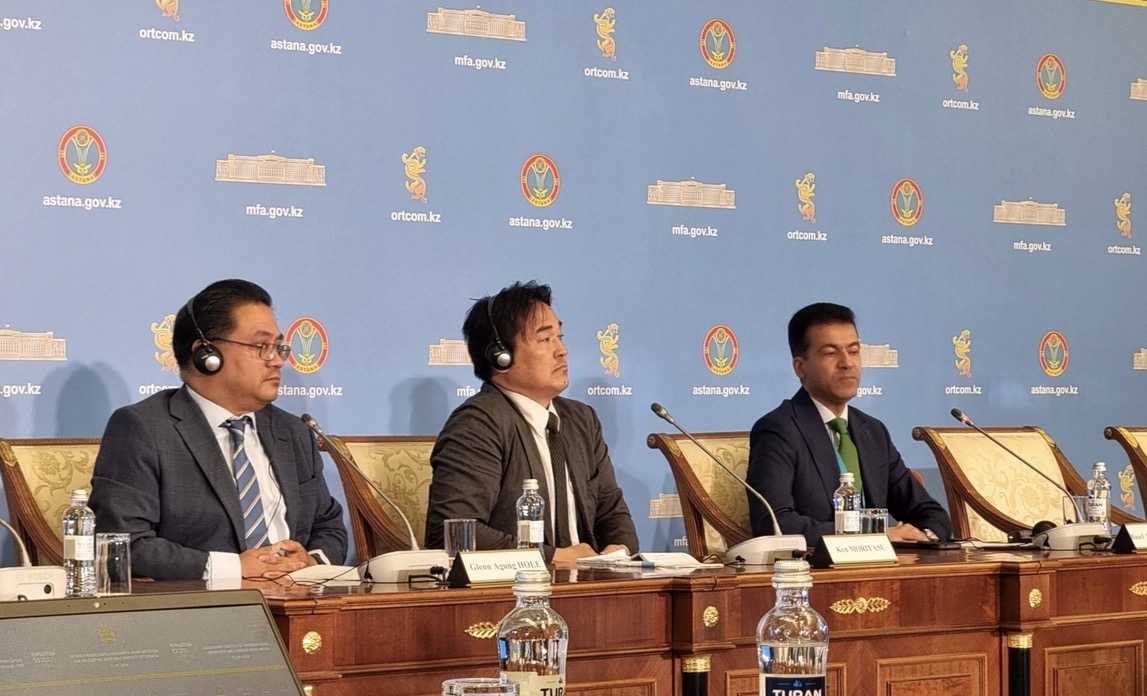
From L to R: Glenn Agung Hole, Ken Moriyasu and Basel al-Haj Jasem. Photo credit: The Astana Times
For international observers, the election to Kurultai, a new unicameral parliament, established under the Constitution adopted in 2026, represents more than a change in the structure of Kazakhstan’s legislature. They said the new political system will ultimately be judged by its ability to strengthen accountability, ensure institutional stability and create a predictable environment for citizens and investors.
Rachman Mohamad Fadjroel, Indonesian ambassador to Kazakhstan. Photo credit: The Astana Times
Indonesian Ambassador to Kazakhstan Rachman Mohamad Fadjroel said the country’s Constitution provides the foundation for its ongoing political reforms.
“I believe the most important point in Kazakhstan is its Constitution, because this is the vision for the future of the country. Article 1 defines Kazakhstan as a democratic, secular, social and law-based state,” Fadjroel told The Astana Times.
He said the reforms underway are guided by these constitutional principles and demonstrate Kazakhstan’s commitment to democratic development.
“Today’s Kurultai election is an opportunity to demonstrate how democracy works in Kazakhstan in practice,” he said, adding that the country’s election has sent a positive message to the international community.
Unicameral parliament as a new political chapter
Domenico Palmieri, secretary general of the Italian Institute of Asia, described the election as a milestone for Kazakhstan, calling it the first major step in implementing the country’s new constitutional framework.
In an interview with The Astana Times, he said the transition to a unicameral parliament could streamline the legislative process and facilitate political reforms.
“From my point of view, a unicameral system is better. It is easier to work smartly and efficiently,” Palmieri said, adding that its effectiveness will ultimately depend on the performance of the new parliament and government.
“Only the future, starting from today, with the new parliament and government, can show whether this was the right decision taken by the Kazakh people,” he said.
He also noted that five Italian parliamentarians were observing the election in the Almaty Region.
“This shows the interest and attention of Italy toward the Kazakh nation,” Palmieri said.
He added that the new constitutional arrangements should now be translated into practical policies that contribute to social stability and economic development.
Clearer institutions could support investment
Nicolas Butylin, head of geopolitics at Berliner Zeitung, Germany’s daily newspaper, spoke about the implications of the new political system for foreign investors. He said a streamlined institutional structure could make it easier to understand where decisions are made and how checks and balances operate.
He described the Kurultai as another step in the country’s institutional development, stressing that the country should be assessed against its own progress rather than measured solely against Western democracies.
“I would not compare Kazakhstan to Western European democracies. I don’t think this is the benchmark. The more useful question, from my perspective, is to compare Kazakhstan with the state of Kazakhstan 10 years ago. To see if, with the new Kurultai, the system is more open, more accountable and more competitive,” Butylin said.
He noted that for Western businesses considering investment in Kazakhstan, institutional evolution and predictability would remain key factors.
Butylin also emphasized Kazakhstan’s growing importance to Germany and Europe through the Middle Corridor, particularly amid disruptions to established trade routes.
“From this perspective, especially in the economic part with natural resources, Kazakhstan will play a crucial role for the future of Germany as well,” he said.
Glenn Agung Hole, professor at the University of Southeast Norway and an expert in economics and international relations, noted that the parliament’s ability to provide legislative stability would be critical for business.
“From an economic perspective, the new Kurultai is important because they need to make stable laws. And business, finance and the stock exchange need to see that taxes and laws are followed through,” Hole said.
He emphasized that international investors need confidence that the rules governing their investments will remain predictable over time.
“We have to see stability over time. At least three to five years, international investors need to see that they can put their investment here and that it will be safe for the next three to five years and longer,” he said.
Kazakhstan’s strategic role in China-West trade
Ken Moriyasu, a senior researcher at the Washington D.C.-based Hudson Institute, placed Kazakhstan’s political reforms within a broader geopolitical and investment context.
“When it comes to investment, it’s important to understand the players involved here. China clearly is the biggest investor,” Moriyasu said.
He described Kazakhstan as a key partner for China as Beijing is seeking to reduce its reliance on maritime routes and expand overland connections.
“Political stability is very important,” he said, noting that Kazakhstan’s vast territory and strategic location make it an important component of these routes.
Moriyasu also emphasized that the development of overland corridors through Kazakhstan, Azerbaijan and Türkiye does not necessarily conflict with U.S. interests.
“It is very beneficial for the United States that China creates these land transport corridors, but the countries that these corridors pass through remain friends with America,” he said.
The Kurultai vote continues in Kazakhstan with 10,423 polling stations operating across the country. The Kurultai will have 145 seats elected for five-year term. A total of 777 foreign observers from 42 countries and 13 international organizations have been accredited to monitor Kazakhstan’s election.
Get The Astana Times stories sent directly to you! Sign upgram, YouTube and Tiktok!
