

Summary
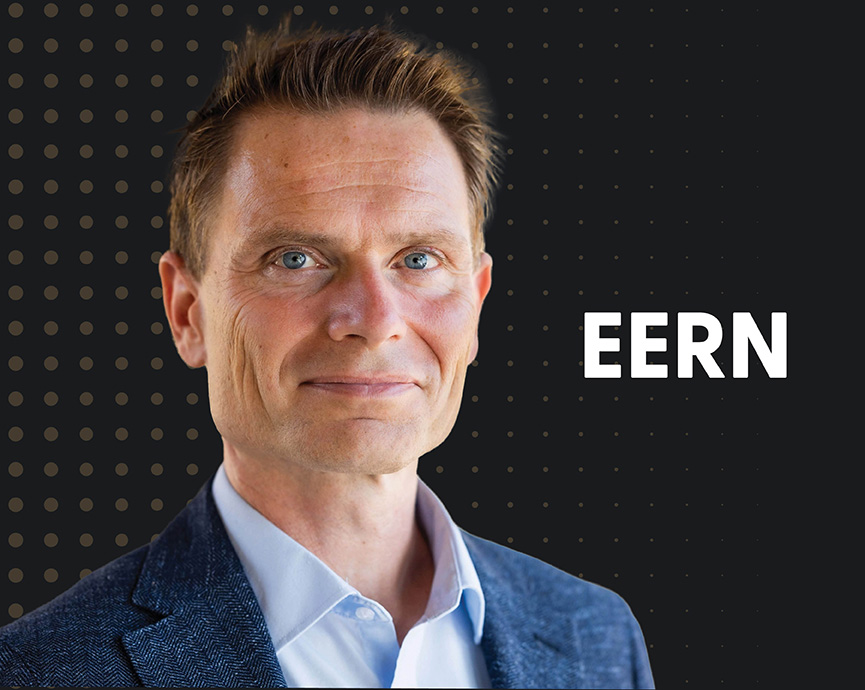
Nicholas Bloom, the William D. Eberle professor of economics at Stanford University, delivered a live presentation on the productivity economics of AI on March 24, 2026.
Professor Bloom explored AI use at the firm level and its impacts on employment and productivity using new research from surveys of over 5,000 CFOs, CEOs, and executives across the US, UK, Germany, and Australia.
Following his presentation, Professor Bloom answered live and pre-submitted questions with our host moderator, Huiyu Li, co-head of the EmergingTech Economic Research Network (EERN) and research advisor at the Federal Reserve Bank of San Francisco.
This was a virtual event hosted by the EmergingTech Economic Research Network (EERN). You can view the full recording on this page.
Key Takeaways
What makes AI adoption uniquely fast compared to prior advances in technology?
“In 1994, when I started work, I was given a share of a computer and it had an internet connection … I didn’t have the internet at home. Most technologies like this started at the workplace because they were just too expensive. Typical people didn’t have this stuff at home when it came out. AI is a bit unusual … more people are using AI outside their job than inside their job, which is another reason why adoption will be potentially quite fast, because in the workplace people are very familiar with it.”
Skip to 7:50 in the video for the full response.
What is AI’s impact on productivity?
“Over the last three years, we just have not seen, on average, a big effect on productivity [from AI], … when you look forward, things are going to look different. … American companies are reporting a 2.25% increase in productivity over the next three years, which is three-quarters of a percent a year. … Productivity growth now is slowing to about one to one and a half percent a year. So, adding three-quarters of a percent will be roughly adding 50 to 100% onto baseline. This is an enormous number.”
How do firms and employees expect AI to affect employment?
“[U.S. companies] are predicting in their own companies a 1.2% reduction in employment over the next three years. The US labor market is about 180 million, this is roughly two million employees … nothing in comparison to the scale of the US labor markets. … So, unemployment, at least in the next three years, I just do not see a big aggregate effect. … What do employees say? … They’re net positive on employment rather than negative, the average American employee thinks [AI] is going to boost employment.”
Skip to 24:42 in the video for the full response.
EERN Events
SF Fed Newsletter
About the Speaker
Nicholas (Nick) Bloom is the William D. Eberle professor of economics at Stanford University, a Senior Fellow of SIEPR, and the Co-Director of the Productivity, Innovation and Entrepreneurship program at the National Bureau of Economic Research. His research focuses on management practices and uncertainty. He previously worked at the UK Treasury and McKinsey & Company.
He is a Fellow of the American Academy of Arts and Sciences, and the recipient of the Alfred Sloan Fellowship, the Bernacer Prize, the European Investment Bank Prize, the Frisch Medal, the Kauffman Medal and a National Science Foundation Career Award. He has a BA from Cambridge, an MPhil from Oxford, and a PhD from University College London.
