

Dubai, United Arab Emirates: Autodesk has released new regional findings from its 2026 State of Design & Make: AI Pulse report, revealing that Middle East organisations are leading globally in translating AI investment into measurable business outcomes.
The research found that 87% of organisations across the region feel an urgent need to adopt AI, the highest level recorded globally and well ahead of the global average of 68%. Meanwhile 92% report positive productivity gains from AI deployment, compared to 84% globally.
Middle East organisations also reported stronger AI-related productivity and innovation outcomes than global peers. 90% said AI was positively impacting innovation, significantly higher than the global average of 77%, while 78% reported improvements in decision-making compared to 65% globally.
The findings suggest organisations across architecture, engineering, construction, operations, design, manufacturing, and media and entertainment industries are increasingly embedding AI into core business processes. They are moving beyond experimentation towards broader operational adoption and measurable business value.
Use of AI assistant tools and chatbots year-on-year increased from 46% to 56%, while AI-enabled design programme usage rose to 57%. AI use within project management platforms also increased from 41% to 49%, reflecting growing adoption across project delivery and business operations.
The findings align with wider regional transformation agendas, including Saudi Arabia’s Vision 2030, the UAE National Artificial Intelligence Strategy 2031, and ongoing investments in smart infrastructure, industrial digitisation, and next-generation urban development across the GCC.
Productivity, Resilience, and Delivery Pressures Are Driving AI Investment
The research indicates that organisations are increasingly viewing AI through the lens of productivity, resilience, and delivery performance, particularly as industries across the region continue managing large-scale infrastructure pipelines and increasingly complex project environments.
Nearly half (49%) of respondents said their organisation had significantly or substantially increased AI investment over the past year, compared to the global average of 40%. Generative AI, process automation, and decision-support systems emerged among the leading investment priorities for the next 12 months.
Interest in more advanced forms of AI is also growing. More than half of respondents (56%) said they expect to use agentic AI within the next year, while 18% reported already using it today.
The research suggests organisations are strengthening the foundations needed to scale AI effectively. Compared with global averages, Middle East respondents reported higher levels of confidence in the structure and security of their data, with 91% saying their data is well structured and 90% saying it is secure.
Organisations Remain Focused on Long-Term Scalability and Practical Value
Despite strong momentum, organisations remain pragmatic about implementation challenges and long-term scalability. Respondents identified lack of talent and skills (59%), implementation costs (55%), and integration with existing systems (54%) among the leading barriers facing organisations today.
The research also indicates that concerns around AI are evolving. While concerns related to job displacement have declined year-on-year, organisations are placing greater focus on practical enterprise risks including security, accuracy, and governance. Security concerns rose to 54%, while concerns around AI accuracy increased significantly from 33% to 48%.
Even amid broader market uncertainty, many organisations remain growth-oriented. The report found that 85% of Middle East respondents are considering entering new markets, compared to the global average of 73%, suggesting that businesses continue to view technology investment as closely linked to long-term competitiveness, resilience, and operational agility.
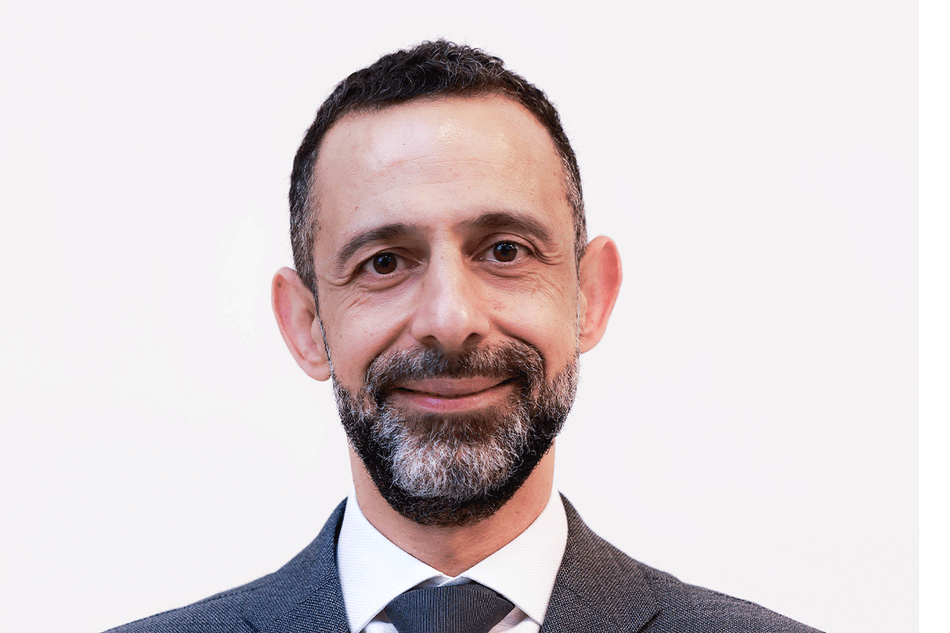
“The Middle East is moving faster than most markets from AI ambition to AI impact. But the real test is not how quickly organisations adopt AI. It is whether they can use it to deliver better projects, better decisions, and better-performing assets,” said Naji Atallah, Head of Construction and Manufacturing, EMEA Emerging at Autodesk. “AI will only create value if it is built on trusted data, connected workflows, and the discipline to reduce rework across the full project lifecycle. That is where construction and manufacturing leaders have an opportunity to turn investment into real delivery advantage.”
About the 2026 State of Design & Make: AI Pulse Report
The 2026 State of Design & Make: AI Pulse report was compiled from research conducted between January and February 2026 in partnership with Statista Plus Research. The study includes responses from 2,500 global industry leaders and experts across architecture, engineering, construction, operations, design, manufacturing, and media and entertainment industries.
The Middle East findings are based on responses from 153 industry professionals across Saudi Arabia and the United Arab Emirates. Countries surveyed globally include Australia, Brazil, Canada, China, France, Germany, India, Italy, Japan, Mexico, South Korea, Spain, the Nordics, the United Kingdom, and the United States.
Media contact:
The Alto Agency on behalf of Autodesk Middle East
Autodesk@thealtoagency.com
