

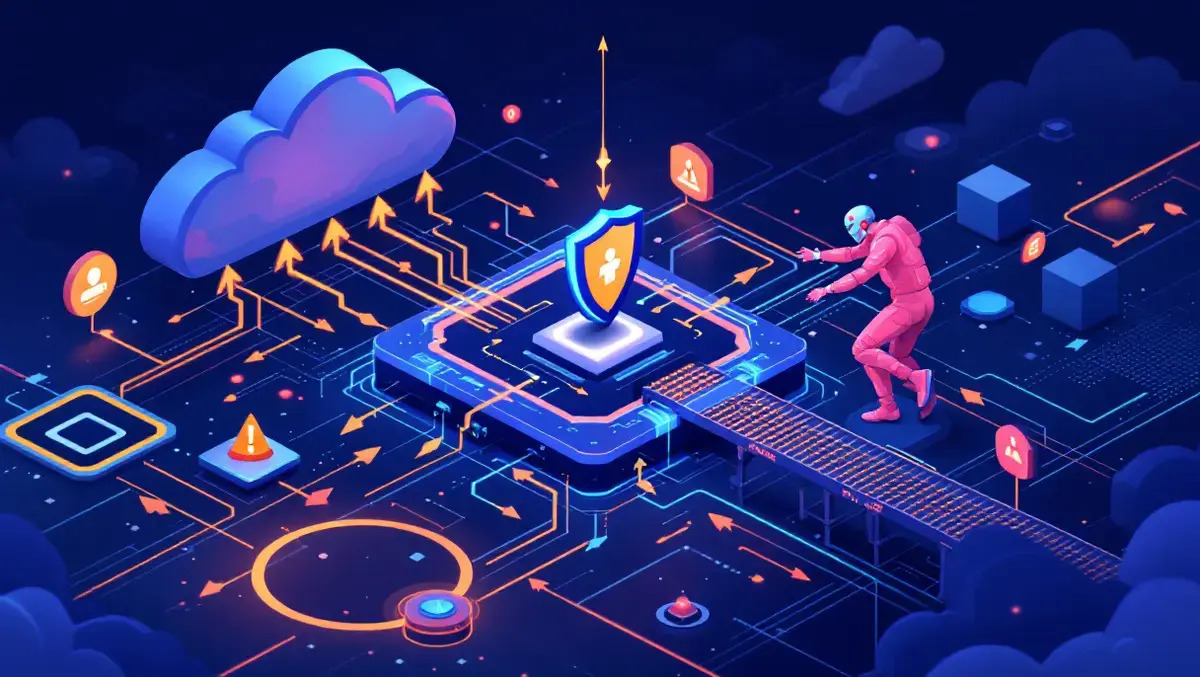
Microsoft’s 2026 Digital Defence Report: AI‑Powered Threat Landscape
The 2026 Digital Defence Report from Microsoft paints a picture of a cyber‑threat environment where artificial intelligence is no longer a peripheral curiosity but a force that intertwines with every stage of an attack.
Why AI Is Redefining Attack Stages
– Reconnaissance and social engineering – AI‑driven language models can craft highly personalized phishing lures at scale, making mass targeting far more effective.
– Malware and exploit development – Generative AI accelerates the creation of polymorphic malware, allowing threat actors to produce variants that evade signature‑based detection faster.
– Post‑compromise activity – Automated agent‑based tools powered by AI can move laterally, exfiltrate data, and adjust tactics in near‑real time.
The report stresses that while AI can turbocharge speed and scalability, the core pathways—people, identities, exposed systems, and trusted access—remain the same. It warns that Malware, Data Protection, and Hybrid Cloud environments become especially fertile ground for AI‑enhanced threats because they combine massive data flows with increasingly permissive access models.
The Dual‑Use Nature of AI
AI is a double‑edged sword: the same capabilities that empower defenders to spot patterns can also enable attackers to discover weaknesses more rapidly. This dual‑use dynamic means security teams must treat AI as both a protective asset and a potential vector for abuse.
The Expanded Role of AI Agents in Enterprise Environments
AI Agents as Connectors in Data, Apps, and APIs
Modern enterprises deploy AI agents to automate workflows, query databases, invoke APIs, and even control internal tools. These agents often enjoy broader access than traditional user accounts, moving seamlessly across Hybrid Cloud boundaries and interacting with sensitive data repositories.
Security Considerations for AI Agents
– Identity and Privilege – Each agent must be assigned a unique identity and the principle of least privilege. Over‑privileged agents become prime targets for credential theft or misuse.
– Authentication and Attestation – Strong mutual authentication between agents and the services they call prevents spoofing and ensures that only legitimate agents can act on behalf of a user.
– Attribution and Revocation – Logging who (or what) performed an action, and the ability to revoke access instantly, are essential for post‑incident analysis and containment.
Integration with Existing Security Disciplines
Microsoft frames these AI‑related risks as an extension of longstanding practices such as identity governance, data protection, monitoring, and secure software development. By treating AI agents as another class of identity within the organization’s identity fabric, security teams can apply familiar controls while addressing new complexities.
AI’s Impact on Vulnerability Discovery and Exploit Development
AI‑Enhanced Code Analysis for Defenders
Advanced AI‑based static and dynamic analysis tools can scan codebases quickly, flagging insecure patterns, outdated libraries, and misconfigurations before they become exploitable. This early visibility improves Data Protection outcomes and reduces the attack surface in Hybrid Cloud deployments.
The Emerging Threat Vector
Conversely, threat actors are adopting similar AI techniques to automate vulnerability discovery. Generative models can parse open‑source repositories, identify zero‑day patterns, and suggest exploit code snippets, shortening the time from discovery to weaponization. The report calls this “dual‑use problem” a key area to watch as AI tools proliferate on both sides of the fence.
The Need for Integrated, Cross‑Domain Visibility
Fragmented Data Across the Enterprise
Security signals flow from endpoints, identity providers, cloud workloads, applications, email systems, networks, and external threat intelligence. When these signals remain siloed, analysts miss the larger picture that emerges when activity is correlated across domains.
Value of Shared Intelligence
Trusted information sharing between organizations and public‑private partnerships can reveal attack paths that no single entity sees. AI can help automate the process of aggregating disparate logs, enriching them with context, and surfacing anomalous patterns that merit deeper investigation.
Balancing Automation and Human Judgment
While AI can handle repetitive tasks—such as stitching together events from multiple sources—identifying an undocumented attack chain or understanding how separate weaknesses interlock still benefits from seasoned analyst insight. Automation frees time for higher‑order thinking, but the human element remains indispensable.
Action Plan for Security Teams
1. Assess AI Agent Deployments
– Catalog every AI agent, the data it accesses, and the permissions it holds.
– Verify that each agent follows least‑privilege principles and that identities are centrally managed.
2. Conduct Cross‑Domain Threat Modeling
– Map data flows and trust relationships across endpoints, cloud, and on‑premises assets.
– Identify where AI‑driven actions could bridge disparate systems, creating new lateral movement paths.
3. Implement Unified Telemetry Platforms
– Integrate logs from endpoints, identity providers, network devices, and cloud services into a single SIEM or data lake.
– Leverage AI‑assisted correlation to surface hidden relationships between events.
4. Drive Intelligence Sharing Partnerships
– Join industry ISACs and collaborate with peers to exchange threat indicators.
– Use AI tools to parse shared feeds and automate the enrichment of internal alerts.
5. Prioritize AI‑Assisted Secure Development
– Embed AI‑driven code review into the CI/CD pipeline to catch vulnerabilities early.
– Combine automated analysis with manual code inspections for high‑risk components.
Future Watch: Emerging Trends and Considerations
AI‑Driven Attack Automation
Expect more sophisticated, AI‑powered attack bots that can autonomously adapt tactics, techniques, and procedures (TTPs) in response to defensive measures. Defenders must therefore adopt adaptive, AI‑enhanced detection mechanisms that can keep pace.
Evolution of Zero Trust in an AI‑Rich World
Zero Trust architectures rely on continuous verification of identity, device posture, and data access. As AI agents gain autonomy, Zero Trust policies must extend to include rigorous validation of AI identities and their actions across Hybrid Cloud environments.
Regulatory and Governance Implications
With AI influencing both data protection and malware creation, regulators may impose stricter requirements around AI transparency, auditability, and third‑party risk management. Organizations should proactively align AI governance with emerging compliance frameworks.
Conclusion
Microsoft’s 2026 Digital Defence Report underscores that AI is deepening the interconnection of cyber threats across Malware, Data Protection, and Hybrid Cloud landscapes. While AI empowers attackers to move faster and broader, it equally equips defenders with tools for more efficient vulnerability discovery, integrated visibility, and automated response.
Security teams must treat AI agents as first‑class identities, enforce strict access controls, and weave AI‑driven analytics into a unified telemetry strategy. By combining automated correlation with human expertise, organizations can navigate the evolving threat terrain, close the gaps in their defenses, and stay ahead of the AI‑enabled adversaries that lurk ahead.
