

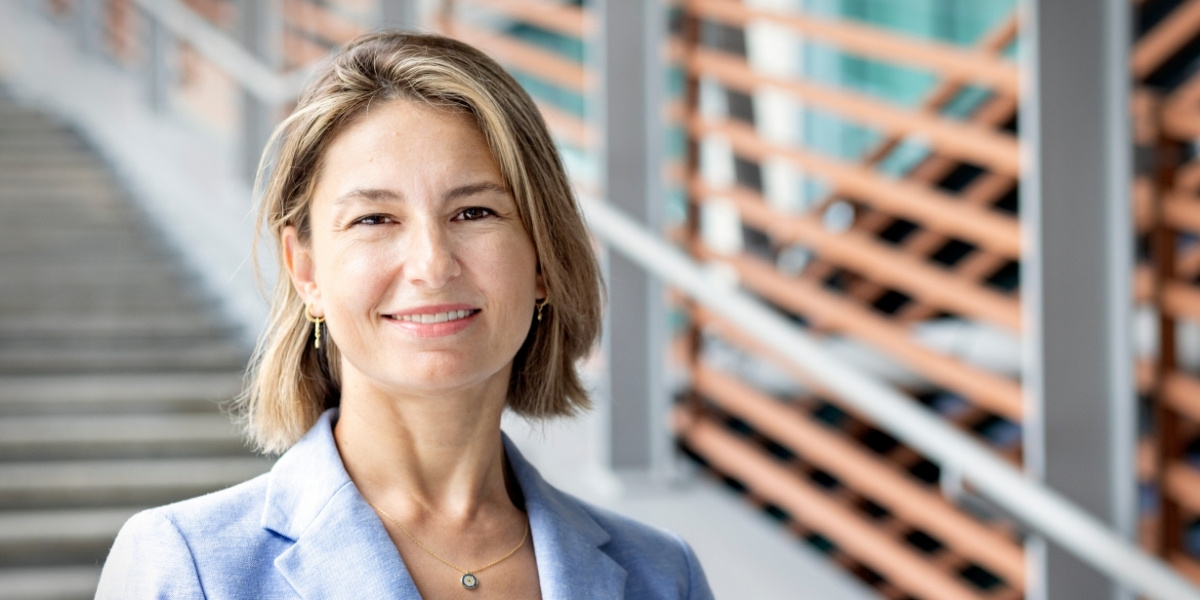
Ayse Ozturk is an unlikely poster child for the use of artifical intelligence in higher
education classrooms.
A native of Turkey and former financial auditor at Pricewaterhouse Coopers with expertise
in marketing and business analytics, she knows the technology is transforming the
world of marketing and business. Nonetheless, she is also keenly aware of the downsides.
She mentions the historian and philosopher Yuval Noah Harari, who popularized the
term “alien intelligence” to describe the technology and has cautioned that, unlike
previous innovations, AI can develop its own concepts and operate independently from
humans.
“He’s saying that for the first time, we have created something more powerful than
ourselves,” says Ozturk, assistant professor of marketing at the Darla Moore School of Business. “That puts us in a difficult position as educators.”
And yet, she is at the forefront of incorporating AI into the classroom. Why?
“You may like it or you may hate it, but there’s no point in liking or hating — you
have to deal with it,” says Ozturk, who holds the rare honor of receiving both the
Michael J. Mungo Undergraduate Teaching Award and the Garnet Apple Teaching Award
in 2026. “That’s the approach I bring because I have the responsibility toward this
for the students so they can be ready for work. And how will they be ready if I ignore
it in my courses?”
For Ozturk, it’s all about harnessing the superpowers afforded by the technology while
avoiding the pitfalls. And it gets to her innate sense of curiosity, her responsibility
to her students and the essence of her field.
“Marketing is one of the most impacted areas in business, with many automation possibilities,”
she says. “That’s why I somehow found myself in AI, because I am a marketing professor.”
Preparing students for an AI-powered workplace
Ozturk has developed an elective AI course in which using the technology is required,
but in her other courses it is encouraged but optional. She knows that not all students
are comfortable with it, but she hopes to move them from a place of fear about being
displaced by AI to confidence in using the technology to their professional advantage.
Nor is the technology blindly praised in her classrooms. Students discuss the incredible
efficiencies AI can unleash right alongside the risk of deepfakes, misleading ads
and public backlash.
Those who dive in find a wealth of tools on her websitethat can help them with everything from preparing for job interviews to creating presentations
or marketing campaigns. In classroom projects, her students have used AI to create
applications for product design, social media consulting and more.
Using AI without replacing critical thinking
Ozturk is clear that she’s encouraging students to use AI as a tool, not a substitute
for their own thinking. Critical thinking remains at the heart of her classes. She
brings in real-world examples of businesses faced with marketing challenges or crises,
and students engage in exercises aimed at how to address those problems. Thinking
is at the heart of those exercises. She’s also reviewing how homework is assigned
to ensure that real learning is still taking place.
Marketing is always adopting new technologies. AI may prove to be more disruptive
than most, but it’s still the same principle: To stay on the leading edge of your
field, you need to stay on top of the latest tools and methods. The same is true of
teaching.
“I was teaching required courses like Principles of Marketing and Marketing Strategy
and Planning, and the courses were going well,” Ozturk says. “But once AI became a
thing in late 2022, I started incorporating it almost immediately, like the spring
of 2023. The feedback was very good. Students appreciated learning about it because
it was on the news all the time.”
An ‘apocaloptimist’ about artificial intelligence
As steeped as she is in the tools, she remains conflicted. There’s a word that perfectly
encapsulates Ozturk’s feelings about artificial intelligence: apocaloptimist. It’s
in the name of a documentary about artificial intelligence — The AI Doc: Or How I Became an Apocaloptimist— and it captures both her anxiety and her optimism.
At the end of the day, though, her goals haven’t changed: She wants to prepare students
for a future in marketing and business.
“I think the biggest thing they get from my class is the feeling of being ready for
what’s to come and not to be scared — or that it’s also OK to be scared,” she says.
